Panthéon
Paris, France
Explore the Panthéon in Paris's Latin Quarter, a neoclassical mausoleum housing France's national heroes like Voltaire and Marie Curie.
Overview
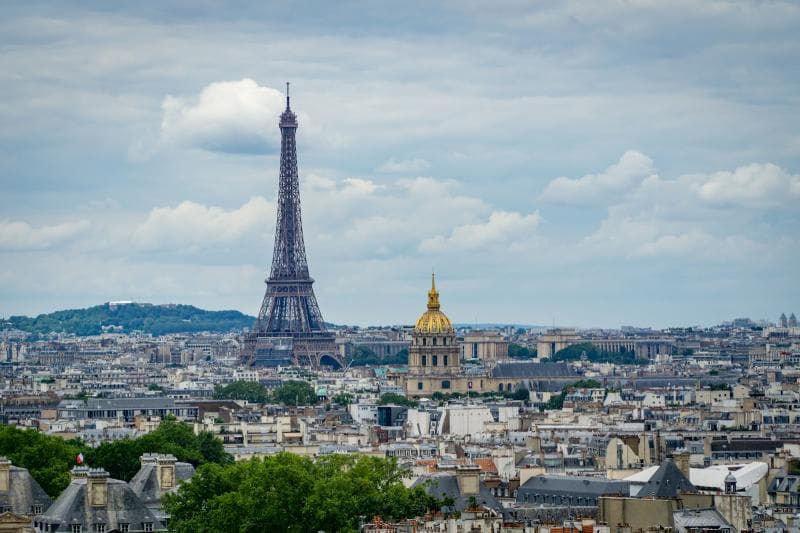
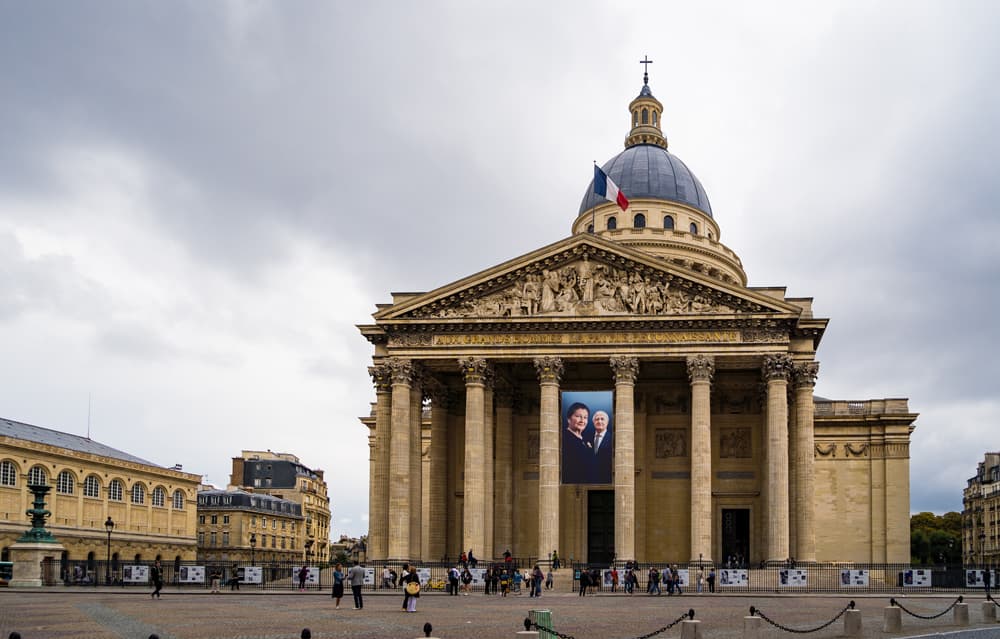
Nestled within the vibrant Latin Quarter of Paris, France, stands the majestic Panthéon, a monumental testament to French history and intellectual prowess. Originally conceived as a church dedicated to Saint Genevieve, Paris's patron saint, this neoclassical masterpiece was transformed during the French Revolution into a secular mausoleum honoring France's most distinguished citizens. Its imposing dome and grand columns dominate the cityscape from the Montagne Sainte-Geneviève, inviting curious travelers to delve into its rich past and profound significance.
Today, the Panthéon serves as the final resting place for many of the nation's revered thinkers, writers, scientists, and heroes, embodying the inscription above its entrance: 'Aux Grands Hommes La Patrie Reconnaissante' ('To the great men, the grateful homeland').
History & Cultural Background
The story of the Panthéon began in 1744 when King Louis XV, recovering from a grave illness, vowed to build a magnificent church in honor of Saint Genevieve. Jacques-Germain Soufflot, a renowned architect, was commissioned to design this ambitious project in 1755, aiming to combine the grandeur of classical principles with the lightness of Gothic cathedrals. Construction commenced in 1758, but neither Soufflot nor King Louis XV lived to see its completion in 1790.
Barely finished, the building's purpose dramatically shifted with the onset of the French Revolution. In 1791, the National Constituent Assembly decreed its conversion into a national necropolis for illustrious French citizens, modeled after the Pantheon in Rome. Throughout the 19th century, the Panthéon's role fluctuated between a church and a mausoleum, reflecting the changing political regimes of France. It was not until the state funeral of Victor Hugo in 1885 that the monument definitively embraced its role as a secular mausoleum, a symbol of national pride and remembrance.
What Makes It Special
The Panthéon stands as an early and significant example of Neoclassical architecture, characterized by its Greek-cross plan and an impressive triple dome that reaches 83 meters (272 feet) in height. Its facade, adorned with Corinthian columns and a triangular pediment, evokes ancient Roman temples. Beyond its architectural beauty, what truly sets the Panthéon apart is its function as France's national mausoleum, housing the remains of figures whose contributions shaped the nation's intellectual and cultural heritage.
One of its most captivating features is Foucault's Pendulum, a scientific marvel reinstalled beneath the central dome. First demonstrated by Léon Foucault in 1851, this pendulum visually proves the Earth's rotation, captivating visitors with its slow, deliberate swing. Visitors can also ascend to the dome for panoramic views, offering a breathtaking perspective of Paris.
Stories, Fun Facts & Local Details
The Panthéon's crypts hold the stories of numerous historical giants. Voltaire, the Enlightenment philosopher, was one of the first to be interred here in 1791, followed by Jean-Jacques Rousseau. Marie Curie, the pioneering physicist and chemist, made history in 1995 when she became the first woman to be interred in the Panthéon on her own merits, a powerful recognition of her groundbreaking work.
Interestingly, for nearly a century, from 1790 until the completion of the Eiffel Tower in 1889, the Panthéon held the distinction of being the highest point in Paris. The monument's dedication 'Aux Grands Hommes La Patrie Reconnaissante' is not merely an inscription; it is a profound declaration of gratitude from the nation to those who have served it with distinction, whether through intellect, art, or sacrifice.
Visitor Perspective
Visiting the Panthéon is an immersive journey through French history and culture. Upon entering, the sheer scale of the neoclassical interior, with its vast nave and impressive artwork, immediately commands attention. The hypnotic swing of Foucault's Pendulum beneath the dome provides a moment of scientific wonder, connecting visitors to the fundamental forces of our planet.
Descending into the crypts is a poignant experience, walking among the tombs of luminaries like Victor Hugo, Émile Zola, Alexandre Dumas, and Jean Moulin. Each tomb tells a story of exceptional contribution to France. The atmosphere is one of quiet contemplation and immense respect, inviting reflection on the legacies of these figures. The opportunity to witness the final resting places of such influential individuals, combined with the architectural splendor and the panoramic views from the dome, makes a visit to the Panthéon a truly enriching and memorable part of any trip to the Latin Quarter in Paris.
Coordinates: 2.34583, 48.84611
View on Google Maps💬 How Travelers Describe This Place
Based on community votes
Photogenic
733Interesting
642Beautiful
409Must See
363Unique
12
Traveler Stories
Discover memorable experiences shared by travelers who have visited this place.
No traveler stories yet.
Be the first traveler to share what made this place memorable.

Tour
By
Spot
Discover amazing places around the world. Your journey starts here.
Explore
© 2026 TourBySpot. All rights reserved.