Panoramic Terrace
Tbilisi, Georgia
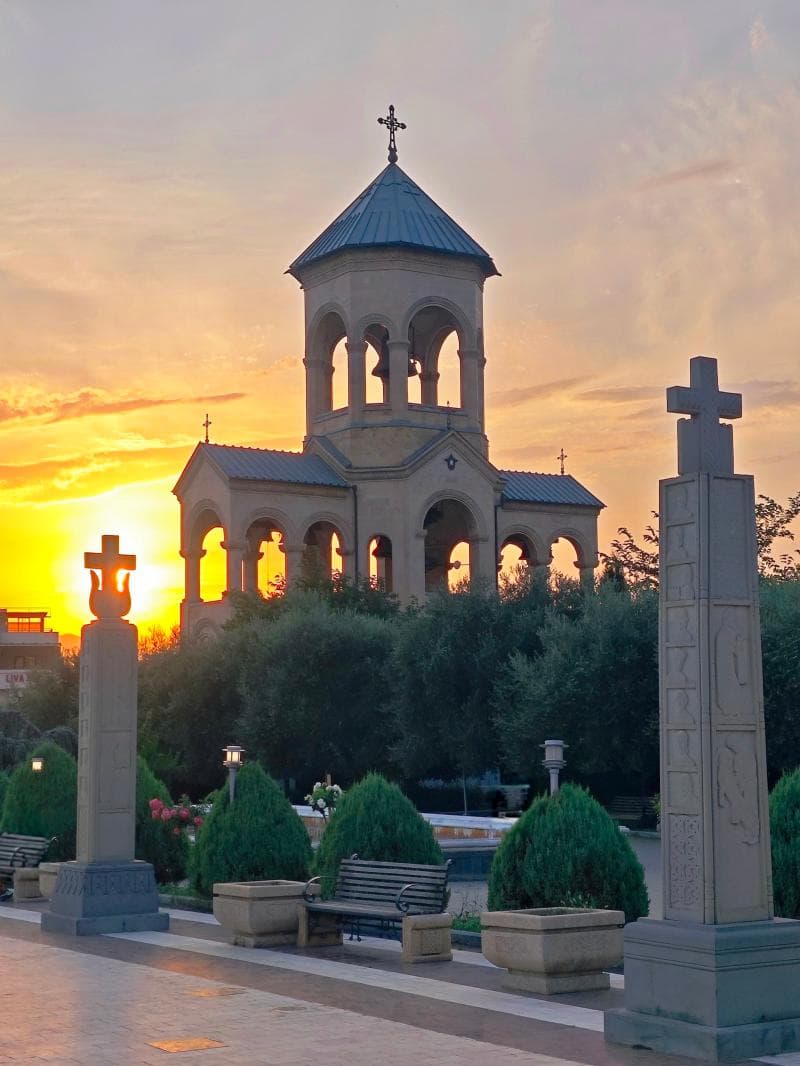
Discover the Holy Trinity Cathedral (Sameba) in Tbilisi, Georgia, for breathtaking panoramic city views and rich historical insights.
Overview
Perched majestically atop Elia Hill in Tbilisi, Georgia, the Holy Trinity Cathedral, affectionately known as Sameba, is far more than just a religious edifice; it is a profound symbol of the nation's spiritual revival and a beacon offering unparalleled vistas of the capital. While not a distinct 'Panoramic Terrace' as a separate structure, the entire cathedral complex is strategically situated to provide breathtaking panoramic views of the city below. Its golden dome, soaring over 100 meters, is visible from nearly every corner of Tbilisi, serving as a constant landmark for residents and visitors alike. Completed in 2004, Sameba stands as the main cathedral of the Georgian Orthodox Church and ranks as the third-tallest Eastern Orthodox cathedral in the world, embodying a grand blend of traditional Georgian and Byzantine architectural styles. Visitors flock not only to admire its immense scale and intricate beauty but also to embrace the expansive horizons it presents, making it an essential stop for anyone seeking to grasp the soul of Tbilisi.
History & Cultural Background
The vision for the Holy Trinity Cathedral emerged in 1989, a pivotal moment marking Georgia's reassertion of its national and religious identity in the wake of the collapsing Soviet Union. Its construction, which spanned from 1995 to 2004, was intended to commemorate two significant anniversaries: 1,500 years of the Georgian Orthodox Church's autocephaly (ecclesiastical independence) and 2,000 years since the birth of Jesus Christ. This ambitious project, however, was not without its controversies. The chosen site on Elia Hill had historically been home to Khojivank, an important Armenian cemetery largely destroyed during the Soviet era. The cathedral's construction led to further debate as graves and stone fragments were reportedly disturbed, highlighting a complex layer of cultural history beneath its foundations. Despite these challenges, Sameba rose as a testament to Georgian resilience and faith, synthesizing diverse elements of Georgian church architecture with subtle Byzantine influences, thereby creating a distinctive and modern religious landmark.
What Makes It Special
The Holy Trinity Cathedral's special allure stems from its monumental presence and its commanding position. As Georgia's largest cathedral and one of the largest Orthodox cathedrals globally, its sheer size is immediately striking. The cathedral's iconic golden dome, topped with a 7.5-meter gilded cross, gleams majestically, becoming a recognizable feature of the Tbilisi skyline. Architecturally, it's a masterpiece that marries traditional Georgian forms with Byzantine undertones, featuring intricate stone carvings on its exterior and a vast, light-filled interior adorned with frescoes and mosaics. Beyond its architectural grandeur, the cathedral complex encompasses beautifully landscaped gardens, several smaller chapels (including five underground), a freestanding bell tower, and a theological academy, creating a serene spiritual oasis amidst the bustling city. However, for many, the most captivating aspect remains the expansive, unobstructed panoramic views it offers across Tbilisi, making it a prime location for photography and contemplation.
Stories, Fun Facts & Local Details
One fascinating detail about Sameba is its foundation on historical ground. The site's past as an Armenian cemetery adds a poignant layer to its history, with a surviving Armenian Pantheon nearby preserving the memory of prominent figures from Tbilisi's Armenian community. Inside the cathedral, visitors can observe the impressive iconostasis wall, a common feature in Orthodox churches separating the nave from the sanctuary, and marvel at the detailed frescoes painted under the supervision of artist Amiran Goglidze. The cathedral is also home to the Trinity Cathedral Choir, dedicated to preserving and promoting polyphonic singing, a unique Georgian art form with deep cultural significance. For those seeking the perfect photo opportunity, local insights suggest visiting during the 'golden hour' just before sunset, when the light illuminates the golden dome spectacularly and casts a warm glow over the city spread out below. The north-western side of the cathedral plateau is particularly noted for offering wide-angle perspectives of Tbilisi, including the Old Town, the TV Tower, and Mtatsminda Hill.
Visitor Perspective
Visiting the Holy Trinity Cathedral offers a profound experience for any traveler to Tbilisi. The journey up Elia Hill, whether by foot or taxi, culminates in entering a sprawling complex designed for both reverence and reflection. As you wander through the expansive grounds, you'll find peaceful gardens and walking paths that provide a tranquil escape from urban life. Inside the main cathedral, the sheer verticality and the serene atmosphere, often enhanced by the faint scent of incense and traditional chants, invite quiet contemplation. Dress modestly, covering shoulders and knees, and women are often expected to cover their heads as a sign of respect within the active place of worship. The truly unforgettable element for many visitors is the panoramic viewpoint from the cathedral's terraces. From here, the tapestry of Tbilisi unfolds beneath you – the winding Kura River, the historic Old Town with its distinctive architecture, the distant TV Tower, and the prominent Mtatsminda. It's a place to capture stunning photographs, appreciate the city's topography, and feel a deep connection to Georgia's rich spiritual and cultural landscape.
Coordinates: 44.816514, 41.697435
View on Google Maps💬 How Travelers Describe This Place
Based on community votes
Must See
540Photogenic
252Unique
147Beautiful
114Interesting
19
Traveler Stories
Discover memorable experiences shared by travelers who have visited this place.
No traveler stories yet.
Be the first traveler to share what made this place memorable.

Tour
By
Spot
Discover amazing places around the world. Your journey starts here.
Explore
© 2026 TourBySpot. All rights reserved.