Palazzo Brera courtyard
Milan, Italy
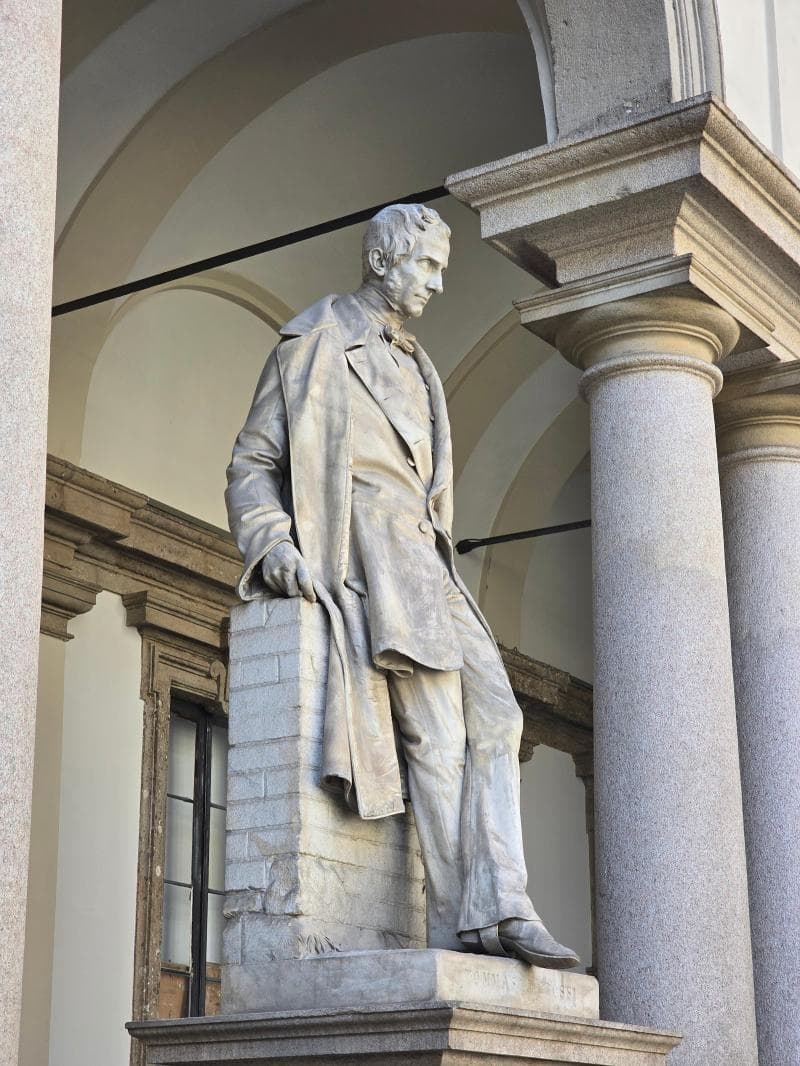
Explore the Palazzo Brera courtyard in Milan, Italy, a historic hub for art, culture, and science, featuring Canova's statue of Napoleon.
Overview
Nestled within the vibrant Brera District of Milan, Italy, lies the majestic Palazzo Brera courtyard, a true cultural heart of the city. This imposing, arcaded space serves as the entrance and central hub for an impressive array of institutions, including the renowned Pinacoteca di Brera (art gallery), the Accademia di Belle Arti (Academy of Fine Arts), the Biblioteca Nazionale Braidense (National Braidense Library), the Osservatorio Astronomico di Brera (Astronomical Observatory), and the Orto Botanico di Brera (Botanical Garden). Far more than just a thoroughfare, the courtyard is a destination in itself, inviting visitors to pause and soak in centuries of history and artistic legacy.
The courtyard's elegant architecture and historical significance make it a key landmark in Milan's bohemian and artistic quarter, offering a peaceful escape from the bustling city streets. It embodies the essence of Brera, a district celebrated for its creative energy and deep cultural roots.
History & Cultural Background
The origins of the Palazzo Brera trace back to the 14th century, when it began as a monastery belonging to the Humiliati religious order. The name 'Brera' itself is believed to derive from the ancient Lombard word 'brayda,' meaning 'a grassy clearing,' reflecting its medieval location outside the city walls.
In 1571, following the suppression of the Humiliati, the monastery was entrusted to the Jesuits, who transformed it into a prominent college. Architect Francesco Maria Richini began the construction of the present Baroque-style palace around 1615, with work continuing through the 17th century.
A pivotal moment arrived in 1773 when the Jesuit order was disbanded. Empress Maria Theresa of Austria then acquired the building for the state, envisioning it as a hub for cultural and scientific institutions. She established the Academy of Fine Arts, the Braidense Library, the Astronomical Observatory, and the Botanical Garden within its walls. Giuseppe Piermarini, a leading Neoclassical architect, was responsible for completing the inner courtyard and the imposing entrance from Via Brera in 1780.
Napoleon Bonaparte further solidified the Palazzo's cultural standing in the early 19th century. He established the Pinacoteca di Brera, filling it with artworks confiscated from suppressed churches and convents. In 1859, a monumental bronze statue of Napoleon, depicted as Mars the Peacemaker and designed by Antonio Canova, was erected in the center of the courtyard, forever linking the space to his legacy.
What Makes It Special
The Palazzo Brera courtyard is a masterful blend of architectural styles and a vibrant testament to Milan's intellectual and artistic history. Its rectangular layout, framed by a double order of arcaded porticos featuring Doric columns on the ground floor and Ionic columns above, is a striking example of 17th-century Baroque design refined by Neoclassical elements.
At its heart stands Canova's magnificent bronze statue of 'Napoleon as Mars the Peacemaker,' a powerful focal point that draws the eye and adds a layer of historical grandeur. This iconic sculpture portrays Napoleon in a classical style, symbolizing his role in bringing peace.
Beyond its central statue, the courtyard and its surrounding porticos are adorned with numerous monuments, busts, and plaques commemorating significant artists, scientists, and benefactors associated with Brera over the centuries. This rich collection transforms the courtyard into an open-air gallery, celebrating the intellectual and creative giants who shaped Lombardy and beyond.
Stories, Fun Facts & Local Details
The Palazzo Brera courtyard has always been a place where ideas converge. Historically, it served as a gathering spot for artists and intellectuals residing in the Brera district, fostering a bohemian atmosphere that still permeates the neighborhood today. Brera is often referred to as Milan's artistic soul or 'Milanese Montmartre,' a reputation deeply tied to the institutions housed within the Palazzo.
A fascinating detail is Napoleon's vision for the Pinacoteca di Brera; he reportedly aimed for it to become 'the Louvre in Italy.' Interestingly, despite commissioning the impressive nude statue of himself by Canova, legend has it that Napoleon himself was not entirely fond of the depiction. The artworks within the Pinacoteca, many of which can be seen after passing through the courtyard, were largely accumulated during the Napoleonic era from various churches and convents that were suppressed, giving the collection a unique origin story.
The district maintains its creative pulse, with artisan workshops, art studios, and even a vibrant craft market held on the third Sunday of every month, echoing the historical artistic community that once thrived around this very courtyard.
Visitor Perspective
For the curious traveler, the Palazzo Brera courtyard offers an immediate immersion into Milan's rich cultural tapestry. Entering through the grand gate at Via Brera 28, you're greeted by a sense of calm grandeur, a welcome contrast to the bustling city.
The open, spacious design makes it easy to navigate between the different cultural institutions, whether you're heading to admire Renaissance masterpieces in the Pinacoteca, explore the historic library, or visit the art academy. It's a perfect spot to pause, sit on one of the benches, and simply absorb the atmosphere, surrounded by centuries of art, science, and history. The courtyard invites you to wander, linger, and discover the layers of Milanese heritage at your own pace, providing a true sense of place and connection to the city's artistic spirit.
Coordinates: 9.1879, 45.472
View on Google Maps💬 How Travelers Describe This Place
Based on community votes
Beautiful
795Interesting
536Must See
522Unique
489Photogenic
251
Traveler Stories
Discover memorable experiences shared by travelers who have visited this place.
No traveler stories yet.
Be the first traveler to share what made this place memorable.

Tour
By
Spot
Discover amazing places around the world. Your journey starts here.
Explore
© 2026 TourBySpot. All rights reserved.