Palace Courtyard
Split, Croatia
Discover the historic Palace Courtyard (Peristyle) and Temple of Jupiter in Split, Croatia, within Diocletian's Palace. Explore Roman history and culture.
Overview
Stepping into the Palace Courtyard, more formally known as the Peristyle, within Diocletian's Palace in Split, Croatia, is like walking onto a stage set two millennia ago. This grand, open-air square served as the ceremonial heart of Emperor Diocletian's retirement residence, a sprawling complex that forms the core of modern-day Split. Adjacent to this impressive courtyard stands the Temple of Jupiter, a remarkably preserved testament to Roman religious architecture. Together, these sites offer a profound glimpse into Roman imperial life, its enduring legacy, and the fascinating ways history continues to breathe within the vibrant urban fabric of a living city. It is a place where ancient stone meets contemporary life, creating an atmosphere unlike any other.
History & Cultural Background
The Peristyle was conceived and constructed between 295 and 305 AD as the central square of Diocletian's magnificent palace. This was not merely a decorative space; it was designed as the grand entrance to the Emperor's private quarters and served as a stage for imperial ceremonies. Diocletian, who viewed himself as a living son of Jupiter, would often appear under the central architrave, receiving his subjects who would kneel before him. The red granite columns surrounding the courtyard were imported from Egypt, their striking color emphasizing the imperial function and the significance of purple as the imperial hue. Nearby, the Temple of Jupiter was built concurrently, dedicated to the supreme Roman god whom Diocletian revered as his divine father. However, Diocletian's unexpected abdication in 305 AD meant parts of the temple were left unfinished. With the advent of Christianity, the Temple of Jupiter underwent a significant transformation in the 6th century, being converted into the Baptistery of St. John the Baptist, while its crypt was dedicated to St. Thomas. This conversion allowed the ancient structure to survive and thrive through the changing religious landscape.
What Makes It Special
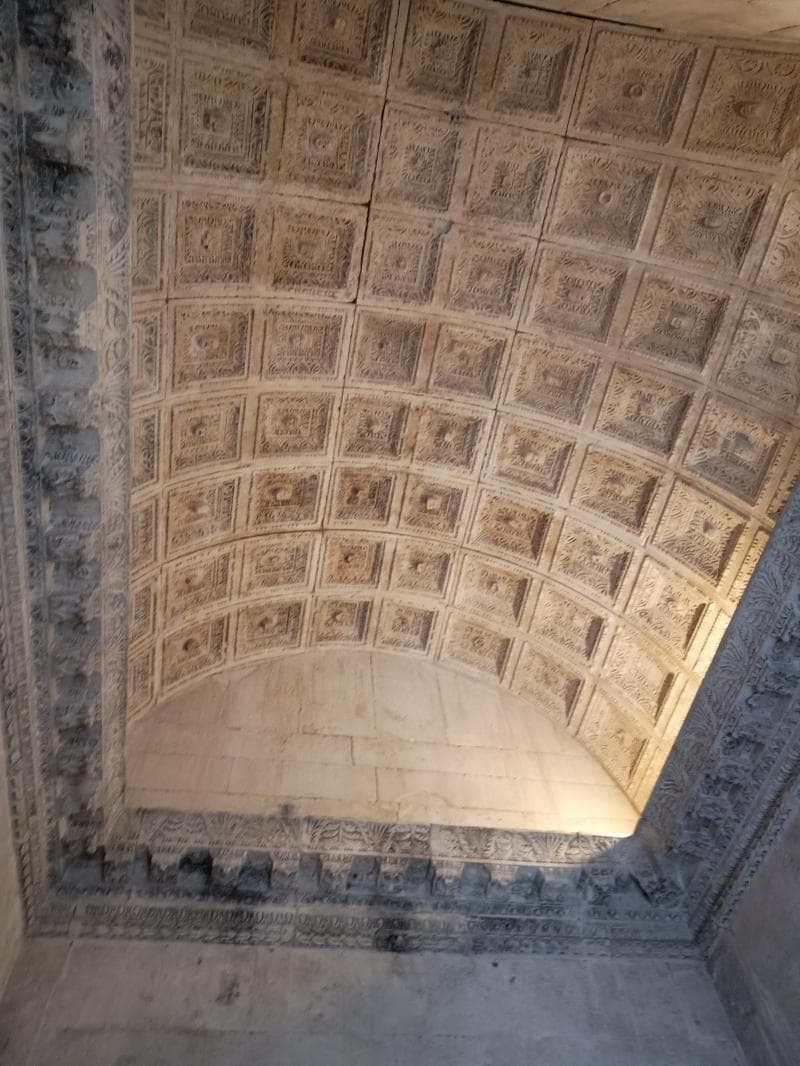
The Peristyle's unique grandeur lies in its architectural blend and its function as a dynamic public space. It showcases the symmetry and balance typical of Roman architecture, adorned with Corinthian columns and intricate stone carvings. The colossal red granite columns, sourced from Egypt, are a striking feature, drawing the eye towards the Vestibule and the former Temple of Jupiter. The Temple of Jupiter itself is heralded as one of the best-preserved Roman temples in Croatia, and even Europe, admired by architects like Robert Adam. Its interior boasts a magnificently barrel-coffered vault ceiling, richly decorated with reliefs of Roman deities such as Victoria, Triton, Helios, Hercules, Jupiter, and Apollo, elements that are believed to have influenced early Renaissance art in Dalmatia. The blend of Roman pagan worship, early Christian adaptation, and medieval additions makes these sites a living historical archive, constantly revealing new layers of Split's rich past.
Stories, Fun Facts & Local Details
Beyond its grand architecture, the Palace Courtyard and Temple of Jupiter are steeped in fascinating tales. Imagine Emperor Diocletian, adorned in his scarlet cloak, making his grand appearance on the Peristyle, his subjects prostrating themselves before him in reverence. A captivating detail visitors often overlook is the ancient Egyptian sphinx, dating back to the reign of Thutmose III, positioned near the entrance of the Temple of Jupiter. Legend suggests that touching its ancient paws brings good luck. Inside the former Temple of Jupiter, now the Baptistery, you can find a pre-Romanesque marble tablet bearing what is considered the oldest representation of a Croatian king, either Peter Krešimir IV or Demetrius Zvonimir. The Peristyle's extraordinary acoustics are also a local secret, often transforming the square into an impromptu open-air stage for opera singers and musicians, especially during the Split Summer Festival. In the evenings, the ancient steps themselves become a lively outdoor café, where locals and travelers alike sip drinks, enveloped by the echoes of imperial grandeur.
Visitor Perspective
Exploring the Palace Courtyard (Peristyle) and the Temple of Jupiter is an immersive journey through time. The Peristyle is a free, public square within the UNESCO World Heritage Site of Diocletian's Palace, meaning you can wander and soak in the atmosphere at any time. It serves as a bustling hub, with tour groups gathering, street performers entertaining, and locals simply going about their day. The sheer scale and preservation of the Roman architecture are awe-inspiring. While the Peristyle itself is open, there is a small entrance fee to step inside the Temple of Jupiter (Baptistery) to fully appreciate its detailed interior, the coffered ceiling, and the artifacts like the sarcophagi of archbishops and the bronze statue by Ivan Meštrović. Standing before the ancient sphinx, or gazing up at the temple's vaulted ceiling, one can't help but feel a profound connection to the countless generations who have trodden these very stones. It is an experience that seamlessly blends historical education with cultural immersion, leaving a lasting impression on every curious traveler.
Coordinates: 16.439568, 43.508341
View on Google Maps💬 How Travelers Describe This Place
Based on community votes
Unique
897Must See
695Beautiful
605Interesting
498Photogenic
481
Traveler Stories
Discover memorable experiences shared by travelers who have visited this place.
No traveler stories yet.
Be the first traveler to share what made this place memorable.

Tour
By
Spot
Discover amazing places around the world. Your journey starts here.
Explore
© 2026 TourBySpot. All rights reserved.