Ostzeile Houses
Frankfurt, Germany
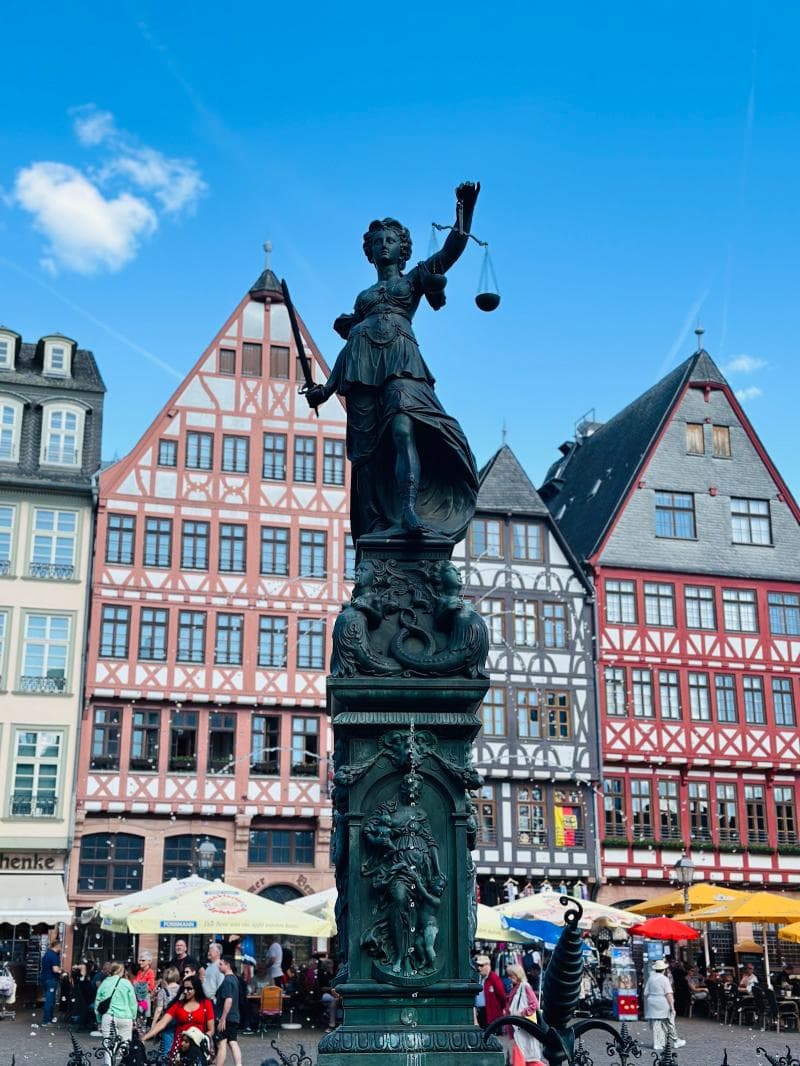
Explore Frankfurt's Ostzeile Houses, a picturesque row of reconstructed half-timbered beauties on Römerberg square in Germany.
Overview
Nestled in the heart of Frankfurt's historic Old Town, the Römerberg square is home to a picturesque row of six half-timbered houses known as the Ostzeile. These charming buildings, with their distinctive gables and intricate wooden facades, form an iconic backdrop to one of Germany's most historically significant public squares. While appearing centuries old, the Ostzeile Houses are a testament to Frankfurt's resilience, standing as meticulously reconstructed versions of their medieval predecessors.
The Ostzeile is often the first image that comes to mind when envisioning Frankfurt's historical core, drawing visitors into a bygone era with its architectural charm and vibrant atmosphere. Positioned opposite the Römer, the city's impressive city hall, these houses contribute significantly to the unique character of Römerberg, a place that has served as a central gathering point for centuries.
History & Cultural Background
The history of the Ostzeile Houses is inextricably linked with that of the Römerberg itself, a square that has been the focal point of Frankfurt since the High Middle Ages. From the 12th century onwards, Römerberg hosted grand trade fairs, attracting merchants and visitors from across Europe, and was the site of numerous imperial coronations and festivities of the Holy Roman Emperors. The original houses lining the square were primarily from the 15th and 16th centuries, with some undergoing reconstruction or expansion in the 18th century, showcasing a rich tapestry of medieval and early modern German architecture.
However, this vibrant historical district faced catastrophic destruction during the Allied air raids of March 1944 in World War II. The entire historic district, including Römerberg and the Ostzeile, was largely obliterated, leaving much of Frankfurt's Old Town in ruins. Following the war, while some significant landmarks like the Römer were rebuilt relatively soon, the reconstruction of the Ostzeile houses took place much later, between 1981 and 1983 (some sources extend this to 1984 or 1986). These were not mere modern buildings but 'creative reconstructions' (schöpferische Nachbauten), meticulously rebuilt using historical models to replicate their original 15th and 16th-century appearance. This painstaking effort aimed to restore the medieval character of the square, offering a poignant reminder of the city's past and its determination to preserve its cultural heritage.
What Makes It Special
What makes the Ostzeile Houses truly special is their ability to transport visitors back in time, even as reconstructions. They perfectly encapsulate the romantic ideal of a medieval German town square, with their steep gabled roofs, exposed timber frames, and charming, uneven facades. Each of the six houses possesses its own individual name, adding a layer of personal history and character to the collective beauty. From left to right, they are known as 'Zum Engel' (At the Angel), 'Goldener Greif' (Golden Griffin), 'Wilder Mann' (Wild Man), 'Kleiner Dachsberg-Schlüssel' (Little Dachsberg Key), 'Großer Laubenberg' (Large Laubenberg), and 'Kleiner Laubenberg' (Little Laubenberg). This level of detail in their reconstruction highlights a deep respect for the historical authenticity and spirit of the original buildings.
These houses stand in stark, yet harmonious, contrast to the modern skyscrapers that define much of contemporary Frankfurt's skyline. They serve as a powerful symbol of the city's commitment to honoring its past while embracing the future, creating a unique urban landscape where centuries seemingly converge. Their architectural style, characterized by traditional German half-timbering, is a rare sight in a city so heavily rebuilt after wartime destruction, making the Ostzeile a focal point for understanding Frankfurt's architectural heritage.
Stories, Fun Facts & Local Details
The names of the Ostzeile houses are not just labels; they carry echoes of their former lives and the stories of the square. For instance, 'Zum Engel' (At the Angel) is notably associated with a significant piece of Frankfurt's financial history, as it was the location where Frankfurt's first bank was established in the 17th century. The names like 'Goldener Greif' (Golden Griffin) or 'Wilder Mann' (Wild Man) likely refer to former tavern signs, family crests, or allegorical figures that adorned the original buildings, guiding merchants and visitors in a time before standardized street numbers.
The Römerberg square itself is rich with anecdotes. It is said that during the coronation of Emperor Matthias in 1612, the Fountain of Justice, located centrally in the square, ran with wine for the populace. While the current fountain does not dispense wine, its statue of Justitia (Justice) famously holds scales without a blindfold, a unique detail signifying direct justice. These small details contribute to the immersive experience of the Ostzeile and the entire Römerberg area, allowing visitors to imagine the bustling markets, imperial processions, and daily life that once filled this space.
Visitor Perspective
For any traveler to Frankfurt, a visit to the Ostzeile Houses is an essential experience. Stepping onto the cobblestones of Römerberg and beholding this charming row of houses instantly offers a sense of connection to old Frankfurt. The ground floors of these reconstructed buildings now house various shops, cafes, and restaurants, inviting visitors to pause, enjoy a traditional Hessian meal, or simply soak in the atmosphere.
Imagining the lives of the merchants, craftsmen, and citizens who once walked these grounds, against the backdrop of these meticulously recreated facades, is a truly engaging experience. The Ostzeile, along with the adjacent Römer and the nearby Old St. Nicholas Church, creates an ensemble that is both historically informative and emotionally evocative. It is a place for reflection on history's impact and appreciation for the dedication to cultural preservation, making it a compelling destination for anyone curious about Frankfurt's past and present.
Coordinates: 8.682249069, 50.110088348
View on Google Maps💬 How Travelers Describe This Place
Based on community votes
Beautiful
673Photogenic
219Interesting
186Must See
143Unique
80
Traveler Stories
Discover memorable experiences shared by travelers who have visited this place.
No traveler stories yet.
Be the first traveler to share what made this place memorable.

Tour
By
Spot
Discover amazing places around the world. Your journey starts here.
Explore
© 2026 TourBySpot. All rights reserved.