Opera Hall
Yerevan, Armenia
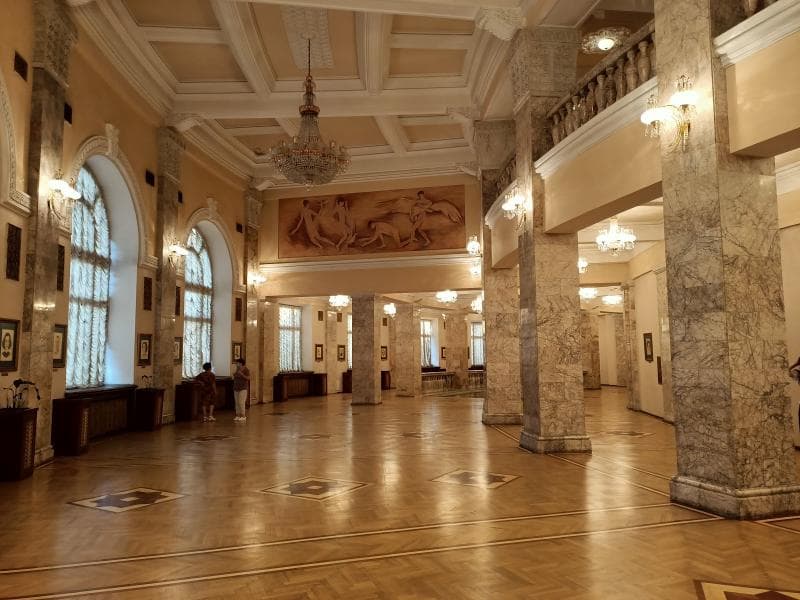
Discover Yerevan's Opera Hall, a cultural beacon within the Alexander Spendiaryan National Academic Theatre of Opera and Ballet, Armenia.
Overview
The Opera Hall, formally known as the Alexander Spendiaryan National Academic Theatre of Opera and Ballet, stands as a crowning jewel in the heart of Yerevan, Armenia. More than just a venue, it is a vibrant cultural institution that plays a pivotal role in the nation's artistic life. This magnificent structure is dedicated to showcasing both grand opera and classical ballet, acting as a custodian of Armenian musical heritage while also embracing international masterpieces. Its impressive architecture and prime location make it an unmissable landmark for any traveler exploring the vibrant capital city.
The theatre complex houses two main halls: the Opera Hall (often referred to as the Alexander Spendiaryan Opera and Ballet National Theatre or the main stage) and the Aram Khachaturian Concert Hall. Both spaces are celebrated for their excellent acoustics and capacity to host large-scale productions, contributing significantly to Yerevan's reputation as a cultural hub.
History & Cultural Background
The journey of the Yerevan Opera Theatre began with its ground-breaking ceremony on November 28, 1930, commemorating the tenth anniversary of Soviet Armenia. The official opening followed on January 20, 1933, with the premiere of Alexander Spendiaryan’s opera 'Almast', a work that laid the foundation for national Armenian opera and gave the theatre its name.
Designed by the eminent Armenian architect Alexander Tamanian, the theatre building is considered one of his most significant works. Tamanian envisioned a structure that would combine traditional Armenian architectural elements with a classical aesthetic. Although he passed away before its full completion, his son, Gevorg Tamanian, oversaw the finishing touches. The theatre hall itself was completed in 1939, and the entire building reached its current majestic form by 1953 after several renovation phases. The building's design even earned the prestigious Grand Prize at the 1937 Paris World Exhibition, highlighting its architectural brilliance on an international stage.
Throughout its history, the theatre has been instrumental in fostering Armenian national art. It established a ballet troupe shortly after its opening, and in 1935, presented the first Armenian ballet, 'Happiness', by Aram Khachaturian. Iconic Armenian operas like Armen Tigranian's 'Anoush' have been staples of its repertoire since 1935, shaping the nation's operatic tradition. In 1956, the theatre was officially granted the esteemed status of National Academic Opera and Ballet Theatre.
What Makes It Special
The Opera Hall's distinctiveness lies in its seamless blend of historical grandeur and artistic vitality. Its architectural design is a marvel, embodying a neoclassical style infused with traditional Armenian motifs, making it a visual masterpiece both inside and out. The main auditorium, functioning as a self-sufficient amphitheater, is renowned for its superior acoustic qualities, allowing every note and vocal nuance to resonate beautifully throughout the space.
With a seating capacity of approximately 1,070 to 1,260 guests, the Opera Hall provides an intimate yet grand setting for performances. The theatre's commitment to a diverse repertoire is also a key feature, regularly staging works by Armenian, Russian, and Western European composers. This ensures that audiences can experience a broad spectrum of operatic and balletic artistry, from Verdi and Puccini to national Armenian works like 'Gayane'.
Beyond the performances, the theatre's central location on Freedom Square, surrounded by Swan Lake park, amplifies its special appeal. This vibrant area forms a cultural axis of Yerevan, where art, nature, and urban life converge, making the Opera Hall a focal point of the city's social and cultural landscape.
Stories, Fun Facts & Local Details
Locals affectionately refer to the entire complex simply as 'Opera', a testament to its pervasive presence in Yerevan's daily life. A fun piece of modern history involves American rapper Kanye West, who, during a visit in 2015, performed a free midnight concert spontaneously outside the theatre, near Swan Lake, drawing a massive crowd.
The theatre's foundational opera, 'Almast', by Alexander Spendiaryan, holds a significant place in Armenian culture, as does Armen Tigranian's 'Anoush', which continues to be a beloved part of the repertoire. The first ballet ever performed here was Pyotr Ilyich Tchaikovsky's classic 'Swan Lake', marking the beginning of a rich ballet tradition.
The area surrounding the Opera Hall transforms into a lively social hub, especially in the evenings. Swan Lake, adjacent to the theatre, is a popular spot for relaxation and often hosts open-air events. During intermission, visitors spill out onto the square, enjoying the ambiance, often to the backdrop of the park's fountains.
Visitor Perspective
For curious travelers, the Yerevan Opera Theatre offers more than just a performance. Dedicated 'Opera Tours' provide an exclusive behind-the-scenes look at areas usually hidden from the audience, including the halls, backstage, VIP lounge, scenery storage, and even balconies offering unique views of Yerevan. These tours offer a deeper appreciation of the theatre's history, architecture, and the meticulous work involved in its productions.
Attending a performance in the Opera Hall is often described as an unforgettable experience. Visitors consistently praise the stunning interior, the exceptional quality of the in-house orchestra, and the talent of the singers and dancers. The ticket prices are notably accessible compared to many international opera houses, providing excellent value for a world-class cultural experience. The main season typically runs from September to June, making these months ideal for experiencing the theatre's full program. The highly walkable surrounding district, with its cafes and proximity to other central attractions, further enhances the visitor experience.
Coordinates: 44.515, 40.1858
View on Google Maps💬 How Travelers Describe This Place
Based on community votes
Unique
703Must See
521Photogenic
380Interesting
291Beautiful
28
Traveler Stories
Discover memorable experiences shared by travelers who have visited this place.
No traveler stories yet.
Be the first traveler to share what made this place memorable.

Tour
By
Spot
Discover amazing places around the world. Your journey starts here.
Explore
© 2026 TourBySpot. All rights reserved.