Olympic Stadium
Barcelona, Spain
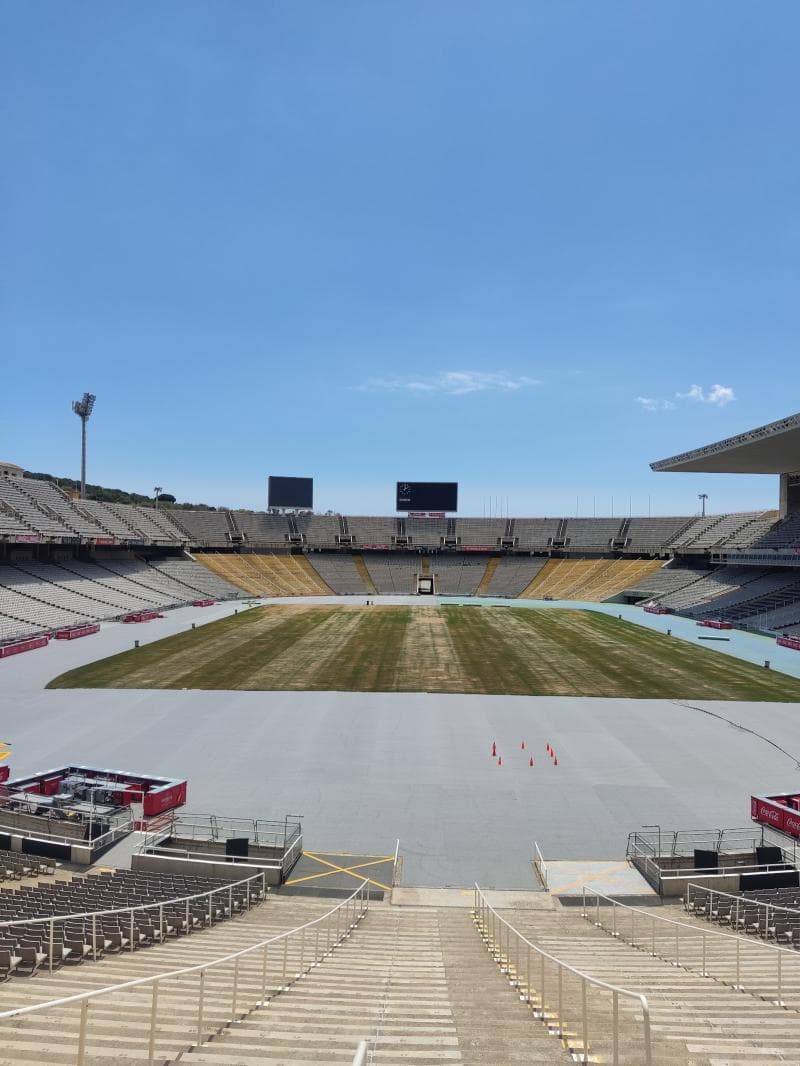
Explore Barcelona's iconic Estadi Olímpic Lluís Companys in Montjuïc. Discover its rich history from the 1929 Expo to the 1992 Olympics and beyond.
Overview
Perched majestically on the Montjuïc hill, overlooking the vibrant city of Barcelona and the sparkling Mediterranean Sea, stands the Estadi Olímpic Lluís Companys. More than just a sports venue, this iconic stadium is a profound landmark, weaving together threads of Barcelona's history, architectural ambition, and enduring Olympic spirit. Originally conceived for the 1929 International Exposition, it underwent a dramatic transformation to become the central stage for the unforgettable 1992 Summer Olympic Games. Today, it continues to serve as a versatile space, hosting major sporting events, electrifying concerts, and even temporarily, the home matches of FC Barcelona, making it a living monument that bridges the past with the present.
History & Cultural Background
The story of the Olympic Stadium begins in 1927, designed by architect Pere Domènech i Roura for the 1929 International Exposition, opening on May 20, 1929. Its construction was also tied to Barcelona's aspirations to host the 1936 Olympic Games, a bid that ultimately went to Berlin. Following the Expo, the stadium entered a period of relative disuse and neglect.
The stadium's fortunes dramatically changed when Barcelona was awarded the 1992 Summer Olympics. Between 1985 and 1989, it underwent an extensive renovation, spearheaded by a team of architects including Vittorio Gregotti, Frederic Correa, Alfons Milà, Joan Margarit, and Carles Buxadé. The renovation was so comprehensive that only the original neoclassical facade and Pau Gargallo's equestrian sculptures, 'Genets', were preserved. The interior was completely rebuilt, the track level lowered, and new stands installed, increasing its capacity.
In 2001, the stadium was officially renamed Estadi Olímpic Lluís Companys, honoring Lluís Companys i Jover, the former President of the Government of Catalonia during the Spanish Civil War, who was executed near Montjuïc Castle in 1940. This renaming added another layer of deep cultural and historical significance to the venue.
What Makes It Special
The Estadi Olímpic Lluís Companys is special for its blend of historical preservation and modern functionality. While its grand neoclassical facade speaks to its 1929 origins, the completely renovated interior embodies the spirit of contemporary sports architecture. The stadium's elliptical shape and minimal ornamentation are hallmarks of its modernist design. It stands as a powerful symbol of Barcelona's successful transformation and its emergence onto the global stage through the 1992 Olympic Games, hosting the opening and closing ceremonies and all athletics events.
Beyond its Olympic legacy, the stadium is highly versatile. It has hosted European Athletics Championships, major concerts by international artists, and was the home ground for RCD Espanyol football club from 1997 to 2009. Notably, it is currently serving as the temporary home for FC Barcelona's home matches during the renovation of Camp Nou for the 2024/2025 and 2025/2026 seasons, adding another significant chapter to its story.
Stories, Fun Facts & Local Details
One fascinating detail often shared is that during the extensive 1980s renovation, the stone excavated to lower the stadium's track level by 11 meters was of such high quality that it was repurposed in the construction of Antoni Gaudí's iconic Sagrada Família. This connects two of Barcelona's most significant architectural landmarks.
The stadium also bears witness to moments of profound human struggle. Few people remember that during the Spanish Civil War in 1936, it temporarily served as a refugee center. Its stands and columns were improvised into dormitories, classrooms, and washrooms, providing shelter and sustenance during a tumultuous period. This underlines its role not just as a sporting arena, but as a space that has mirrored the city's broader social and political narratives.
Of course, the most iconic moment associated with the stadium is the 'Hola' that Barcelona extended to the world during the opening ceremony of the XXV Olympiad on July 25, 1992. The lighting of the Olympic cauldron, with an arrow shot by Paralympic archer Antonio Rebollo, remains a magical and much-celebrated memory, symbolizing the city's spirit and vision. The cauldron itself can still be admired near the stadium.
Visitor Perspective
Visiting the Estadi Olímpic Lluís Companys today offers a unique opportunity to walk in the footsteps of sporting legends and experience a piece of Barcelona's vibrant history. The stadium is generally open to the public, allowing visitors to walk around its exterior and admire the impressive facade and equestrian sculptures. Access to the stadium's interior and visitor areas may be restricted during events, so it's always advisable to check the official website for current opening hours and event schedules.
Entry to the stadium itself is often free during opening hours, making it an accessible point of interest on Montjuïc. For those wishing to delve deeper, the nearby Museu Olímpic i de l'Esport Joan Antoni Samaranch provides an interactive journey through the history of sports and the Olympic ideals. The stadium's location within Montjuïc Park also means it's surrounded by other attractions, including the National Art Museum of Catalonia (MNAC), the Joan Miró Foundation, and Montjuïc Castle, offering a rich cultural experience.
Coordinates: 2.1557, 41.3648
View on Google Maps💬 How Travelers Describe This Place
Based on community votes
Photogenic
963Interesting
663Beautiful
653Must See
566Unique
503
Traveler Stories
Discover memorable experiences shared by travelers who have visited this place.
No traveler stories yet.
Be the first traveler to share what made this place memorable.

Tour
By
Spot
Discover amazing places around the world. Your journey starts here.
Explore
© 2026 TourBySpot. All rights reserved.