Odeon Of Herodes Atticus
Athens, Greece
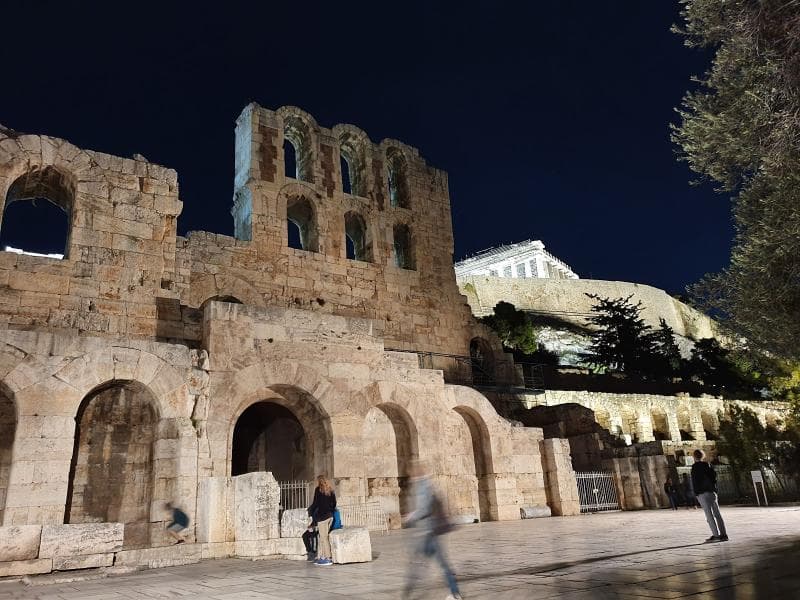
Explore the Odeon of Herodes Atticus in Athens, Greece, a magnificent ancient Roman odeon on the Acropolis slope. Discover its rich history, architecture, and role as a vibrant cultural venue today.
Overview
Nestled dramatically on the southwest slope of the magnificent Acropolis of Athens, the Odeon of Herodes Atticus stands as a timeless testament to ancient architectural prowess and enduring cultural significance. Often affectionately referred to by locals as the 'Herodeon', this impressive stone theatre was constructed between 160 and 174 AD by the immensely wealthy Athenian benefactor, Herodes Atticus. It was built in loving memory of his Roman wife, Regilla, serving as a grand and poignant ode to her memory.
Originally designed as a roofed music conservatory, or odeon, it boasted a seating capacity of approximately 5,000 spectators, making it a prominent venue of its time. Unlike many Greek theatres typically carved into hillsides, the Odeon of Herodes Atticus showcases distinctive Roman architectural elements, including its original three-story stage building and Roman arches, offering a unique blend of Greek and Roman influences. Today, it has been beautifully restored and serves as a primary venue for the internationally acclaimed Athens & Epidaurus Festival, hosting a diverse array of musical, dance, and theatrical performances under the Athenian sky.
History & Cultural Background
The story of the Odeon begins with its generous patron, Tiberius Claudius Atticus Herodes, a distinguished philosopher, Roman senator, and consul, whose philanthropic endeavors greatly enriched Athens during the 2nd century AD. His decision to construct this monumental odeon was a deeply personal one, dedicated to his wife, Aspasia Annia Regilla, following her death around 160 AD. This act of remembrance created not just a structure, but a lasting symbol of love and civic pride.
In its prime, the Odeon was a marvel of engineering and aesthetics. The ancient Greek traveler and geographer Pausanias, who visited Athens during the reign of Marcus Aurelius, famously described it as 'the finest building of its type'. Its original design included a costly wooden roof made of cedar from Lebanon, contributing to its excellent acoustics, and a three-story stage facade adorned with decorative pilasters and niches housing statues of imperial and family members. The auditorium featured 35 rows of marble seats, and the semi-circular orchestra was paved with black and white marble.
However, the Odeon's glory was not to last uninterrupted. It suffered catastrophic damage during the Heruli invasion of Athens in 267 or 268 AD, when many ancient buildings were burned and destroyed. For centuries thereafter, it lay in ruins, its stones repurposed for fortifications and dwellings, its original purpose lost to the sands of time. It was not until significant restoration work was undertaken in the 1950s, specifically between 1952 and 1953, that the Odeon began to reclaim its former splendor. Reopened in 1955, it has since been revitalized as a premier cultural venue, inaugurating its modern era as a central stage for the Athens Festival in 1957.
What Makes It Special
The Odeon of Herodes Atticus is distinguished by several unique characteristics that set it apart. Its location directly on the southwest slope of the Acropolis provides a breathtaking backdrop, creating an unparalleled atmosphere for performances. The architectural blend of Roman design principles with the traditional Greek theatre form is notable; unlike purely Greek amphitheatres, this odeon incorporated Roman innovations like a self-supporting stone structure for its seating area, or 'cavea', rather than relying solely on natural inclines.
Furthermore, its acoustics are renowned. The semi-circular design and the meticulous use of materials in its construction create a natural amplification of sound, ensuring that even today, performers' voices and music resonate clearly throughout the entire auditorium, reaching every one of its almost 5,000 seats. This enduring acoustic quality is a testament to the engineering genius of its ancient builders. It stands as one of the world's oldest and finest open-air theatres that remains actively in use, offering a living connection to the performing arts traditions of antiquity.
Stories, Fun Facts & Local Details
Beyond its grand architecture, the Odeon is rich with stories and cultural details. The locals' endearing nickname, 'Herodeon', reflects a familiar affection for this landmark. Over the decades of its modern operation, the Odeon's stage has been graced by an extraordinary roster of international and Greek luminaries. Icons such as Maria Callas, Nana Mouskouri, Luciano Pavarotti, and Frank Sinatra have all performed here, adding to its legendary status.
A fascinating historical tidbit reveals that during the German occupation of Greece (1941-1944), the Odeon of Herodes Atticus continued to host performances, including those by the Athens State Orchestra and the nascent Greek National Opera, with the young Maria Callas, then known as Maria Kalogeropoulou, making notable appearances. It even played host to the Miss Universe pageant in 1973, showcasing its versatility as a venue for diverse events.
The romantic origin story, of Herodes Atticus building it for his beloved wife Regilla, adds a layer of emotional depth to the impressive stone and marble, making it not just an architectural wonder but also a monument to eternal love.
Visitor Perspective
For the curious traveler, visiting the Odeon of Herodes Atticus is primarily an experience tied to its vibrant performance schedule. Generally, the interior of the Odeon is not open for casual sightseeing. Instead, access is granted to those holding tickets for one of the many concerts, operas, ballets, or ancient dramas that take place here, typically during the Athens & Epidaurus Festival season, which runs from May to October. Attending a performance is undoubtedly the most immersive way to experience its magic, allowing you to feel the echoes of ancient audiences.
If you're attending a show, be prepared for a truly authentic experience. Comfortable flat shoes are highly recommended due to the steep stairs within the auditorium, and indeed, the theatre enforces a 'no heels policy' to protect the ancient marble seating. While the marble benches offer a connection to the past, many find hiring a cushion at the entrance a welcome comfort. For those unable to attend a performance, excellent views of the Odeon's interior and its impressive scale can be enjoyed from above, when visiting the Acropolis itself. The Odeon is conveniently located and easily accessible, being a short walk from the Acropolis Metro Station, and offers wheelchair access via a dedicated ramp for those with mobility difficulties.
Coordinates: 23.7244, 37.9708
View on Google Maps💬 How Travelers Describe This Place
Based on community votes
Beautiful
872Must See
846Unique
684Interesting
363Photogenic
250
Traveler Stories
Discover memorable experiences shared by travelers who have visited this place.
No traveler stories yet.
Be the first traveler to share what made this place memorable.

Tour
By
Spot
Discover amazing places around the world. Your journey starts here.
Explore
© 2026 TourBySpot. All rights reserved.