Observatory Terraces
Los Angeles, United States
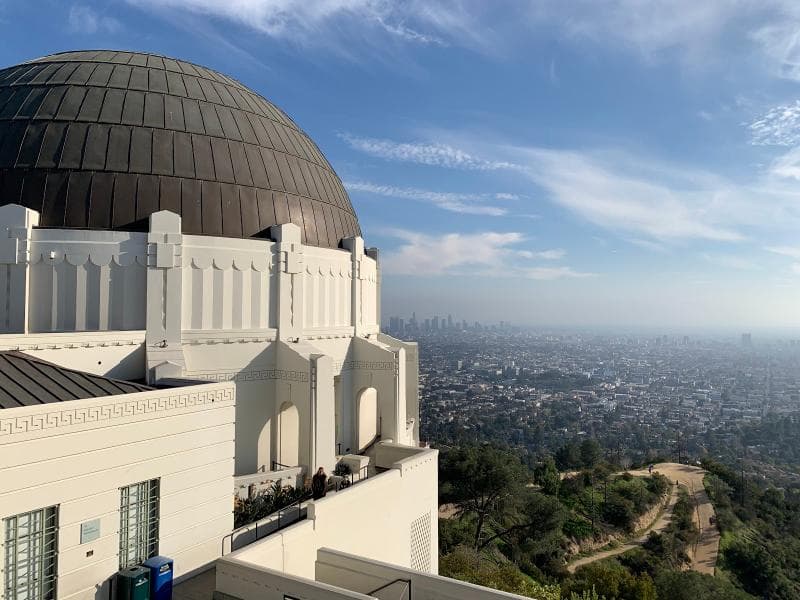
Discover the Observatory Terraces at Griffith Observatory, Los Angeles, United States. Enjoy panoramic views of the city, Hollywood Sign, and Pacific Ocean.
Overview
Perched majestically on the southern slope of Mount Hollywood, the Observatory Terraces at Griffith Observatory in Los Angeles, United States, offer an unparalleled vantage point to experience Southern California's iconic landscape. These expansive outdoor areas are an integral part of the renowned Griffith Observatory, providing visitors with breathtaking panoramic views that stretch across the vast Los Angeles Basin, encompassing Downtown Los Angeles to the southeast, the Hollywood Hills, and the shimmering Pacific Ocean to the southwest. Beyond their visual splendor, the terraces serve as key observational platforms, inviting the public to engage directly with astronomy through various exterior exhibits and telescopes. They are accessible daily from sunrise until 10:00 p.m., aligning with Griffith Park's closing hours, making them a must-visit destination for both celestial observers and city view enthusiasts.
History & Cultural Background
The vision for the Griffith Observatory, and by extension its spectacular terraces, originated with Colonel Griffith J. Griffith, a Welsh immigrant who amassed a fortune in real estate and mining. In 1896, he donated 3,015 acres to the City of Los Angeles for a public park, now known as Griffith Park. Later, in his 1916 will, Griffith provided funds for an observatory, exhibit hall, and planetarium within this park, driven by his desire to make astronomy accessible to everyone, a revolutionary idea at the time. Construction began in 1933, with architects John C. Austin and Frederic M. Ashley designing the building in a blend of Art Deco, Greek, and Beaux-Arts styles.
Opened on May 14, 1935, the Griffith Observatory quickly became a cherished civic landmark. The terraces were an essential part of its original design, intended to complement the indoor exhibits by offering natural outdoor observatories of the surrounding environment and sky. Over the decades, the observatory, including its terraces, has undergone renovations and expansions, such as the major project from 2002-2006, to enhance its facilities while preserving its historic integrity and the founder's noble objective of public engagement with science.
What Makes It Special
What truly sets the Observatory Terraces apart is their diverse and dynamic viewing experience. From the Hollywood Sign Terrace, visitors can capture some of the best photographs of the world-famous Hollywood Sign.
- East Terrace: This area provides sweeping views of Downtown Los Angeles and Mount Wilson Observatory, offering coin telescopes for closer inspection of landmarks.
- Upper and Lower West Terraces: These terraces present stunning vistas encompassing Downtown Los Angeles, the vast cityscape, and the distant Pacific Ocean. The lower West Terrace is particularly notable for its 'Sunset & Moonset Radial Lines,' a series of stone and bronze lines embedded in the ground that point towards significant sunset and moonset positions on the western horizon, turning a simple view into an astronomical lesson.
These distinct areas ensure that every angle offers a unique perspective, combining natural beauty with opportunities for scientific observation. The accessibility of public telescopes, including the historic 12-inch Zeiss Refracting Telescope on the roof when the observatory is open, further enhances the special nature of these terraces, fulfilling Griffith's original wish for public viewing of celestial objects.
Stories, Fun Facts & Local Details
The Observatory Terraces are more than just a viewpoint; they are a stage for countless personal memories and a silent star in Hollywood's narrative. Interestingly, the observatory itself was featured prominently in the iconic 1955 film 'Rebel Without a Cause', cementing its place in popular culture. While admission to the observatory building and all outdoor areas, including the terraces, has been free since its opening in 1935, in accordance with Griffith J. Griffith's will, the institution has welcomed over 85 million visitors. This commitment to free public access ensures that the wonder of the cosmos and the beauty of Los Angeles remain available to everyone. It's a place where locals often come for a reflective moment or a romantic evening, and where tourists can soak in quintessential Los Angeles views.
Visitor Perspective
For visitors, the Observatory Terraces offer an experience that is both accessible and profound. They are open every day from sunrise until 10:00 p.m., even when the observatory building itself might be closed, allowing for early morning jogs or late-night strolls under the stars. Many find the late afternoon or dusk to be the most popular times to visit, as it allows for witnessing a stunning sunset over the city, followed by the twinkling city lights and, on clear evenings, exceptional stargazing opportunities through the provided coin telescopes. Whether you spend a quick hour or linger for several, exploring the exhibits, walking the terraces, and simply enjoying the vistas is a common recommendation. The blend of a vibrant city panorama, the serene Pacific Ocean, and the iconic Hollywood Sign makes a visit to the terraces a truly unforgettable Los Angeles experience.
Coordinates: -118.3004, 34.1186
View on Google Maps💬 How Travelers Describe This Place
Based on community votes
Unique
685Photogenic
472Beautiful
446Interesting
399Must See
33
Traveler Stories
Discover memorable experiences shared by travelers who have visited this place.
No traveler stories yet.
Be the first traveler to share what made this place memorable.

Tour
By
Spot
Discover amazing places around the world. Your journey starts here.
Explore
© 2026 TourBySpot. All rights reserved.