National History Museum
Tirana, Albania
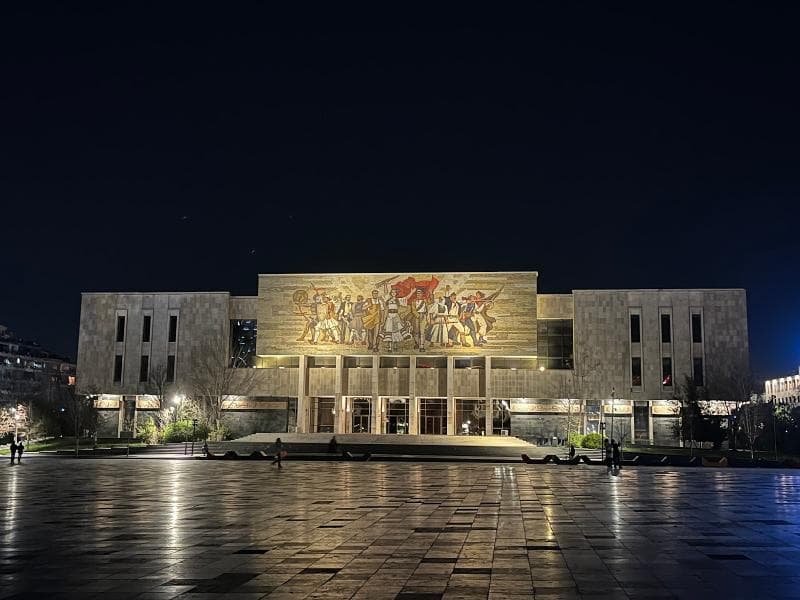
Discover Albania's rich past at the National History Museum in Tirana's Skanderbeg Square, spanning millennia of history and culture.
Overview
Nestled proudly on Skanderbeg Square in the vibrant heart of Tirana, Albania, the National History Museum stands as the country's largest and most significant institution dedicated to preserving the rich tapestry of its past. Inaugurated in 1981, this museum serves as a comprehensive chronicle of Albanian civilization, housing an impressive collection of over 5,000 artifacts that span from the 4th millennium BC to the latter half of the 20th century. While it is currently undergoing extensive renovations and is projected to reopen in 2028, its imposing presence and the stories it promises to tell remain a cornerstone of Albania's cultural identity.
The museum's striking façade, dominated by a monumental Socialist Realist mosaic, immediately captures attention, hinting at the profound historical journey awaiting visitors. It is an essential landmark for anyone seeking to understand Albania's complex heritage, its struggles, and its triumphs, all housed within a building that itself is a product of a specific historical era.
History & Cultural Background
The National History Museum was officially opened on October 28, 1981, a period when Albania was under a communist regime. Designed by Albanian architect Enver Faja, its construction necessitated the demolition of the former Tirana Municipal Building, making way for what was intended to be a grand symbol of national history.
Its establishment was a monumental effort, involving a team of leading specialists in history, archaeology, ethnography, and art. The museum's mission has always been to foster an understanding and appreciation of Albania's historical and cultural heritage, encouraging dialogue about the nation's past, present, and future. It functions not only as an exhibition space but also as a scientific research institution, preserving both material and intangible evidence of Albania's journey.
The museum's collection is thoughtfully organized into eight distinct pavilions, each dedicated to a significant period or theme. These include the Pavilion of Antiquity, the Middle Ages, the Albanian National Renaissance, Independence, Iconography, the National Liberation Anti-fascist War, Communist Terror, and Mother Teresa. This chronological and thematic arrangement allows for a profound exploration of Albania's development through various epochs.
What Makes It Special
Beyond its sheer size and extensive collection, what truly sets the National History Museum apart is its monumental façade mosaic, titled 'The Albanians.' This vibrant artwork, measuring an impressive 11 meters high and 40 meters long, covers an area of 440 square meters. It vividly portrays thirteen figures, symbolizing different phases of Albanian history, from ancient Illyrian warriors and fighters against the Ottoman Empire to a communist worker and the allegorical 'Mother Albania' at its center. This mosaic, completed in 1980, is a quintessential example of Socialist Realism and was meticulously restored in 2023.
Inside, the museum's pavilions house unique and nationally significant objects. The Pavilion of Antiquity, for instance, is the richest, featuring 585 objects from the Late Paleolithic to the Early Middle Ages, including artifacts from the prehistoric settlement of Maliq. The Middle Ages Pavilion holds treasures like the Epitaph of Gllavenica from 1373, offering insights into the resistance against Ottoman occupation and the era of national hero Skanderbeg. The Communist Terror Pavilion, inaugurated in 2012, is particularly poignant, displaying documents and photographs from the repressive one-party system between 1945 and 1990.
Stories, Fun Facts & Local Details
The National History Museum is more than just a repository of objects; it's a storyteller of resilience and identity. The imposing mosaic on its exterior acts as a grand visual narrative, immediately immersing visitors in the collective memory of the Albanian people, even before stepping inside. It reflects a nation's continuous struggle for sovereignty and cultural preservation.
Consider the story told by the 'Beauty of Durrës,' a significant Hellenistic statue found in the Antiquity Pavilion. Or the intricate details of the Onufri icons in the Iconography Pavilion, representing centuries of Post-Byzantine religious art and the enduring spirit of Albanian craftsmanship. Each exhibit, from ancient tools to modern-era documents, is a piece of a larger puzzle, revealing how different civilizations and empires influenced Albania and shaped its unique traditions.
The museum's very location on Skanderbeg Square, the central plaza named after Albania's national hero, highlights its symbolic importance. The square itself was redeveloped with natural stones sourced from all regions of Albania, forming a subtle pyramid shape that points towards the monument of Skanderbeg, and features over 100 fountains. This interconnectedness emphasizes how the museum is an integral part of Tirana's, and indeed Albania's, living history and public life.
Visitor Perspective
As of late 2024, the National History Museum is undergoing extensive renovations and is anticipated to remain closed until 2028. This temporary closure is part of a larger €40 million EU4Culture initiative aimed at a full structural restoration, modernization of exhibitions, and significant accessibility upgrades, including lifts and ramps. While this means direct entry is not currently possible, the ongoing work promises an enhanced and more immersive experience upon its reopening.
Historically, the museum has been praised for its comprehensive overview of Albanian history, serving as an invaluable resource for both locals and international visitors. While in the past some explanatory texts were predominantly in Albanian, the renovation plans include dual-language labels (English/Albanian) and digital storytelling, such as augmented reality (AR) and virtual reality (VR) snippets, ensuring a more accessible and engaging journey through Albania's past for everyone.
Coordinates: 19.81694, 41.32917
View on Google Maps💬 How Travelers Describe This Place
Based on community votes
Must See
551Interesting
421Photogenic
366Beautiful
298Unique
212
Traveler Stories
Discover memorable experiences shared by travelers who have visited this place.
No traveler stories yet.
Be the first traveler to share what made this place memorable.

Tour
By
Spot
Discover amazing places around the world. Your journey starts here.
Explore
© 2026 TourBySpot. All rights reserved.