Namazgoh Mosque
Tashkent, Uzbekistan
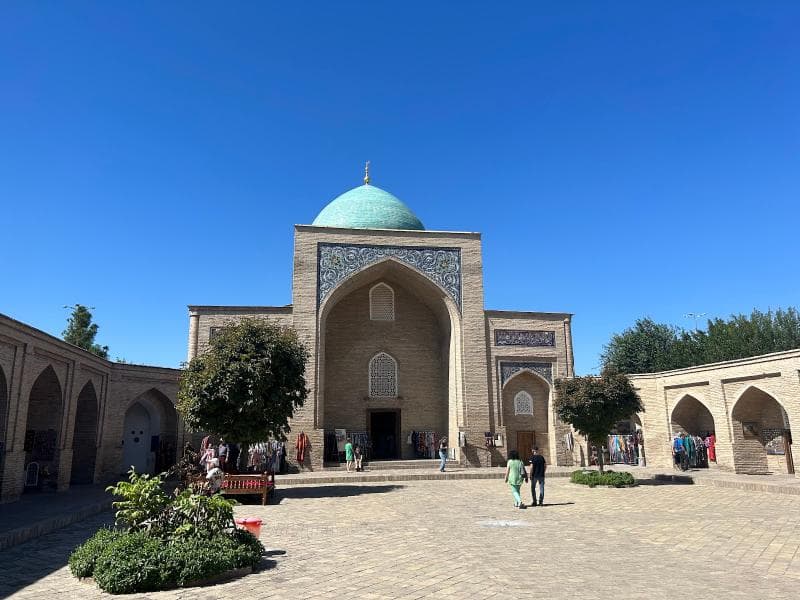
Explore the historic Namazgoh Mosque within Tashkent, Uzbekistan's Hazrat Imam Complex, a 19th-century spiritual and educational landmark.
Overview
The Namazgoh Mosque, nestled within the historic Hazrat Imam Complex in Tashkent, Uzbekistan, stands as a profound symbol of the city's rich Islamic heritage and enduring spiritual life. Its name, 'Namazgoh,' directly translates to 'place for prayer,' signifying its original purpose as a large open-air area for communal worship, especially during major religious festivals like Ramadan Eid and Kurban Eid. While the broader Hazrat Imam Complex dates back centuries, the Namazgoh Mosque itself is a significant 19th-century addition, contributing to the complex's role as a central hub for Islamic culture and learning in Central Asia. Today, it not only functions as a mosque but also houses the esteemed Imam al-Bukhari Islamic Institute, a pivotal educational institution that has played a crucial role in Islamic education throughout the region, particularly during the Soviet era.
Located in the 'Old City' part of Tashkent, the mosque is part of an architectural ensemble that impressively survived the devastating 1966 earthquake, offering visitors a rare glimpse into the city's authentic medieval past. Its elongated structure, traditional Uzbek architecture, and the serene atmosphere make it a captivating destination for those seeking to understand the spiritual heart of Tashkent.
History & Cultural Background
The history of the Namazgoh Mosque is intertwined with the political and religious landscape of 19th-century Tashkent. Construction of the mosque began in 1845, initiated by Khudoyar Khan, a ruler from the Uzbek Ming dynasty of the Kokand Khanate, who controlled Tashkent at the time. The building effort continued until 1865, coinciding with the Russian conquest of Tashkent. Despite the turbulent period, the mosque was not damaged and continued its vital function as a place for Friday and holiday prayers.
The early 20th century, however, brought significant challenges. Following the 1917 Revolution, the mosque suffered looting and fell into disrepair. A remarkable turning point arrived in the 1970s with restoration efforts led by Sheikh Ziyauddinkhan ibn Eshon Babakhan. His vision extended beyond mere restoration; in 1971, he successfully secured permission from Soviet authorities to open a higher Islamic educational institution on the grounds of the Namazgoh Mosque. This institution, named the Imam al-Bukhari Islamic Institute, became the sole higher Islamic educational establishment in the USSR, serving as a beacon of Islamic learning for millions of Muslims across Central Asia, Kazakhstan, and other parts of the Soviet Union.
What Makes It Special
The Namazgoh Mosque's uniqueness stems from its dual role as both a sacred place of worship and a vital educational center. Architecturally, it is an elongated building characterized by domed galleries and a wooden ayvan, or veranda. Its walls are constructed of fired brick, and the main prayer hall features a mihrab niche adorned with stalactite ornamentation. The mosque measures 56 by 15 meters and boasts 12 domes, reflecting traditional Central Asian design principles.
Beyond its physical attributes, the mosque holds profound significance as the birthplace of modern Islamic higher education in a region that faced religious suppression for decades. The Imam al-Bukhari Islamic Institute, housed within its walls, educated generations of Muslim clergy, with almost all muftis in the Commonwealth of Independent States being its graduates. This transformation from a traditional prayer space to a hub of intellectual and spiritual development makes the Namazgoh Mosque a truly special monument. Its resilience through conquest, revolution, and restoration underscores its enduring importance to the people of Uzbekistan.
Stories, Fun Facts & Local Details
One captivating aspect of the Namazgoh Mosque, as with many ancient sites in the Hazrat Imam Complex, is the blend of verifiable history with local legends and cultural nuances. For many years, a popular local legend circulated that a golden strand of the Prophet Muhammad's hair was kept within the sacred walls of the complex, drawing pilgrims and curious visitors alike. While the Muyi Muborak Madrasah within the complex is famously said to house the oldest Quran, this specific legend adds to the mystical allure of the area.
The very name 'Namazgoh' isn't just a label; it reflects a functional tradition. In the past, these were open-air prayer grounds situated outside city walls, designed to accommodate large congregations during significant religious holidays. This tradition highlights a communal aspect of worship that was essential to the social fabric of Central Asian cities. The mosque's transition from a prayer ground to an educational institution also tells a compelling story of adaptation and perseverance, showcasing how religious institutions found ways to thrive even during challenging political periods. Its existence within the Hazrat Imam Complex, which itself is built around the tomb of Abu Bakr Muhammad Kaffal Shashi – a revered scholar, poet, and even a skilled locksmith (earning him the nickname 'Qaffol') – weaves a rich tapestry of history and devotion around this sacred site.
Visitor Perspective
Visiting the Namazgoh Mosque within the Hazrat Imam Complex offers a contemplative journey through centuries of Islamic faith and culture. As you step into the complex, you are enveloped by an atmosphere of tranquility and historical depth. While the mosque itself may not always be open for general tourist entry, its exterior and surroundings provide a profound sense of place. The mosque's architecture, with its burnt brick walls, domed galleries, and the wooden ayvan, evokes a sense of traditional Central Asian artistry.
Visitors are encouraged to explore the broader Hazrat Imam Complex, which includes other significant structures like the Barak-Khan Madrasah and the Tilla-Sheikh Mosque. It's advisable to dress respectfully, with women bringing a headscarf as is customary when visiting mosques and mausoleums. Removing shoes before entering religious buildings is also a common practice. The complex is not just a collection of buildings; it's a living spiritual center that resonates with the daily prayers of worshippers and the scholarly pursuits of the Islamic Institute. Taking the time to observe the intricate details of the architecture and absorb the peaceful ambiance provides a truly enriching cultural experience.
Coordinates: 69.2163, 41.2647
View on Google Maps💬 How Travelers Describe This Place
Based on community votes
Photogenic
951Unique
748Beautiful
499Interesting
427Must See
94
Traveler Stories
Discover memorable experiences shared by travelers who have visited this place.
No traveler stories yet.
Be the first traveler to share what made this place memorable.

Tour
By
Spot
Discover amazing places around the world. Your journey starts here.
Explore
© 2026 TourBySpot. All rights reserved.