Murugan Statue
Kuala Lumpur, Malaysia
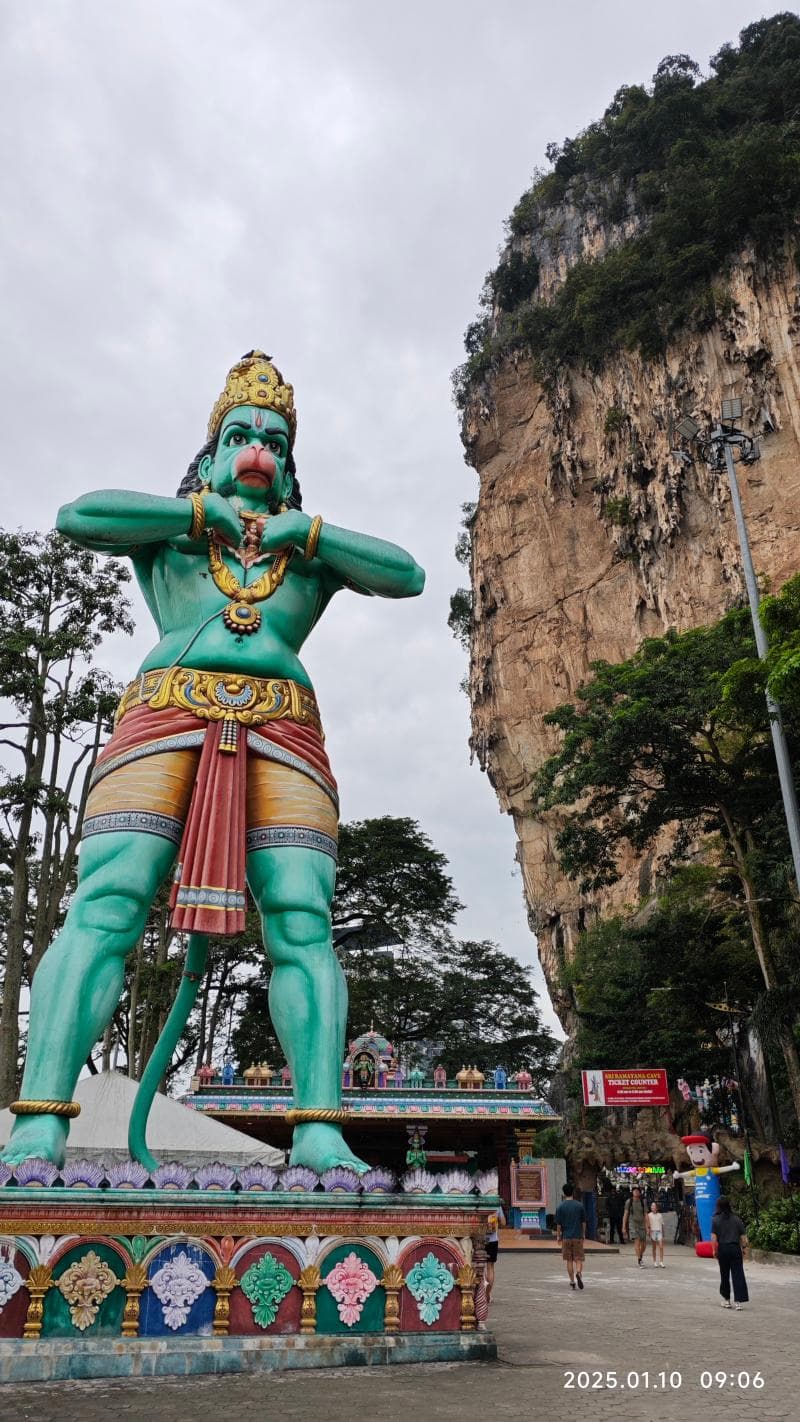
Discover the magnificent Murugan Statue at Batu Caves, Kuala Lumpur, Malaysia. Learn about this 42.7m golden deity, its history, cultural significance, and role in the Thaipusam festival.
Overview
Standing majestically at the entrance of Batu Caves in Kuala Lumpur, Malaysia, the Murugan Statue is an awe-inspiring golden beacon that captivates all who visit. Towering at 42.7 meters (140 feet), it proudly holds the title of the tallest statue in Malaysia and ranks as one of the world's most impressive statues dedicated to a Hindu deity. This colossal figure depicts Lord Murugan, also revered as Kartikeya or Subramaniam, the Hindu god of war, victory, and wisdom. It serves not just as a striking landmark, but as a profound spiritual gateway to the ancient limestone cave temples nestled within the Batu Caves complex. Visible from a considerable distance, its gleaming golden facade signals the sanctity and cultural richness that lies beyond, setting the stage for a memorable journey into Hindu faith and Malaysian heritage.
History & Cultural Background
The history of Batu Caves as a significant religious site predates the statue itself. While the caves were brought to wider attention by American naturalist William Temple Hornaday in 1878, it was Indian trader K. Thamboosamy Pillai who established a shrine dedicated to Lord Murugan here in 1891. Pillai was notably inspired by the main cave's entrance, which he felt resembled the 'vel,' Lord Murugan's divine spear. This act laid the foundation for Batu Caves to become one of the most important Hindu pilgrimage sites outside India.
The Murugan Statue, as we know it today, is a more recent addition, a testament to enduring devotion and architectural ambition. Its construction commenced in 2003 and spanned three years, culminating in its official unveiling on January 29, 2006. This strategic timing, just weeks before the annual Thaipusam festival, maximized its cultural impact and significance. The project was an immense undertaking, funded by the Malaysian Tamil Hindu community at a cost of approximately 2.5 million Malaysian Ringgits (over US$550,000). A dedicated team, including 15 skilled sculptors from India and 15 local workers, meticulously crafted this monumental effigy, cementing its role as a cornerstone of Malaysian Hindu identity and spiritual expression.
What Makes It Special
The Murugan Statue's allure stems from its extraordinary scale, intricate symbolism, and dramatic setting. Standing at 42.7 meters (140 feet), it is not only Malaysia's tallest statue but also the second tallest statue of Lord Murugan globally, surpassed only by a replica in Salem, India. The sheer engineering feat involved in its creation is remarkable; it required an estimated 1,550 cubic meters of concrete, between 250 and 350 tonnes of steel bars for structural integrity, and 300 liters of radiant gold paint, much of it imported from Thailand or India, to achieve its iconic shimmer.
Artistically, the statue depicts Lord Murugan in a traditional standing pose, firmly grasping his 'vel' – a sacred spear that is central to his iconography. This 'vel' symbolizes his triumph over evil forces and represents spiritual victory and divine power for devotees. The statue's golden form, set against the ancient, 400-million-year-old limestone cliffs of Batu Caves, creates a breathtaking contrast between human artistry and natural grandeur. More than just a magnificent structure, it embodies strength, unwavering devotion, and the promise of spiritual triumph, drawing millions of pilgrims and tourists alike to witness its splendor.
Stories, Fun Facts & Local Details
The Murugan Statue and Batu Caves are deeply intertwined with the vibrant Thaipusam festival, an annual Hindu celebration held in January or February during the Tamil month of Thai. This festival commemorates Lord Murugan's victory over the demon Soorapadman, a triumph made possible when his mother, Parvati, bestowed upon him the divine 'vel.' During Thaipusam, Batu Caves becomes the epicenter of celebrations in Malaysia, attracting up to two million devotees and visitors. The statue serves as a commanding focal point for this spiritual event, its golden presence overlooking the elaborate processions and acts of devotion, which often include devotees carrying 'kavadis' as penance.
A common misconception is that the statue is solid gold; however, it is constructed from concrete and steel, then meticulously coated with gold paint. Visitors cannot enter the statue itself, as it is a solid structural monument. The area around the statue and the famous 272 colorful steps leading to the main cave is also home to a lively population of macaque monkeys. While often entertaining, these monkeys are known to be quite bold and will attempt to snatch food from unsuspecting visitors, adding an unexpected local detail to the pilgrimage experience. Currently, a restoration project is underway, having begun in mid-2023 and expected to continue through December 2025, focused on cleaning, repairing, and refreshing the statue's golden paint to preserve its grandeur.
Visitor Perspective
For many travelers arriving at Batu Caves, the Murugan Statue is the very first sight to greet them, its immense scale instantly signaling the significance of the site. Its prominent location makes it an undeniable focal point, standing guard at the base of the iconic 272 steps. The journey from admiring the statue to embarking on the climb up the colorful staircase is often described as a pivotal part of the Batu Caves experience. This ascent is not merely a physical endeavor but a symbolic spiritual journey, offering moments of reflection amidst the bustling atmosphere.
As visitors climb, they are rewarded with increasingly panoramic views of the surrounding area, making the effort worthwhile. Accessing Batu Caves and the Murugan Statue from Kuala Lumpur is convenient, with options including the KTM Komuter train directly to Batu Caves station, or readily available taxis and ride-sharing services like Grab. The statue's sheer presence, coupled with the anticipation of exploring the ancient caves above, creates a powerful and immersive experience for anyone seeking to understand the spiritual and cultural heart of this Malaysian landmark.
Coordinates: 101.6839, 3.2374
View on Google Maps💬 How Travelers Describe This Place
Based on community votes
Unique
989Beautiful
613Photogenic
603Interesting
581Must See
207
Traveler Stories
Discover memorable experiences shared by travelers who have visited this place.
No traveler stories yet.
Be the first traveler to share what made this place memorable.

Tour
By
Spot
Discover amazing places around the world. Your journey starts here.
Explore
© 2026 TourBySpot. All rights reserved.