Murals
Vientiane, Laos
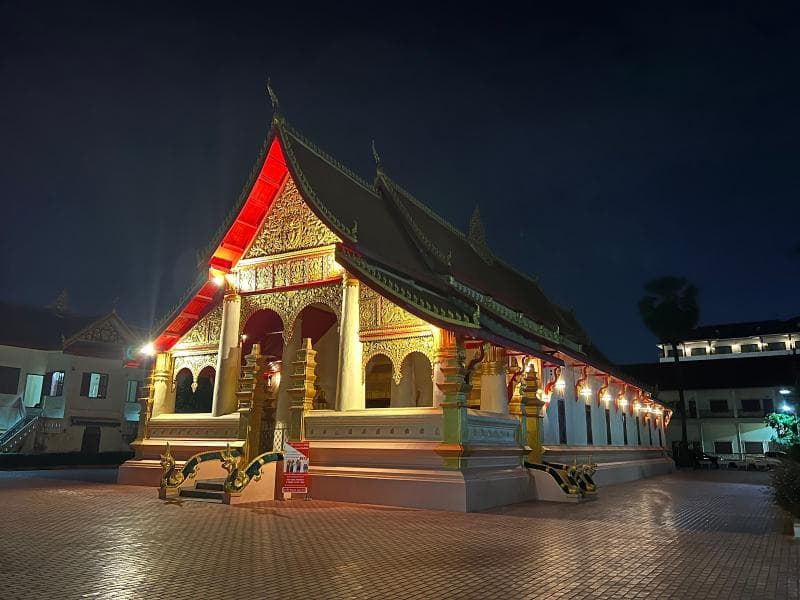
Explore the vibrant murals of Wat Ong Teu Mahawihan in Vientiane, Laos, depicting Buddhist tales and teachings within this historic temple.
Overview
Deep within the revered Wat Ong Teu Mahawihan in Vientiane, Laos, lie the captivating murals that tell stories of a spiritual journey. While the temple is widely celebrated for its monumental bronze Buddha, Phra Ong Teu, the murals offer an equally profound experience, adorning the walls of the ordination hall (sim) with vibrant narratives and intricate artistry. These visual tales contribute significantly to the temple's identity as a beacon of Buddhist education and cultural heritage, inviting visitors to delve deeper into its spiritual essence.
Wat Ong Teu Mahawihan, often known as the 'Temple of the Heavy Buddha' due to its colossal central image, stands in the historic heart of Vientiane. It is not merely a place of worship but also a vital center for Buddhist learning, where monks from across Laos come to study the dhamma. The murals, with their colorful depictions, serve as didactic tools, bringing ancient scriptures and moral lessons to life for both the monastic community and visiting devotees.
History & Cultural Background
The origins of Wat Ong Teu Mahawihan trace back to the 16th century, during the reign of King Setthathirath I, a period considered a 'Golden Age' for Buddhism in Laos. The temple, like many in Vientiane, faced destruction during the Siamese invasion around 1828 but was meticulously rebuilt and restored throughout the 19th and 20th centuries. This history of resilience is subtly echoed in its artistic elements.
Originally conceived by King Setthathirath I to house the immense Phra Ong Teu Buddha image, the temple evolved into a significant Buddhist learning center under King Souligna Vongsa in the 17th century. Monks from across Southeast Asia flocked here to study Buddhist teachings, cementing its role as a spiritual and academic hub. The murals, therefore, are not merely decorative; they are integral to this educational mission, presenting complex Buddhist doctrines in an accessible, visual format.
What Makes It Special
The murals of Wat Ong Teu Mahawihan are special because they provide a rich visual tapestry that complements the temple's primary purpose. Surrounding the majestic Phra Ong Teu Buddha statue in the ordination hall, these 'elaborate' and 'colorful' wall frescoes illustrate scenes from the life of the Buddha and various Buddhist teachings. Their presence transforms the sacred space into a living scripture, allowing contemplation and understanding through art.
Unlike the more austere interiors of some ancient temples, the ordination hall of Wat Ong Teu Mahawihan is richly decorated, featuring not only the murals but also gilded ornamentation and intricate wood carvings. This combination creates an immersive environment where every surface contributes to the spiritual narrative. The artistic blend, reflecting traditional Lao and Thai styles, showcases the craftsmanship and devotional artistry dedicated to the preservation and dissemination of Buddhist principles.
Stories, Fun Facts & Local Details
While specific detailed accounts of individual mural panels are not widely documented, it's understood that these vibrant frescoes primarily depict key moments from the life of Siddhartha Gautama, the Buddha. These include scenes such as his birth, enlightenment under the Bodhi tree, his first sermon, and his parinirvana. They also illustrate Jataka tales, which are stories of the Buddha's previous lives, teaching moral lessons through parables.
One can imagine the generations of monks and lay practitioners who have gazed upon these walls, internalizing the narratives and finding inspiration for their own spiritual paths. The murals serve as a constant reminder of the core tenets of Buddhism: suffering, the cause of suffering, the cessation of suffering, and the path to liberation. Observing these artistic interpretations offers a quiet moment of reflection, connecting visitors to centuries of faith and tradition in Laos.
Visitor Perspective
For a curious traveler, encountering the murals at Wat Ong Teu Mahawihan is an opportunity to step into a tranquil realm of cultural and spiritual depth. As you enter the ordination hall, the sheer scale of the Phra Ong Teu Buddha is breathtaking, but take a moment to allow your eyes to wander over the surrounding walls. The 'vibrant wall frescoes' offer a different kind of reverence, one that unfolds through narrative and artistic expression.
The serenity within the temple, often filled with the quiet presence of meditating monks or worshippers making offerings, enhances the experience of viewing the murals. It provides a rare glimpse into the living traditions of Lao Buddhism. Observing the artistic details and understanding their thematic significance can be a deeply moving and educational experience, transcending mere sightseeing to offer a genuine connection to the spiritual heart of Vientiane.
Coordinates: 102.60389, 17.9656
View on Google Maps💬 How Travelers Describe This Place
Based on community votes
Interesting
926Unique
646Photogenic
482Beautiful
380Must See
291
Traveler Stories
Discover memorable experiences shared by travelers who have visited this place.
No traveler stories yet.
Be the first traveler to share what made this place memorable.

Tour
By
Spot
Discover amazing places around the world. Your journey starts here.
Explore
© 2026 TourBySpot. All rights reserved.