Mur Des Canuts
Lyon, France
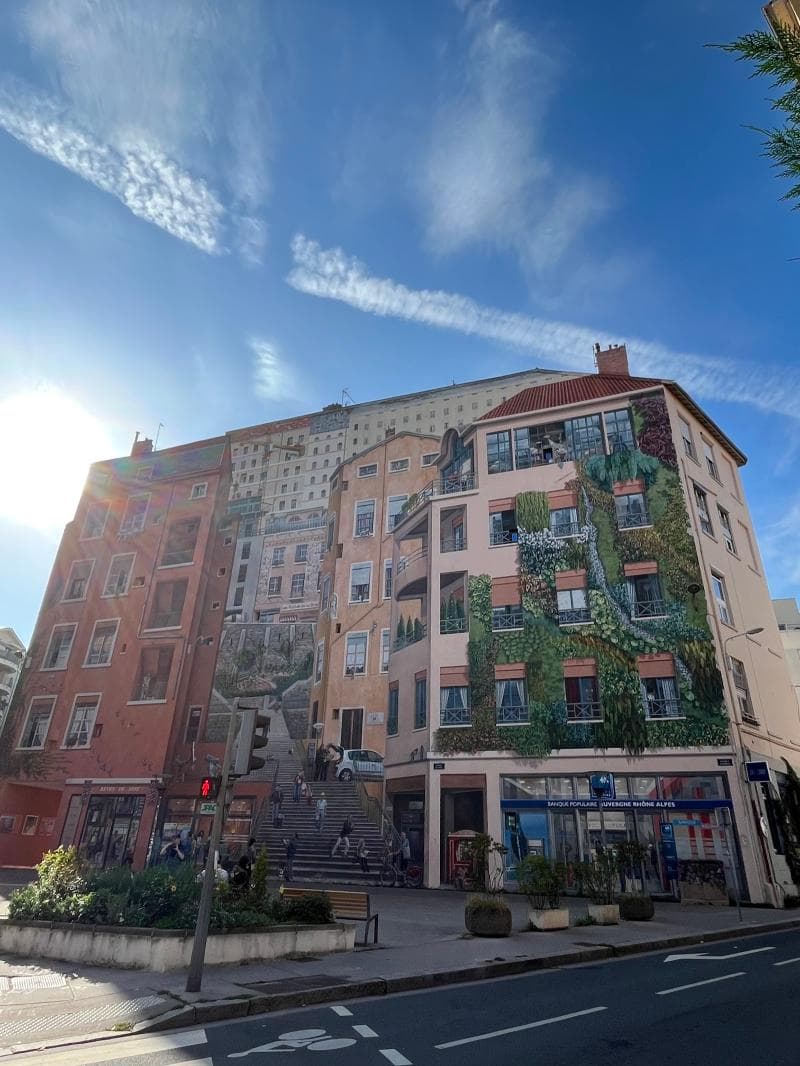
Discover the Mur des Canuts, Europe's largest trompe-l'oeil mural in Lyon's La Croix-Rousse district, celebrating the city's silk weaving history.
Overview
Perched atop the picturesque La Croix-Rousse hill in Lyon, France, a remarkable work of art captivates visitors: the Mur des Canuts. This monumental mural is a stunning example of 'trompe-l'oeil' – a French term meaning 'to deceive the eye' – creating an optical illusion so convincing it appears to be a real streetscape. Covering an expansive area of 1200 square meters, it stands as one of Europe's largest painted walls, transforming a once-plain building facade into a vibrant, living canvas. The Mur des Canuts intricately portrays the daily life and architectural charm of the Croix-Rousse district, inviting observers to pause and immerse themselves in its hyperrealistic details. It is not merely a painting, but a dynamic tribute to the neighborhood's enduring spirit and rich heritage, constantly evolving to reflect the passage of time and the transformations within the community.
History & Cultural Background
The story of the Mur des Canuts is deeply intertwined with Lyon's identity as a historic center of silk production. The mural pays homage to the 'Canuts,' the skilled silk weavers who inhabited and worked in the La Croix-Rousse district during the 19th century. This area was the bustling economic heart of Lyon's silk industry, famously known as 'the hill that works,' in contrast to Fourvière, 'the hill that prays.' The Canuts were renowned for their craftsmanship, but also for their resilience, notably staging significant revolts in 1831 against challenging working conditions. The mural itself was conceived and brought to life in 1987 by the acclaimed CitéCréation artistic collective. Their vision was to beautify the neighborhood while immortalizing the legacy of these industrious workers. Over the years, the Mur des Canuts has been updated and renovated multiple times, first in 1997 and then again in 2013, ensuring it remains a relevant and evolving representation of the district's past and present.
What Makes It Special
What sets the Mur des Canuts apart is its breathtaking mastery of the trompe-l'oeil technique and its sheer scale. It is celebrated as one of the largest such murals in Europe, offering an immersive visual experience that blurs the lines between art and reality. The artists have meticulously depicted colorful buildings, windows with pastel shades, and a seemingly real stone stairway, creating a remarkable illusion of depth and three-dimensionality. Beyond its artistic brilliance, the mural's unique characteristic lies in its evolution. Unlike static artworks, the Mur des Canuts has been periodically updated by CitéCréation to reflect the changes in the neighborhood and even to 'age' the depicted residents, showcasing the passage of time. This dynamic nature makes each visit potentially fresh and engaging, inviting careful observation to discover new details and transformations.
Stories, Fun Facts & Local Details
The Mur des Canuts is a tapestry of small narratives and local winks. Within its expansive scene, you can spot various 'Croix-roussiens' – inhabitants of the district – going about their daily activities, whether climbing stairs, tending to plants, or engaging in conversation. A charming detail often highlighted is the presence of a small Guignol puppet theater, a nod to Lyon's beloved traditional puppet character. You might also notice elements like Vélo'v, Lyon's self-service bike system, cleverly integrated into the painting, reflecting modern city life alongside historical references. Another fascinating aspect is the depiction of a silk workshop on the ground floor of one of the buildings, directly referencing the Canuts' primary trade and the reason for the district's historical prominence. The meticulous attention to 'slice of life' scenes, including pigeons on railings and everyday objects, creates a sense of profound realism, encouraging viewers to scrutinize every corner for hidden gems.
Visitor Perspective
Visiting the Mur des Canuts offers a unique opportunity to engage with public art that tells a compelling story. It is freely accessible and can be appreciated at your own pace, typically requiring about 20 to 40 minutes to take in all its intricate details and perspective-bending artistry. To truly grasp the mural's grandeur, it's recommended to view it from a distance first, then approach to admire the countless nuances and 'slice of life' vignettes that make it so captivating. The mural is easily reached via Lyon's public transport system; taking Metro Line C to the Hénon station brings you just a few minutes' walk away. While there, travelers can also explore the surrounding Croix-Rousse district, known for its village-like atmosphere, historic 'traboules' (hidden passageways), and vibrant local life, offering a deeper dive into the culture that inspired this magnificent artwork.
Coordinates: 4.827976, 45.777928
View on Google Maps💬 How Travelers Describe This Place
Based on community votes
Must See
998Unique
903Beautiful
481Interesting
458Photogenic
197
Traveler Stories
Discover memorable experiences shared by travelers who have visited this place.
No traveler stories yet.
Be the first traveler to share what made this place memorable.

Tour
By
Spot
Discover amazing places around the world. Your journey starts here.
Explore
© 2026 TourBySpot. All rights reserved.