Motherland Statue
Kiev, Ukraine
Explore Kyiv's Motherland Statue, a colossal 102-meter monument symbolizing Ukrainian resilience. Discover its history, unique features, and panoramic city views.
Overview
Towering majestically over the right bank of the Dnieper River in Kyiv, Ukraine, stands the Motherland Statue (often referred to as Motherland Monument). This colossal stainless steel sculpture of a female warrior, holding a sword and shield, is an undeniable symbol of the nation's strength and resilience. Forming the heart of the National Museum of the History of Ukraine in the Second World War complex, the Motherland Statue is not merely a monument; it is a focal point of historical memory and national identity. Its immense scale makes it one of the tallest statues in Europe, reaching a commanding height of 102 meters (335 feet) from its base to the tip of its sword. Visible from countless vantage points across the city, it has become an iconic landmark, instantly recognizable as a guardian of the Ukrainian capital.
Visitors are drawn to its impressive stature and the profound history it embodies, offering not just a visual spectacle but also a deep dive into Ukraine's past and its ongoing journey. The monument's imposing presence commands attention, inviting contemplation on the historical events and the spirit of the people it commemorates.
History & Cultural Background
The genesis of the Motherland Statue dates back to the 1970s, when the idea for a grand memorial complex dedicated to the Soviet victory in World War II began to take shape. Initially, the project was envisioned by sculptor Yevgeny Vuchetich, who proposed a golden figure. However, following his death in 1974, Ukrainian sculptor Vasyl Borodai took the reins, significantly reshaping the concept. Borodai opted for a stainless steel construction and refined the statue's image, imparting a more restrained and majestic presence.
Construction of this monumental undertaking spanned from 1979 to 1981, culminating in its grand unveiling on May 9, 1981, a date of significant historical importance, reportedly attended by Soviet leader Leonid Brezhnev. While initially conceived as a symbol of 'Victory,' it swiftly became known as the 'Motherland' (Rodina Mat), embodying a broader sense of national identity.
Originally, the shield held by the statue proudly displayed the Soviet Union's coat of arms. However, in a significant act of decommunization and assertion of national sovereignty, this emblem was replaced with the Ukrainian national symbol, the trident (Tryzub), in August 2023. This transformative change has imbued the monument with renewed meaning, now standing as a powerful emblem of Ukraine's independence and its determination to forge its own future, free from its Soviet past.
What Makes It Special
The Motherland Statue is a marvel of engineering and design, boasting a unique all-welded steel structure – a pioneering feat in the Soviet Union at the time. The high-quality stainless steel used in its construction was sourced and produced in Zaporizhzhia, Ukraine, a testament to local industrial capabilities. This impressive structure weighs approximately 450 to 560 tons, with the statue itself standing 62 meters tall. Including its massive museum base, the entire monument reaches an astounding 102 meters.
The statue's right hand grasps a 16-meter-long sword, weighing a hefty 9 tons, while its left hand cradles a shield measuring 13 by 8 meters. Designed with incredible foresight, the monument is engineered to endure a 9-point earthquake and robust winds, with an expected lifespan exceeding 150 years.
Within the monument, an intricate system of two unique elevators—one inclined and one vertical—provides access to various levels. Furthermore, the massive pedestal upon which the statue stands is not merely structural; it houses the National Museum of the History of Ukraine in the Second World War. The monument's deep underground foundation, extending nearly 18 meters, ensures its remarkable stability, making it an architectural and engineering masterpiece.
Stories, Fun Facts & Local Details
Often affectionately nicknamed 'Big Mama' by locals and visitors alike, the Motherland Statue holds numerous intriguing tales and details. It notably surpasses the height of the Statue of Liberty in New York, standing taller by nearly 9 meters. An interesting anecdote recounts that the sword's original design projected a greater height. However, it was intentionally shortened at the request of the Kyiv Metropolitan to ensure it would not overshadow the Great Lavra Bell Tower, a revered religious landmark. The statue now stands approximately 12 meters lower than the Lavra's highest point.
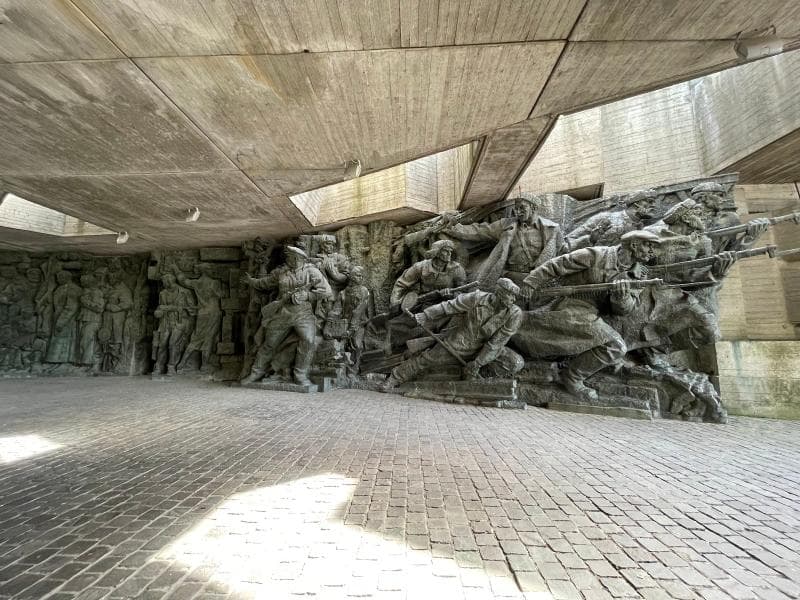
During its construction, architects even made precise adjustments to the statue's facial features, such as the nose, to achieve perfect proportions. The prototype for the powerful female figure was reportedly Ukrainian artist Nina Danyleiko. The broader memorial complex surrounding the statue is an engaging area featuring an eternal flame, an alley dedicated to hero cities, and outdoor displays of various military equipment, including tanks, planes, and helicopters, offering a tangible connection to the wartime history.
Visitor Perspective
A visit to the Motherland Monument offers an enriching experience that goes beyond simply viewing the colossal statue. The base of the monument serves as the entrance to the National Museum of the History of Ukraine in the Second World War, a comprehensive institution detailing Ukraine's involvement in the war. The museum provides insightful exhibitions, some of which touch upon the current conflict, making the visit profoundly relevant.
For those seeking breathtaking vistas, the monument features observation decks. A primary viewing platform, located at 36.6 meters inside the statue's shield, provides incredible panoramic views of Kyiv, the sprawling Dnieper River, and the city's left bank. There is also an 'Extreme' platform at 91 meters, though access might be more physically demanding and subject to age restrictions. Exploring the extensive grounds surrounding the statue reveals an open-air exhibition of military hardware, an impressive collection of tanks, artillery, and aircraft, allowing for a tangible connection with history.
Reaching the Motherland Monument is convenient, with public transportation readily available. Visitors can take the metro to Arsenalna station and then connect via trolleybus or bus directly to the memorial complex. Alternatively, a scenic 15-20 minute walk through the picturesque Park of Eternal Glory from Arsenalna station offers a pleasant approach. Adjacent to the monument, the historic Kyiv Pechersk Lavra and the Holodomor Museum provide further opportunities for historical and cultural exploration, making the area ideal for a full day's visit. While the outdoor areas are generally accessible, checking the museum's operating hours, typically closed on Mondays, is advisable for indoor exhibitions and observation deck access.
Coordinates: 30.563187, 50.426521
View on Google Maps💬 How Travelers Describe This Place
Based on community votes
Interesting
912Must See
875Unique
820Beautiful
718Photogenic
479
Traveler Stories
Discover memorable experiences shared by travelers who have visited this place.
No traveler stories yet.
Be the first traveler to share what made this place memorable.

Tour
By
Spot
Discover amazing places around the world. Your journey starts here.
Explore
© 2026 TourBySpot. All rights reserved.