Mosque Area
Tbilisi, Georgia
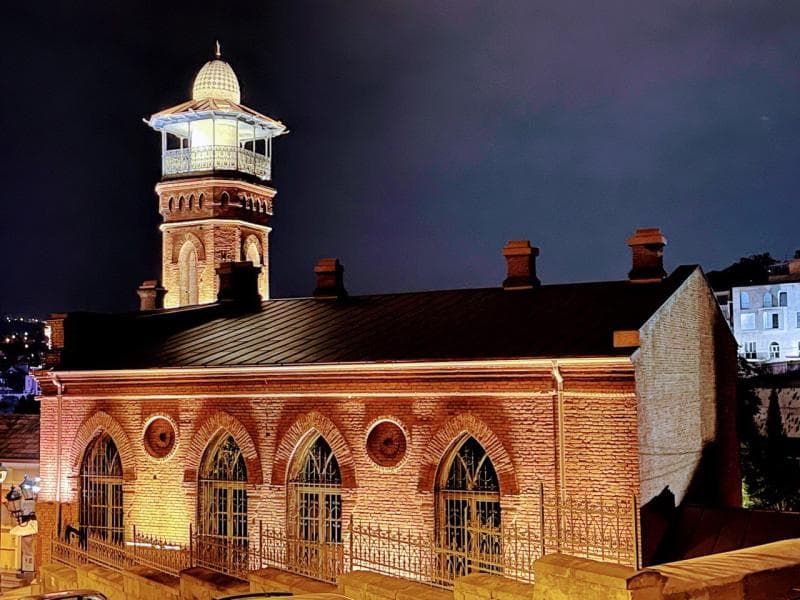
Explore Tbilisi's Juma Mosque in Abanotubani, Georgia – a unique historical site where Sunni and Shia Muslims pray together, showcasing religious harmony.
Overview
Nestled within the historic Abanotubani district of Tbilisi, Georgia, the Mosque Area centers around the venerable Juma Mosque. This distinctive red-brick edifice, often referred to as the Jumah Mosque or Tbilisi Central Mosque, stands as the sole surviving mosque in the city's old town and a poignant symbol of Tbilisi's enduring multicultural fabric. It is situated prominently on Botanical Street, at the foot of the majestic Narikala Fortress, and blends seamlessly into a landscape rich with sulfur baths, Orthodox churches, and other historical landmarks. The mosque is an active place of worship for Tbilisi's Muslim community, primarily Azerbaijanis, and serves as a vital spiritual and cultural hub in the Georgian capital.
History & Cultural Background
The presence of Muslim communities in Tbilisi dates back to the Arab conquest in the 7th century, establishing a long and complex history of Islamic influence in the region. The site where the Juma Mosque now stands has housed a place of worship for centuries. The original mosque was built by the Ottomans in the early 18th century, specifically between 1723 and 1735, near the hot thermal springs that define Abanotubani. This early structure was unfortunately destroyed by Persian forces in the 1740s during a period of shifting regional power.
The mosque was rebuilt between 1846 and 1851 by the Italian architect Giovanni Scudieri. However, the building we see today largely took its current form from a significant reconstruction effort in 1895, funded by the Azerbaijani philanthropist Zeynalabdin Taghiyev. Further restoration work was carried out in 1998. A pivotal moment in its history occurred in 1951 when the Soviet authorities demolished Tbilisi's other major mosque, the Shia Blue Mosque, to make way for a bridge. This event led to the Juma Mosque opening its doors to both Sunni and Shia worshippers, a practice that continues to this day and defines its unique cultural significance.
What Makes It Special
What truly sets the Juma Mosque apart is its remarkable role as a shared prayer space for both Sunni and Shia Muslims. This peaceful co-worship is a rare phenomenon in the Islamic world, where the two main branches often maintain separate mosques. Initially, a curtain physically separated the two communities during prayer, but this divider was removed in 1996, allowing them to pray side by side. This arrangement reflects both a pragmatic accommodation for a smaller community in a predominantly Christian country and a profound testament to religious coexistence.
Architecturally, the mosque is a captivating blend of styles. Its exterior, primarily constructed from red brick, features Neo-Gothic elements such as arched windows, alongside traditional Islamic design. The mosque is topped by a distinctive octagonal minaret that rises elegantly above the Abanotubani skyline. Inside, the prayer hall is adorned with colorful geometric and floral patterns, blue details, and Arabic calligraphy, creating a serene and spiritually rich atmosphere. The presence of two mihrabs, niches indicating the direction of Mecca, further symbolizes its connection to both Sunni and Shia traditions.
Stories, Fun Facts & Local Details
The story of the Juma Mosque is intrinsically linked to the broader narrative of Tbilisi's religious tolerance. Its existence in a district shared with Georgian Orthodox, Armenian, and Catholic churches, and even a synagogue, makes Abanotubani a compact demonstration of the city's long-standing multi-religious urban life. The practice of Sunni and Shia Muslims praying together, which began after the demolition of the Blue Mosque, is often cited as one of the most striking facts of religious life in Georgia, a genuine and unusual example of coexistence. The mosque is currently administered under the Mufti of Azerbaijan.
Visitors approaching the mosque will notice its striking red-brick facade and the slender octagonal minaret, which is easily visible when walking uphill from the sulfur baths towards the Botanical Garden. The interior, with its vibrant blue-green tile work and painted floral motifs, mirrors Persian influences, adding to its unique aesthetic. This blend of architectural styles and the story of shared worship make the Juma Mosque a compelling cultural landmark, embodying centuries of history and diverse influences.
Visitor Perspective
The Juma Mosque in Abanotubani welcomes respectful visitors outside of prayer times, offering an opportunity to experience its serene interior and absorb its rich cultural atmosphere. As with visiting any religious site, modest attire is recommended, covering shoulders and knees. While photography is generally allowed, it is always courteous to ask permission before photographing the interior or worshippers.
Visiting the Mosque Area is an integral part of exploring Abanotubani, allowing travelers to witness firsthand the historical and cultural diversity that defines Tbilisi. Its proximity to the famous sulfur baths, the Narikala Fortress, and the Leghvtakhevi waterfall means that it can be easily incorporated into a broader exploration of the Old Town. The experience is not just about observing architecture but about understanding a living tradition of faith and coexistence in the heart of Georgia's capital.
Coordinates: 44.81019, 41.687192
View on Google Maps💬 How Travelers Describe This Place
Based on community votes
Photogenic
926Must See
703Interesting
646Unique
380Beautiful
291
Traveler Stories
Discover memorable experiences shared by travelers who have visited this place.
No traveler stories yet.
Be the first traveler to share what made this place memorable.

Tour
By
Spot
Discover amazing places around the world. Your journey starts here.
Explore
© 2026 TourBySpot. All rights reserved.