Mosaic Details
Lviv, Ukraine
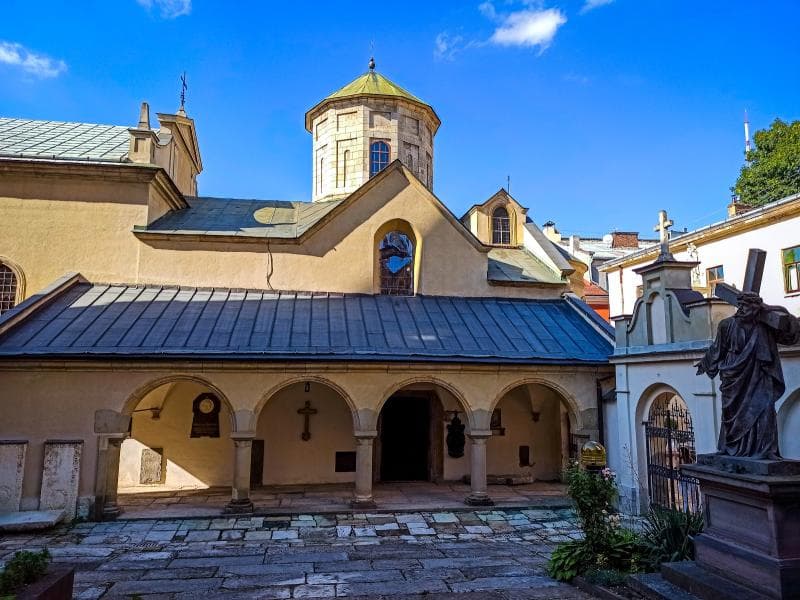
Discover the stunning 'Mosaic Details' within the Armenian Cathedral of Lviv, Ukraine. Explore early 20th-century Murano mosaics and vibrant artistry.
Overview
Within the venerable Armenian Cathedral of Lviv, nestled in the historic heart of Lviv, Ukraine, lies a captivating sub-spot known for its intricate 'Mosaic Details'. While the cathedral itself is a monumental testament to centuries of Armenian presence and architectural evolution, its mosaics, particularly those adorning the dome and other key areas, represent a distinct artistic chapter. These luminous artworks, brought to life primarily in the early 20th century, blend ancient traditions with contemporary artistic movements, offering a unique visual and spiritual experience to visitors. The mosaics contribute significantly to the cathedral's rich interior tapestry, standing alongside remarkable frescoes and centuries-old architectural elements.
The Armenian Cathedral, officially known as the Armenian Cathedral of the Assumption of Mary, is a UNESCO World Heritage site, reflecting its profound historical and cultural importance. Its 'Mosaic Details' are a crucial part of the extensive restoration efforts undertaken during the early 20th century, transforming its interior into the vibrant space seen today. These mosaics are not merely decorative; they embody a synthesis of Eastern liturgical art with European artistic influences, making them a focal point for understanding the cathedral's layered history and the resilience of the Armenian community in Lviv.
History & Cultural Background
The history of the Armenian Cathedral dates back to the 14th century, with construction beginning between 1363 and 1370, founded by an Armenian merchant from Caffa. Modeled on the Cathedral of Ani, the ancient Armenian capital, it served as a spiritual anchor for Lviv's flourishing Armenian community. Over centuries, the cathedral underwent numerous reconstructions and expansions, incorporating elements of Byzantine, Gothic, Romanesque, and later, Baroque styles.
The creation of the prominent 'Mosaic Details' largely falls within the extensive restoration period of 1908-1927. This era marked a significant revitalization of the cathedral's interior, steered by architects and artists who sought to enhance its sacred spaces. It was during this time that the Polish artist Józef Mehoffer was commissioned to create the Murano mosaics found in the dome and vault of the altar area. His work introduced a luminous quality, utilizing colored stones and enamel to depict sacred imagery. These mosaics complement the expressive wall paintings, or frescoes, by Jan Henryk Rosen, which were also executed in the 1920s in an Art Deco style, further enriching the cathedral's artistic narrative.
Culturally, the inclusion of such detailed mosaics reflects a conscious effort to imbue the cathedral with renewed spiritual and aesthetic grandeur following centuries of complex history for the Armenian community in Lviv, including periods of union with the Roman Catholic Church and later, the re-establishment of the Armenian Apostolic Church. The mosaics, therefore, are not just art; they are a visual representation of enduring faith and cultural identity.
What Makes It Special
What makes the 'Mosaic Details' of the Armenian Cathedral truly special is their exquisite artistry and their unique blend of influences. The Murano mosaics, particularly those adorning the dome, are a dazzling example of early 20th-century mosaic art, showcasing a rich palette of colored stones and enamel. The technique and materials used bring a vibrant luminosity to the sacred narratives depicted, drawing the eye upwards and creating a sense of awe.
Furthermore, the collaboration between Józef Mehoffer for the mosaics and Jan Henryk Rosen for the frescoes provides a fascinating artistic dialogue within the cathedral's interior. While Rosen's frescoes are known for their dramatic and mystical Art Nouveau style, Mehoffer's mosaics offer a contrasting yet harmonious visual texture, emphasizing grandeur and light. This interplay of different artistic expressions from a specific historical period (early 20th century) within a medieval structure creates a distinct and memorable aesthetic. The fact that these detailed mosaics were part of a comprehensive restoration makes them integral to the cathedral's modern identity while respecting its ancient roots.
Stories, Fun Facts & Local Details
One fascinating aspect of the cathedral's artistic renewal, particularly during the period when the mosaics and frescoes were created, is the blend of traditional iconography with innovative artistic approaches. Józef Mehoffer, a prominent figure in Polish Symbolism and Art Nouveau, brought a refined sensibility to the mosaic work, contributing to the broader artistic movement in Central Europe at the time. The choice of Murano glass for the mosaics also highlights a connection to high-quality European craftsmanship, linking Lviv to a wider artistic world.
A notable 'fun fact' related to the interior decorations, though more directly to Rosen's frescoes that are intertwined with the mosaic details, is that the artist is said to have used local personalities and celebrities as models for some of the figures in his murals. While specific individuals are rarely named, this detail adds a layer of human connection and local flavor to the sacred art, inviting visitors to ponder the faces they see. Although this primarily applies to Rosen's paintings, it underlines the local context of the art created within the cathedral during that period.
The comprehensive restoration project in the early 20th century, which saw the creation of these mosaics, was a significant undertaking, breathing new life into a historic sanctuary that had witnessed centuries of change and upheaval. The cathedral's ability to integrate these relatively modern artistic elements into its ancient fabric speaks to its enduring capacity for adaptation and renewal, mirroring the resilience of the Armenian community itself.
Visitor Perspective
For a curious traveler, the 'Mosaic Details' within the Armenian Cathedral of Lviv offer a profound sensory and intellectual experience. Upon entering, one is immediately struck by the interplay of light and color, particularly as it illuminates the dome mosaic. The intricate patterns and symbolic figures draw the eye upward, fostering a sense of reverence and wonder. It's a moment where history, art, and spirituality converge, creating a powerful atmosphere.
Taking the time to examine the details of the mosaics, one can appreciate the meticulous craftsmanship and the rich narrative they convey. Coupled with the surrounding frescoes and architectural elements, these mosaics complete a holistic artistic vision, providing insight into the Armenian Church's traditions and its unique cultural expression within Lviv. Observing these details allows for a deeper appreciation of the community's dedication to preserving and enriching its spiritual home, making the Armenian Cathedral a truly immersive destination. It is recommended to spend ample time looking upwards to fully absorb the golden hues and intricate designs that adorn the sacred space.
Coordinates: 24.03083, 49.84333
View on Google Maps💬 How Travelers Describe This Place
Based on community votes
Beautiful
674Photogenic
399Must See
356Unique
182Interesting
76
Traveler Stories
Discover memorable experiences shared by travelers who have visited this place.
No traveler stories yet.
Be the first traveler to share what made this place memorable.

Tour
By
Spot
Discover amazing places around the world. Your journey starts here.
Explore
© 2026 TourBySpot. All rights reserved.