Monument To The People’s Heroes
Beijing, China
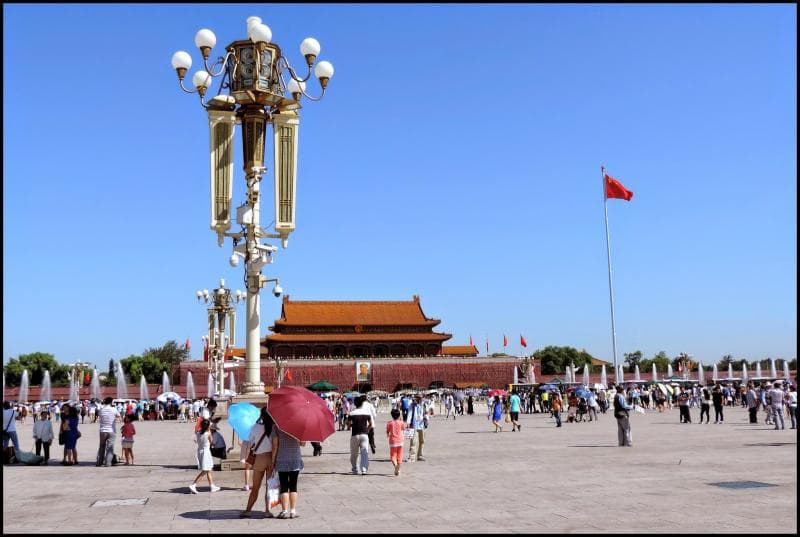
Explore the Monument to the People's Heroes in Beijing, China. Discover its history, powerful inscriptions, and detailed bas-reliefs commemorating revolutionary struggles.
Overview
At the heart of Beijing's expansive Tiananmen Square stands the Monument to the People’s Heroes, a towering obelisk that serves as a profound national symbol. Erected as a tribute to those who sacrificed their lives during China's revolutionary struggles throughout the 19th and 20th centuries, this monument commands attention with its impressive scale and intricate details. It is positioned on the central axis of Tiananmen Square, north of the Mausoleum of Mao Zedong, making it a focal point within this historically significant space. The Monument to the People's Heroes reaches a height of 37.94 meters, equivalent to a ten-story building, and its base covers an area of approximately 3,100 square meters. It is constructed from an estimated 17,000 pieces of granite and white marble, materials chosen for their symbolism of eternity and purity.
History & Cultural Background
The genesis of the Monument to the People's Heroes dates back to September 30, 1949, when the First Plenary Session of the Chinese People's Political Consultative Conference (CPPCC) unanimously resolved to erect a monument commemorating those who died in the People's Liberation War and the broader people's revolution. On that same day, a foundation-laying ceremony was held, with Mao Zedong personally reading the inscription for the monument. Construction officially commenced in August 1952 and concluded on April 22, 1958, with its unveiling on May 1st of the same year. The monument was a monumental undertaking, designed by prominent architects such as Liang Sicheng, with elements contributed by Lin Huiyin, and civil engineer Chen Zhide playing a crucial role. It represents the first large-scale national monument built in New China, dedicated to veterans of Chinese wars from 1839 to 1949, marking a period of significant struggle against both internal and external adversaries.
What Makes It Special
What truly sets the Monument to the People's Heroes apart are its powerful inscriptions and its narrative bas-reliefs. On the northern face of the main stele, facing Tiananmen Gate, are eight large Chinese characters written by Mao Zedong, which translate to 'Eternal glory to the people's heroes!' On the southern face, facing away from Tiananmen Gate and towards Mao's Mausoleum, is a longer epitaph drafted by Mao Zedong and inscribed by Premier Zhou Enlai. This detailed inscription eulogizes heroes who sacrificed their lives in the People's War of Liberation and the People's Revolution over different periods, extending back to 1840.
The monument's lower Xumi pedestal features eight immense marble bas-reliefs, arranged chronologically and read in a clockwise direction starting from the east. These captivating carvings depict pivotal revolutionary historical events. They include the 'Destruction of Opium at Humen' in 1839, the 'Jintian Uprising' of 1851 (catalyst for the Taiping Revolution), the 'Wuchang Uprising' of 1911 (leading to the Xinhai Revolution), the 'May Fourth Movement' of 1919, the 'May 30 Movement' of 1925, the 'Nanchang Uprising' of 1927, the 'War of Resistance Against Japan' (1937-1945), and the 'Crossing the Yangtze River Campaign' during the Chinese Civil War in 1949. These reliefs offer a visual chronicle of China's struggle for independence and liberation, making the monument a tangible link to the nation's revolutionary past.
Stories, Fun Facts & Local Details
The Monument to the People's Heroes is not merely a structure but a narrative in stone. The choice of materials, such as granite and white marble sourced from Qingdao and Fangshan, was deliberate, symbolizing the enduring spirit and purity of the heroes it honors. The monument's design incorporates traditional Chinese elements, including a four-sided sloped roof atop the stele and decorative patterns of red stars, pine, cypress trees, and flags, signifying tribute to life and peace. Surrounding the upper base are eight large wreaths carved with peonies, lotuses, and chrysanthemums, flowers that represent nobility and purity in Chinese culture. Since its designation as a Major Cultural Heritage Site under national-level protection in 1961, the monument has become a cherished national landmark. It has also served as a central gathering point for national remembrance and various activities throughout modern Chinese history.
Visitor Perspective
Visiting the Monument to the People's Heroes offers a profound experience for any traveler seeking to understand China's modern history. Standing before this magnificent obelisk, one can feel the weight of history and the collective memory it embodies. Many visitors come to pay their respects, often laying wreaths or simply observing the intricate bas-reliefs that tell the story of a nation's arduous journey. The monument is freely accessible during the operating hours of Tiananmen Square, typically from early morning until late evening, though it is always advisable to check current timings. For a more serene visit, consider coming during weekdays or outside of major national holidays, when the square can be exceptionally crowded. Allow at least 15-30 minutes to appreciate its scale, inscriptions, and the detailed artistry of the reliefs. It's a place for reflection, offering a quiet moment amidst the bustling energy of Beijing to connect with the revolutionary spirit that shaped modern China.
Coordinates: 116.39167, 39.90306
View on Google Maps💬 How Travelers Describe This Place
Based on community votes
Must See
886Beautiful
564Unique
201Interesting
121Photogenic
87
Traveler Stories
Discover memorable experiences shared by travelers who have visited this place.
No traveler stories yet.
Be the first traveler to share what made this place memorable.

Tour
By
Spot
Discover amazing places around the world. Your journey starts here.
Explore
© 2026 TourBySpot. All rights reserved.