Monastery Complex
Tbilisi, Georgia
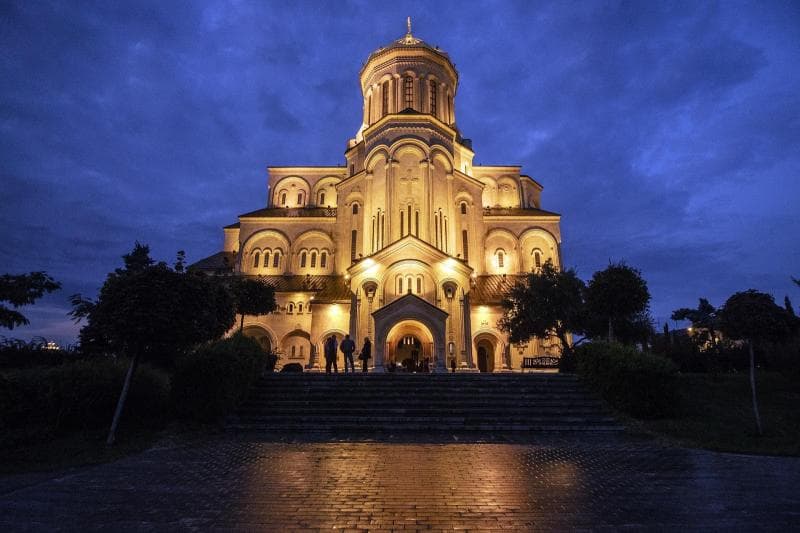
Explore the Monastery Complex at Holy Trinity Cathedral, Tbilisi, Georgia. Discover its spiritual significance, stunning architecture, and role in Georgian Orthodox tradition.
Overview
Nestled atop Elia Hill in Tbilisi's historic Avlabari district, the Holy Trinity Cathedral, locally known as Sameba, stands as a profound symbol of Georgia's spiritual renewal. More than just the main cathedral of the Georgian Orthodox Church, Sameba is a sprawling complex encompassing various ecclesiastical structures, including a significant Monastery Complex. This grand site serves not only as a place of worship but also as a vibrant center for theological education and monastic life, reflecting the enduring faith and cultural identity of the Georgian people. Its golden dome is a prominent feature on the city's skyline, visible from many vantage points across Tbilisi, signifying its monumental presence.
History & Cultural Background
The vision for the Holy Trinity Cathedral emerged in 1989, during a period of national awakening for Georgia as it moved towards independence from the Soviet Union. The project was conceived to commemorate two pivotal anniversaries: 1,500 years of the autocephaly (self-governance) of the Georgian Orthodox Church and 2,000 years since the birth of Jesus Christ. Construction began in 1995 amidst a challenging post-Soviet era of civil unrest and economic hardship, highlighting the immense symbolic weight Georgians placed on its creation as a 'symbol of the Georgian national and spiritual revival.' Designed by architect Archil Mindiashvili, the cathedral was largely funded by anonymous donations from citizens and businessmen, underscoring a collective national effort. It was finally consecrated on November 23, 2004, on St. George's Day, a significant religious holiday in Georgia.
What Makes It Special
The entire Sameba complex, including its Monastery Complex, is a testament to Georgian architectural ambition and spiritual dedication. The cathedral itself is one of the largest Orthodox churches in the world, combining traditional Georgian church architecture with Byzantine influences, resulting in a design that is both historically resonant and awe-inspiring in its scale. The Monastery Complex, integrated within these extensive grounds, is not merely a historical remnant but an active component of the Georgian Orthodox Church's spiritual and educational mission. It comprises monastic living quarters, a theological seminary, and an academy dedicated to training future clergy and scholars. This makes the site a living institution where ancient traditions of Orthodox faith, scholarship, and liturgical practice are preserved and passed down. The cathedral also houses nine chapels, five of which are located underground, creating a multifaceted spiritual space. The presence of a separate bell tower, the Patriarch's residence, and various ecclesiastical offices further solidifies the complex's role as the central hub of Georgian Orthodoxy.
Stories, Fun Facts & Local Details
The construction of the Holy Trinity Cathedral complex is rich with fascinating details. Its foundation, for instance, is said to contain soil from Jerusalem, rocks from Mount Zion and the Jordan River, and a piece of the tomb of St. George, symbolically grounding the new cathedral in millennia of Christian history. The impressive bell tower houses nine bells, all cast in Germany, with the largest weighing a remarkable 8,000 kilograms. Inside the main cathedral, visitors are greeted by a vast interior adorned with frescoes, mosaics, and a gilded iconostasis, with natural light filtering through the massive dome. The complex is also known for its association with the Trinity Cathedral Choir, tasked by the Georgian Patriarch with safeguarding and promoting Georgia's unique polyphonic singing tradition, an art form deeply interwoven with both religious and secular culture. While the monastery component mainly focuses on scholarly and spiritual life, its very presence ensures the continuity of sacred practices and the development of future generations of Georgian Orthodox spiritual leaders.
Visitor Perspective
Visiting the Holy Trinity Cathedral complex offers a unique opportunity to immerse oneself in Georgia's vibrant spiritual heritage. As an active place of worship, the complex provides a chance to observe Orthodox services and experience the profound spiritual ambiance. While there is no specific 'tour' of the monastic living areas, their integration within the larger complex allows visitors to feel the pulse of a living religious community dedicated to prayer and study. The extensive grounds, complete with landscaped gardens, offer serene spaces for contemplation and provide stunning panoramic views of Tbilisi. Entry to the complex is free, making it accessible to all. Visitors are encouraged to dress modestly, covering shoulders and knees, and women may consider a head covering out of respect for local customs. Whether exploring the majestic main cathedral, wandering through the gardens, or simply taking in the views, the Monastery Complex at Sameba underscores the cathedral's role not just as a landmark, but as a thriving spiritual and educational heart of Georgia.
Coordinates: 44.8167, 41.6918
View on Google Maps💬 How Travelers Describe This Place
Based on community votes
Interesting
556Must See
394Beautiful
269Photogenic
254Unique
145
Traveler Stories
Discover memorable experiences shared by travelers who have visited this place.
No traveler stories yet.
Be the first traveler to share what made this place memorable.

Tour
By
Spot
Discover amazing places around the world. Your journey starts here.
Explore
© 2026 TourBySpot. All rights reserved.