Millennium Monument
Budapest, Hungary
Explore Budapest's Millennium Monument at Heroes' Square, a UNESCO World Heritage site. Discover Hungary's 1000-year history, iconic statues, and cultural significance in Budapest, Hungary.
Overview
At the heart of Budapest's expansive Heroes' Square (Hősök tere) stands the majestic Millennium Monument, a profound symbol of Hungarian national identity and a testament to a thousand years of history. This iconic sub-spot within the larger public square serves as a focal point for visitors, captivating with its grandeur and intricate details. It commemorates the momentous 1,000th anniversary of the Magyar conquest of the Carpathian Basin, which led to the founding of the Hungarian state. Positioned prominently at the end of the historic Andrássy Avenue, and bordering the tranquil City Park, the monument draws the eye with its towering central column and sweeping colonnades, inviting contemplation on Hungary's rich past.
History & Cultural Background
The genesis of the Millennium Monument dates back to 1896 when it was commissioned as a centerpiece for Hungary's Millennium celebrations. While construction began that year, the ambitious project wasn't fully completed until 1929, though it was officially inaugurated in 1906. Designed by architect Albert Schickedanz, with sculptures crafted primarily by György Zala, the monument is a grand historical narrative cast in stone and bronze. Its purpose was to honor the foundational figures and pivotal moments in Hungarian history, marking a millennium since the Magyar tribes, led by Prince Árpád, settled the region around 895 AD. The monument also reflects the shifting political landscape of Hungary; initially, spaces were reserved for figures from the ruling Habsburg dynasty. However, after the Second World War, these were replaced by other prominent Hungarian national heroes, underscoring a period of national redefinition.
What Makes It Special
The Millennium Monument is a remarkable architectural and sculptural ensemble that stands out for its symbolic depth. Its most striking feature is the 36-meter-tall central Corinthian column, surmounted by a statue of the Archangel Gabriel. Gabriel is depicted holding the Hungarian Holy Crown and a double cross, symbolizing Hungary's Christian heritage and the legend of the Archangel appearing to Saint Stephen, offering him the crown. At the base of this towering column are seven equestrian statues, powerful bronze representations of the legendary Magyar chieftains, including Prince Árpád, who led their people into the Carpathian Basin.
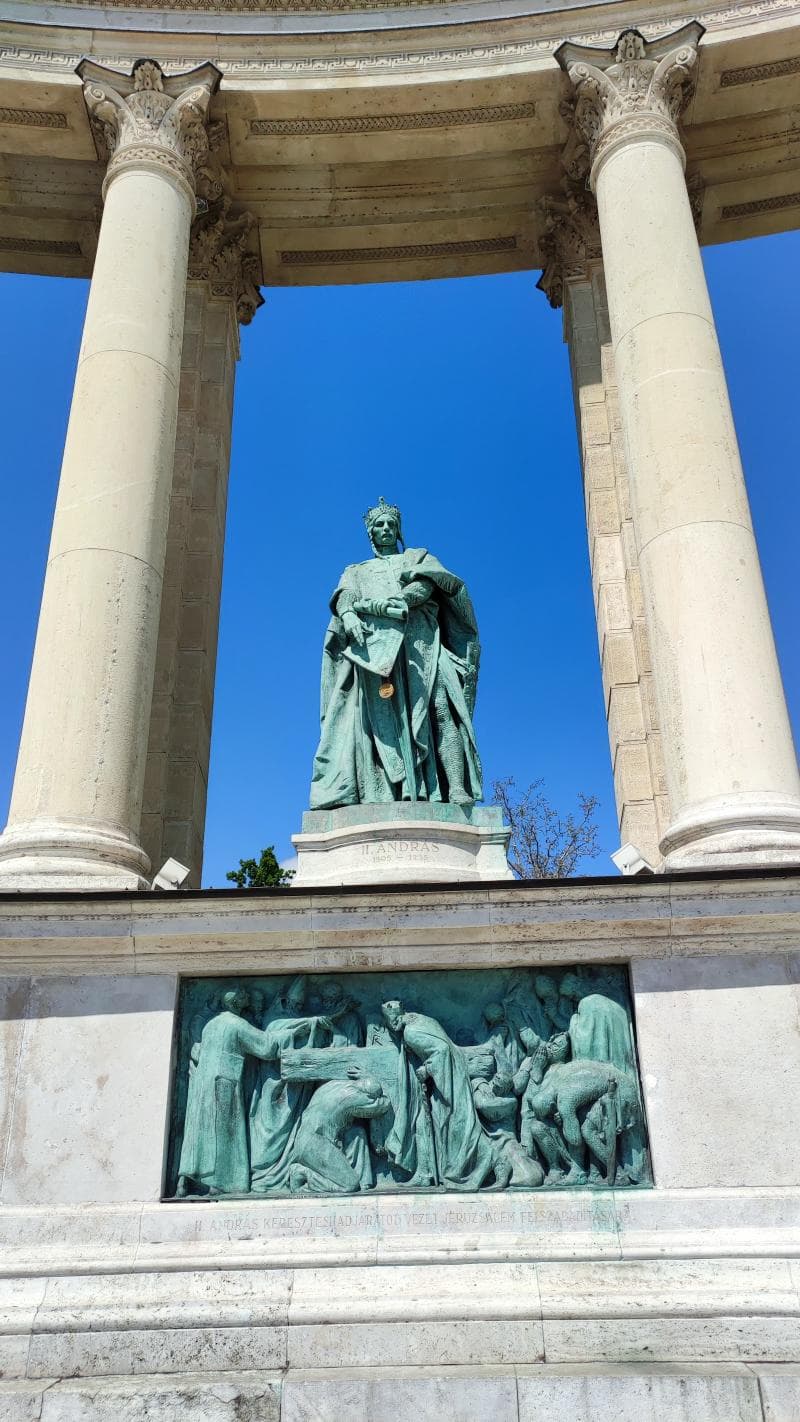
Flanking the central column are two elegant semi-circular colonnades. These host an impressive collection of statues depicting 14 of Hungary's most significant historical figures, ranging from its first king, Saint Stephen I, to the revolutionary leader Lajos Kossuth. Below each statue, intricate relief panels illustrate key historical scenes related to the respective figure, creating a visual timeline of the nation's past. The entire Heroes' Square, encompassing the Millennium Monument and its surroundings, earned its place on the UNESCO World Heritage List in 2002, alongside the prestigious Andrássy Avenue, recognizing its outstanding universal value.
Stories, Fun Facts & Local Details
Beyond its monumental appearance, the Millennium Monument holds several fascinating stories and local connections. A source of national pride, the Archangel Gabriel's Column actually won the grand prize at the 1900 World Exhibition in Paris, a significant international recognition at the time. Interestingly, the square itself only officially received its widely recognized name, 'Heroes' Square' (Hősök tere), in 1932, a few years after the monument's full completion.
Beneath the square lies an artesian well, a practical and intriguing feature that supplies hot water to the famed Széchenyi thermal baths located nearby in City Park. The monument has also been a witness to modern Hungarian history, notably serving as the site for the emotionally charged reburial ceremony of Imre Nagy, the leader of the 1956 Hungarian Revolution, in 1989. This event marked a crucial turning point in Hungary's journey toward freedom.
Another detail often misunderstood is the Memorial Stone of Heroes, located in front of the central column. While sometimes mistakenly referred to as the 'Tomb of the Unknown Soldier,' it is actually a cenotaph, an 'empty tomb,' dedicated to the memory of those who sacrificed their lives for Hungary's freedom and independence, with no human remains interred beneath it.
Visitor Perspective
Visiting the Millennium Monument offers a deeply immersive experience into Hungary's soul. As you step into Heroes' Square, the sheer scale of the monument is immediately impressive. It's a place where history feels tangible, and you can spend considerable time admiring the detailed sculptures, reliefs, and the powerful symbolism embedded in every aspect of its design. It's not merely a static display; the square is a vibrant public space, a popular meeting point, and a fantastic spot for photography, especially with its impressive backdrop.
The monument's accessibility is excellent, with the Hősök tere metro station (on the M1 yellow line) conveniently opening directly onto the square. This makes it easy to reach from anywhere in Budapest. Beyond the monument itself, visitors can explore the surrounding cultural institutions, including the Museum of Fine Arts and the Műcsarnok (Art Hall), which flank the square, offering further artistic and historical enrichment. The proximity to City Park also provides opportunities for leisurely strolls, making the Millennium Monument a central highlight of any Budapest itinerary, blending historical gravitas with contemporary urban life.
Coordinates: 19.07777777777778, 47.515
View on Google Maps💬 How Travelers Describe This Place
Based on community votes
Unique
872Beautiful
846Interesting
684Photogenic
363Must See
87
Traveler Stories
Discover memorable experiences shared by travelers who have visited this place.
No traveler stories yet.
Be the first traveler to share what made this place memorable.

Tour
By
Spot
Discover amazing places around the world. Your journey starts here.
Explore
© 2026 TourBySpot. All rights reserved.