Military Museum
Belgrade, Serbia
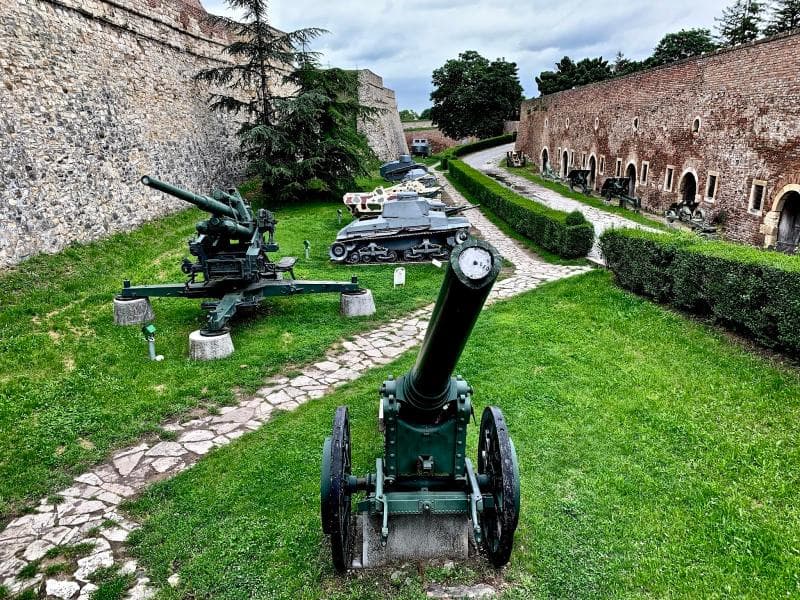
Explore the Military Museum in Belgrade, Serbia, located within the historic Belgrade Fortress. Discover Serbia's rich military history from ancient times to the present through vast collections of weapons, uniforms, and outdoor artillery displays.
Overview
The Military Museum in Belgrade, Serbia, stands as a prominent landmark within the historic Belgrade Fortress, nestled in the expansive Kalemegdan Park. Established in 1878, shortly after Serbia re-gained its independence, this institution offers a profound journey through the nation's military heritage. Its comprehensive collection, comprising over 30,000 to 33,000 artifacts across 12 to 15 distinct collections, traces a timeline from ancient settlements in the Balkans to the conflicts of the late 20th century.
Visitors can explore a diverse array of exhibits, including antique weapons, historical uniforms, significant flags, military decorations, and a remarkable outdoor display featuring numerous armored vehicles and artillery pieces. The museum's strategic location within the fortress underscores its intrinsic connection to Belgrade's long history as a contested strategic point, making it an essential stop for anyone seeking to understand the region's martial past.
History & Cultural Background
The Military Museum's origins are deeply intertwined with Serbia's fight for sovereignty. It was formally founded on August 22, 1878, by decree of Prince Milan Obrenović IV, following a proposal by Minister of Army Colonel Sava Grujić, marking the nation's declaration of independence.
Its first exhibition opened in 1904, coinciding with the centenary celebrations of the First Serbian Uprising and the coronation ceremonies of King Peter I Karađorđević. This initial display was housed in a modest Ottoman-era building situated near the Roman Well within the Belgrade Fortress.
The museum faced significant challenges, suffering destruction and considerable damage to its collections during World War I. Despite these setbacks, it reopened its doors in 1937 in new premises within the fortress. The current iconic building, originally constructed between 1924 and 1928 for the Military Geographical Institute by Russian architect Vasiliev, became the museum's home in 1959. This relocation and adaptation, overseen by architect Đuka Kavurić, provided a larger, more suitable space for its expanding collections.
Throughout its history, the museum has continuously adapted, enriching its holdings with artifacts from various conflicts, including the tumultuous events of World War II and the Balkan wars of the 1990s. A new permanent exhibition inaugurated in 1961 by Josip Broz Tito chronicled the military history of Yugoslav peoples from their early settlement in the Balkans to the 20th century, a display largely preserved to this day.
What Makes It Special
The Military Museum distinguishes itself as one of the oldest and most extensive military history museums in Southeastern Europe. Its chronological presentation offers an unparalleled narrative of Serbian and Yugoslav military evolution, from ancient times to modern warfare.
A particularly captivating feature is the museum's sprawling outdoor exhibition, where visitors encounter an impressive array of tanks, howitzers, and armored vehicles. These include pieces of German, Russian, and American origin, testament to the region's complex military engagements. Notable among these are unique exhibits such as parts of a US F-117 stealth aircraft downed during the 1999 NATO aggression and a captured NATO Humvee, which provide a tangible link to recent history.
Inside, the museum houses diverse collections that include Roman swords and helmets, Greek daggers, heavy medieval Serbian knight's armor, and a rich assortment of Ottoman-era weapons and uniforms. The exhibits also cover the Balkan Wars, World War I, and World War II, with a significant focus on the Yugoslav partisan struggle and even personal belongings of Marshal Tito.
Beyond weaponry and uniforms, the museum boasts an invaluable collection of artworks by prominent Serbian painters like Paja Jovanović and Uroš Predić, alongside a rare cartographic collection featuring 17th to 19th-century maps.
Stories, Fun Facts & Local Details
The very foundation of the Military Museum holds a special symbolic significance for Serbia, having been established on the same day the nation's independence from the Ottoman Empire was proclaimed. This highlights its role not just as a repository of military artifacts, but as a chronicler of national identity and struggle.
An interesting historical note is the museum's participation in the Balkan Exhibition in London in 1907. With approximately a hundred carefully selected historical items, the museum captivated the London public and garnered attention in the local press, showcasing Serbia's rich cultural and military heritage on an international stage shortly after its inception.
For many local visitors and families, the outdoor display of tanks and cannons around the museum building is a cherished memory, often serving as a backdrop for childhood photographs. These imposing machines are not merely static displays but powerful reminders of past conflicts and technological advancements.
The museum's presentation of the 1999 NATO aggression from a Serbian perspective, including the display of remnants of the F-117 stealth aircraft, provides a unique and often thought-provoking insight into a pivotal modern event. Furthermore, its extensive photo archive, containing over 100,000 photographs and negatives dating back to the 1840s, offers an extraordinary visual record of wars, personalities, and everyday life through military lenses.
Visitor Perspective
Strategically positioned in the heart of Belgrade Fortress, the Military Museum is easily accessible to travelers. It operates Tuesday through Sunday, from 10:00 to 17:00, with the last tickets sold an hour before closing. Mondays are typically non-working days for the permanent exhibition.
Admission fees are structured, with adult tickets costing 350 RSD, and reduced rates for groups, students, pupils, and families. For a more in-depth experience, professional guided tours in English are available for 5000 RSD. While the outdoor exhibits are generally well-documented, some visitors note that English translations for certain indoor displays can be limited, making a guided tour a valuable option for non-Serbian speakers.
Most visitors recommend allocating two to three hours to explore the museum thoroughly, including both its indoor galleries and the impressive outdoor collection. The museum is well-connected by public transport, with tram lines (2 and 11) stopping near Kalemegdan Park and trolleybuses (28, 29, 41) serving Students' Square, making it a convenient destination for a day of historical immersion.
Coordinates: 20.45, 44.8219
View on Google Maps💬 How Travelers Describe This Place
Based on community votes
Must See
826Photogenic
494Beautiful
242Interesting
125Unique
82
Traveler Stories
Discover memorable experiences shared by travelers who have visited this place.
No traveler stories yet.
Be the first traveler to share what made this place memorable.

Tour
By
Spot
Discover amazing places around the world. Your journey starts here.
Explore
© 2026 TourBySpot. All rights reserved.