Memorial Engravings
Chisinau, Moldova
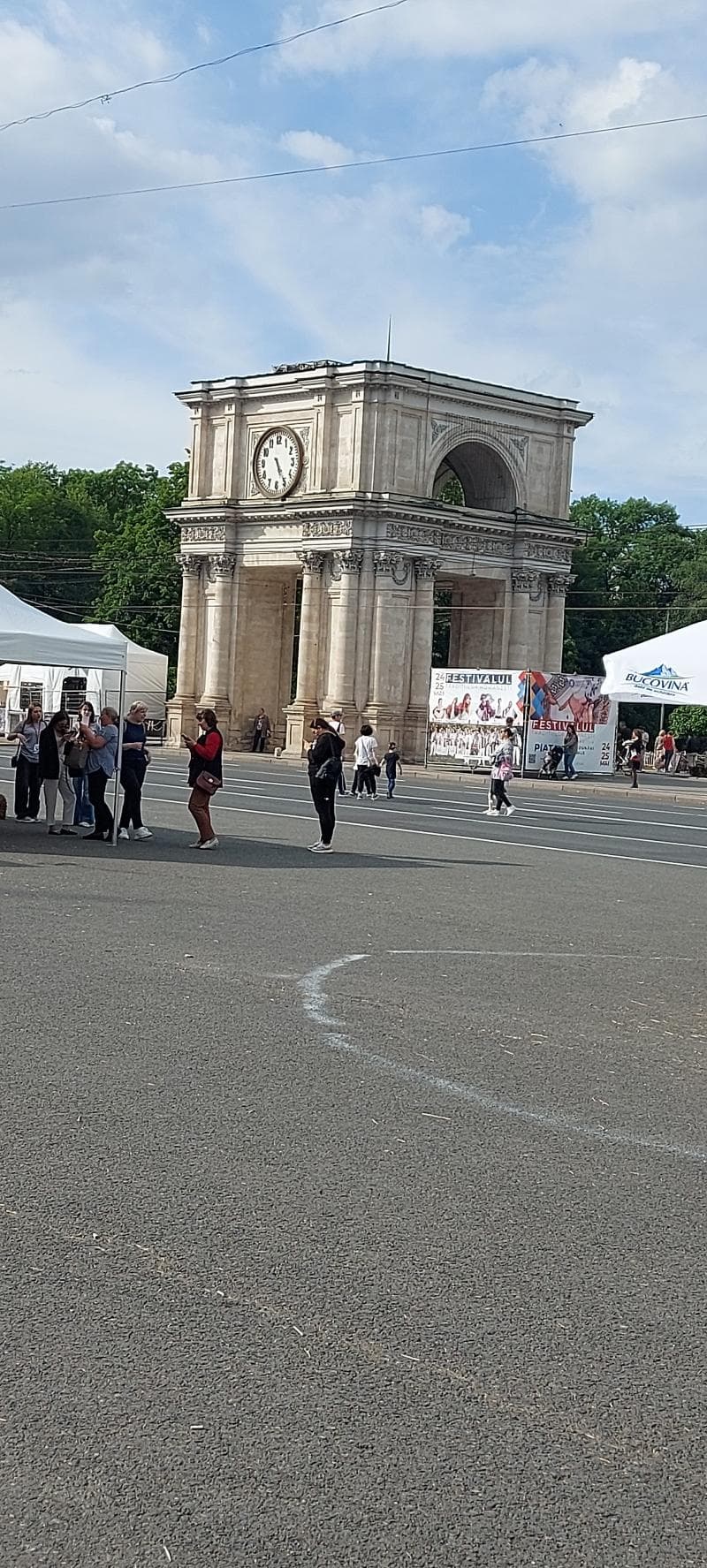
Discover the Triumphal Arch in Chisinau, Moldova, and its historic memorial engravings reflecting centuries of victory and changing national identity.
Overview
Standing proudly in the heart of Chișinău, Moldova, the Triumphal Arch, also known as the 'Holy Gates' or 'Arch of Victory', is far more than just a grand structure. It serves as a profound historical marker, reflecting the city's complex past and the shifting tides of its cultural identity. While its primary purpose was to commemorate a military triumph, it also holds within its stone edifice a lesser-known, yet equally significant, sub-spot: the site of its memorial engravings. These inscriptions, though largely removed today, tell a compelling story of remembrance, political change, and national evolution. Located adjacent to the Nativity Cathedral and bordering Cathedral Park, this neoclassical monument is a central focal point for locals and a captivating starting point for any curious traveler seeking to understand Moldova's layered heritage.
History & Cultural Background
The Triumphal Arch was constructed between 1840 and 1841 by architect Luka Zaușchevici (also known as I. Zaukevich or Ivan Zaushkevich). Its original intent was to commemorate the victory of the Russian Empire over the Ottoman Empire during the Russo-Turkish War of 1806–1812 or 1828–1829. An intriguing facet of its history is its 'accidental' genesis: it was initially built to house a massive 6.4-ton church bell, cast from captured Turkish cannons. This bell was intended for the nearby Nativity Cathedral but proved too large for the cathedral's belfry, prompting the construction of the Arch as its grand enclosure.
Throughout its existence, the Arch has undergone several transformations, mirroring Moldova's own turbulent history. During the Soviet era, specifically after 1945, the inner sides of the Arch's pylons became canvases for what are now known as the 'Memorial Engravings'. These were marble plaques displaying decrees from the Presidium of the Supreme Soviet of the USSR, featuring texts in both Russian and Moldavian. They detailed what were considered 'heroic deeds' from battles on Moldovan territory during the Great Patriotic War (World War II) and honored Soviet Army soldiers by listing the names of those who received the 'Hero of the Soviet Union' title.
However, with Moldova's declaration of independence, these prominent Soviet-era inscriptions were removed in 1991, signifying a break from its Soviet past and a reassertion of national identity. This act of removal itself became a historical moment, reflecting the nation's effort to redefine its narrative.
What Makes It Special
What truly distinguishes the Triumphal Arch and its former memorial engravings is their embodiment of historical palimpsest – a document where the original text has been effaced or scraped off to make room for later writing, but traces of which remain. The Arch, initially a symbol of imperial victory and later a repository for a disproportionately large bell, then became a testament to Soviet valor. The existence, and subsequent disappearance, of these Soviet-era plaques make the Arch a unique monument where history itself was literally carved, then uncarved, from its stone.
Architecturally, the 13-meter tall Arch is a fine example of neoclassical design, featuring four sturdy pylons adorned with Corinthian columns and an upper tier that includes a historic mechanical clock. The clock, which has its own fascinating history of repairs and replacements since its first installation in 1842, continues to mark time, a silent observer of all the changes the monument has witnessed.
Stories, Fun Facts & Local Details
One of the most charming anecdotes surrounding the Triumphal Arch is its very reason for existing: a bell too big for its belfry. The enormous 6.4-ton bell, forged from captured Turkish cannons, was meant for the Nativity Cathedral. When it arrived, its sheer size presented a monumental problem, leading to the decision to construct a dedicated Arch to house it. This unexpected turn of events gave Chișinău one of its most iconic landmarks.
The Arch has worn several names throughout its history – 'Arch of Triumph', 'Arch of Victory' during the Soviet period, and commonly 'Holy Gates' due to its alignment with the Cathedral and Bell Tower. This multiplicity of names underscores its evolving meaning to the people of Chișinău. The changing memorial engravings are another powerful 'story' etched into the Arch's identity, a direct physical representation of a nation reshaping its memory. While the grand Soviet-era narratives are gone, their former presence speaks volumes about the historical layers of the city. Today, only a small plaque remains, commemorating the Arch's construction and its 1973 restoration.
Visitor Perspective
As you approach the Triumphal Arch today, a direct encounter with the 'Memorial Engravings' as they once were is not possible. The grand Soviet-era marble plaques have been removed. Instead, you'll find a small, more unassuming memorial plate, which quietly acknowledges the Arch's creation by architect I. Zaushkevich and a restoration in 1973. This absence, however, is a powerful presence in itself. It invites contemplation on how history is remembered, revised, and re-presented. The very act of these inscriptions being removed adds another layer to the Arch's rich narrative, making it a dynamic monument rather than a static one.
Standing beneath its neoclassical arches, observing the enduring clock above, you can appreciate the architectural beauty and its central role in the city's urban fabric. Though the specific 'memorial engravings' of the Soviet period are no longer physically manifest, the story of their existence and removal is an integral part of understanding this landmark. It encourages a deeper reflection on national identity and the way societies choose to honor and contextualize their past. The Arch remains a symbol of Chișinău's resilience and its ongoing dialogue with its own history.
Coordinates: 28.8325, 47.02472
View on Google Maps💬 How Travelers Describe This Place
Based on community votes
Must See
545Unique
211Photogenic
123Interesting
74Beautiful
20
Traveler Stories
Discover memorable experiences shared by travelers who have visited this place.
No traveler stories yet.
Be the first traveler to share what made this place memorable.

Tour
By
Spot
Discover amazing places around the world. Your journey starts here.
Explore
© 2026 TourBySpot. All rights reserved.