Mass Grave Sites
Phnom Penh, Cambodia
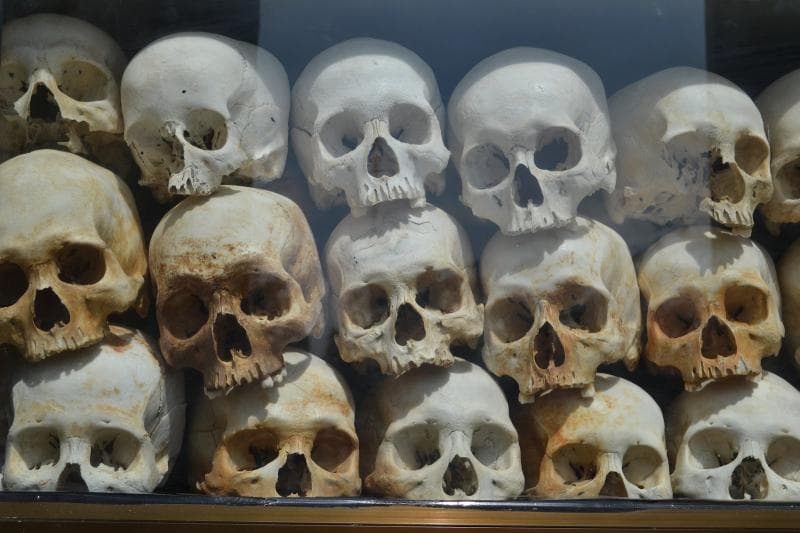
Explore the Mass Grave Sites at Choeung Ek Genocidal Center in Phnom Penh, Cambodia, a powerful memorial to Khmer Rouge victims.
Overview
The Mass Grave Sites at Choeung Ek Genocidal Center, located approximately 17 kilometers south of Phnom Penh, Cambodia, stand as a profoundly somber memorial to the victims of the Khmer Rouge regime. This former orchard became one of the most infamous 'Killing Fields' during the brutal period of Pol Pot's rule between 1975 and 1979. It is estimated that upwards of 17,000 men, women, and children were brutally executed and buried in mass graves here. Many of these victims were prisoners transported from the notorious S-21 prison, also known as Tuol Sleng Genocide Museum, in central Phnom Penh. Today, the site is preserved as a memorial, with a towering Buddhist stupa at its heart, housing thousands of exhumed skulls and other human remains, serving as a poignant reminder of the atrocities committed.
History & Cultural Background
Between 1975 and 1979, Cambodia endured the devastating reign of the Khmer Rouge, led by Pol Pot, who sought to transform the country into an agrarian socialist society. This radical ideology led to a campaign of mass genocide against anyone perceived as an enemy of the regime, including intellectuals, professionals, ethnic minorities, and those with foreign connections. Cities were emptied, money was abolished, and millions were forced into labor camps. Choeung Ek emerged as a primary execution site between 1977 and 1979. Prisoners, often after enduring torture at S-21, were brought here, typically under the cover of night, to be murdered and interred in unmarked graves. The discovery of Choeung Ek and similar sites across Cambodia after the fall of the Khmer Rouge in 1979 revealed the horrifying scale of the genocide to the world.
What Makes It Special
The Mass Grave Sites at Choeung Ek are unique in their raw and unvarnished presentation of history. The site comprises numerous depressions in the earth that mark the original mass graves, some of which remain untouched out of respect for the victims. Visitors can still observe fragments of bone, teeth, and cloth surfacing from the ground, particularly during the rainy season, a stark and immediate connection to the past. A particularly haunting feature is the 'Killing Tree,' where children and infants were tragically beaten to death to prevent them from growing up and seeking revenge for their parents' deaths. The central Memorial Stupa, a glass tower filled with over 5,000 human skulls arranged by age and gender, provides a powerful and overwhelming visual testament to the immense loss of life.
Stories, Fun Facts & Local Details
The methods of execution at Choeung Ek were chosen for their cost-effectiveness; bullets were deemed too expensive, so victims were often killed with blunt instruments like pickaxes, hoes, and shovels. Loudspeakers were hung from trees, blaring revolutionary Khmer Rouge music to drown out the screams of the dying. The name 'Choeung Ek' itself is said to mean 'to pour out' or 'to overflow,' potentially referring to a once-flourishing natural landscape, now ironically associated with immense human suffering. Annually, on May 9th, a memorial ceremony is held at the stupa, where survivors and their families, officials, and Cambodians gather to pay their respects. Visitors often leave flowers, light incense, or place bracelets on memorials as gestures of remembrance. The term 'Killing Fields' was popularized by Cambodian journalist Dith Pran, who survived the regime and later used the phrase to describe the mass execution sites.
Visitor Perspective
Visiting the Mass Grave Sites at Choeung Ek is an incredibly moving and often emotionally challenging experience. It is not a typical tourist attraction but a place for solemn reflection and remembrance. The site is designed to educate visitors about the brutal history of the Cambodian genocide and the resilience of its people. An audio guide, included with admission, is highly recommended as it provides detailed historical context, personal testimonies, and accounts from former Khmer Rouge workers, guiding visitors through the various points of interest and intensifying the experience. Visitors are encouraged to maintain a respectful demeanor, dress appropriately, and observe silence, treating the site as a sacred graveyard. While profoundly disturbing, many describe the visit as life-changing, offering an essential understanding of Cambodia's recent past and a powerful reminder of the importance of peace and human dignity.
Coordinates: 104.9012, 11.484
View on Google Maps💬 How Travelers Describe This Place
Based on community votes
Must See
710Unique
102Interesting
102Photogenic
95Beautiful
87
Traveler Stories
Discover memorable experiences shared by travelers who have visited this place.
No traveler stories yet.
Be the first traveler to share what made this place memorable.

Tour
By
Spot
Discover amazing places around the world. Your journey starts here.
Explore
© 2026 TourBySpot. All rights reserved.