Marble Staircase
Bucharest, Romania
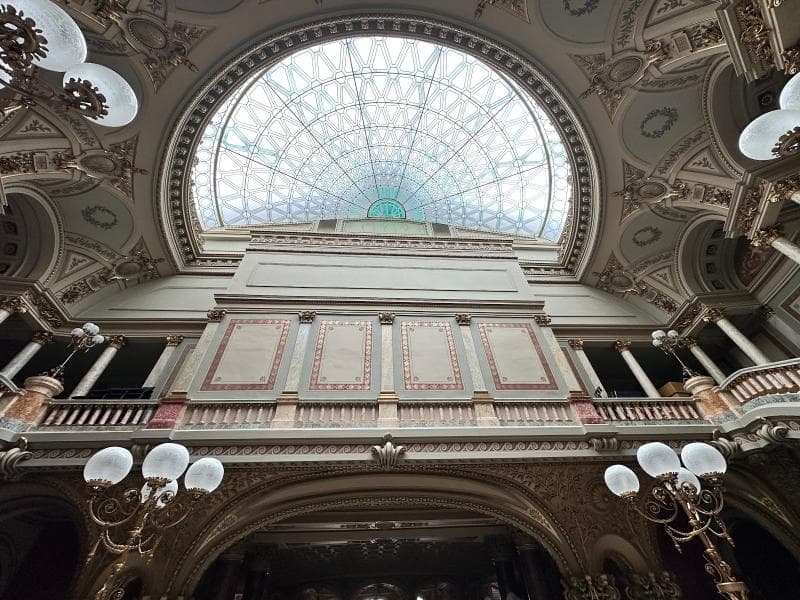
Explore the elegant Marble Staircase inside the Romanian Athenaeum in Bucharest, Romania. Discover its history, unique design, and cultural significance.
Overview
The Romanian Athenaeum, an iconic architectural masterpiece in Bucharest, Romania, is more than just a concert hall; it is a profound symbol of the nation's cultural identity. Within its grand embrace lies a sub-spot of exquisite beauty and historical significance: the Marble Staircase. Nestled within the circular foyer, often referred to as the Rotunda, this ceremonial ascent forms a breathtaking introduction to the main auditorium. It is a key element of the Athenaeum's opulent interior, a testament to neoclassical design intertwined with French Belle Époque elegance. Visitors often find themselves pausing here, captivated by its graceful curves and the stories it silently tells, before ascending to experience the world-renowned acoustics of the concert hall.
History & Cultural Background
The story of the Marble Staircase is intrinsically linked to the very foundation of the Romanian Athenaeum itself. Conceived by the Romanian Athenaeum Cultural Society in 1865, the building's construction commenced in 1886 and was inaugurated in 1888, though work continued for nearly another decade. The project was largely a national endeavor, financed almost entirely by public donations through an impassioned campaign famously sloganed, 'Donate one leu for the Athenaeum!' French architect Albert Galleron, who also designed the National Bank of Romania, was entrusted with its design. He ingeniously adapted his plans to circular foundations originally laid for a riding school, which dictated the building's distinctive rounded form. This constraint led to a unique architectural solution where the foyer, housing the Marble Staircase, is situated directly beneath the main concert hall, creating a memorable transition for all who enter.
What Makes It Special
The Marble Staircase is not merely a functional element; it is a work of art and an integral part of the Athenaeum's grandeur. Comprising four distinct flights crafted from exquisite Carrara marble, these stairs were designed by the notable sculptor Carol Storck. Storck's contribution extends beyond mere ornamentation; the staircases are designed to choreograph the movement of the audience, transforming the journey from the ground floor foyer to the upper concert hall into a 'small performance in its own right'. This ceremonial ascent is set within the Athenaeum's central rotunda, where twelve impressive Doric columns, clad in a striking pink stucco that mimics marble, frame the space. The entire foyer, including elements finished with high-quality artificial marble by Italian craftsmen Pietro and Giovanni Axerio, contributes to a distinctive palette of colors and textures that make the interior truly unique.
Stories, Fun Facts & Local Details
One fascinating aspect of the Athenaeum's design, and by extension, its Marble Staircase, is born from a historical quirk. The land available for the project was limited, particularly the area now occupied by the garden, which belonged to another owner. This constraint forced architect Galleron to stack the two main volumes—the foyer and the concert hall—one above the other. This necessity gave birth to the unique and celebrated sequence of the Athenaeum's interior, where visitors naturally ascend along the curving Marble Staircase towards the music, an architectural solution that turned a potential limitation into a design triumph. Carol Storck, the sculptor behind the marble flights, hailed from a renowned family of artists, further embedding the staircase within a rich legacy of Romanian artistry. The interplay between the genuine Carrara marble of the main stairs and the skillfully crafted artificial marble in other parts of the foyer showcases the meticulous attention to detail and the innovative techniques employed during the building's construction.
Visitor Perspective
For a curious traveler, encountering the Marble Staircase is an essential part of the Romanian Athenaeum experience. While the building's neoclassical facade and grand dome are iconic, it is often the interior that leaves the most lasting impression. The visual splendor of the staircase, with its polished marble and elegant curves, provides a moment of quiet admiration before the excitement of a concert or the depth of a guided tour. Access to the interior, including the impressive foyer and its staircase, is generally available to those attending performances by the 'George Enescu' Philharmonic or other events. Additionally, guided tours often provide an opportunity to explore the architectural nuances and historical context of the building, offering a close-up view of the Marble Staircase. Entering through the side entrance, sometimes referred to as the Musicians' Entrance, visitors are welcomed into this culturally significant space, embarking on an architectural journey that is both visually stunning and deeply resonant with Romania's artistic heritage.
Coordinates: 26.0973, 44.4413
View on Google Maps💬 How Travelers Describe This Place
Based on community votes
Must See
276Interesting
152Photogenic
33Beautiful
30Unique
16
Traveler Stories
Discover memorable experiences shared by travelers who have visited this place.
No traveler stories yet.
Be the first traveler to share what made this place memorable.

Tour
By
Spot
Discover amazing places around the world. Your journey starts here.
Explore
© 2026 TourBySpot. All rights reserved.