Marble Hall
Vienna, Austria
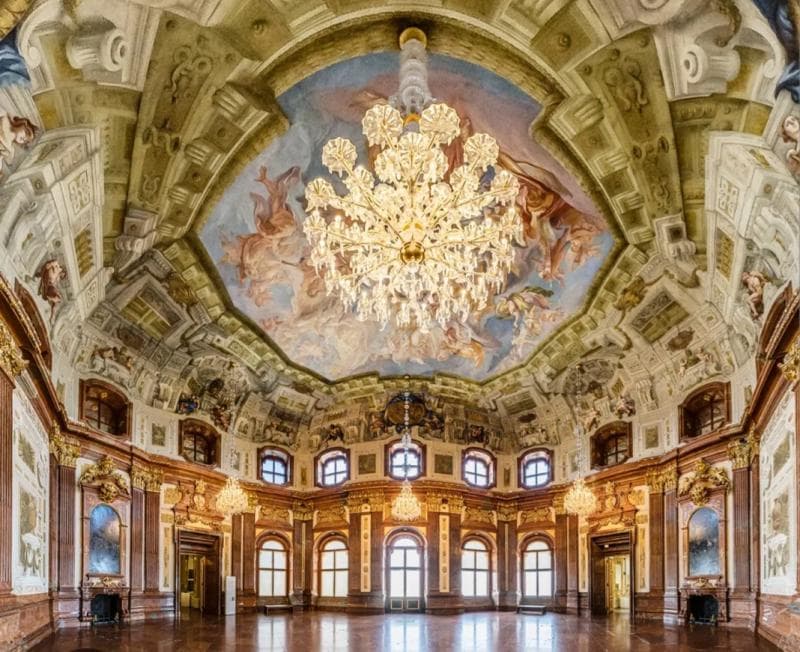
Explore the Marble Hall at Belvedere Palace in Vienna, Austria. Discover its Baroque art, rich history, and the site where the Austrian State Treaty was signed.
Overview
Step into the grandeur of the Marble Hall, the magnificent heart of the Upper Belvedere Palace in Vienna, Austria. This central chamber, reaching two stories in height, is a breathtaking example of Baroque artistry and historical significance. Dominated by luxurious reddish-brown marble, rich gilding, and an expansive ceiling fresco, it offers a glimpse into the opulent world of Prince Eugene of Savoy, who commissioned its creation in the early 18th century. Today, beyond its visual splendor, the Marble Hall stands as a witness to pivotal moments in Austrian history, serving as a venue for significant events and offering visitors a panoramic view of Vienna's cityscape and the stunning Baroque gardens below.
History & Cultural Background
The Belvedere Palace, including its esteemed Marble Hall, was conceived as the summer residence for Prince Eugene of Savoy, a celebrated general and art connoisseur, between 1714 and 1723. Designed by the renowned Baroque architect Johann Lucas von Hildebrandt, the complex was a symbol of Eugene's military triumphs and high status, constructed during a period of prosperity following his successful campaigns against the Ottoman Empire. The Upper Belvedere, where the Marble Hall is located, was primarily intended for grand receptions and ceremonial display. While the interior decoration was still underway, Prince Eugene hosted the Turkish ambassador Ibrahim Pasha here in 1719. The elaborate ceiling fresco in the Marble Hall was a collaborative effort, with Gaetano Fanti commissioned for illusionistic quadratura painting in 1719, followed by Carlo Innocenzo Carlone who executed the main ceiling fresco between 1721 and 1723. After Prince Eugene's death in 1736, the entire complex was acquired by Empress Maria Theresa in 1752, who transformed the Upper Belvedere into one of the world's first public museums.
What Makes It Special
The Marble Hall's distinctiveness lies in its lavish Baroque design, characterized by the striking contrast of reddish-brown marble against opulent gilding. The grand scale of the hall, extending over two levels, creates an immediate sense of awe. The illusionistic frescoes on the ceiling and walls, primarily by Carlo Innocenzo Carlone, Marcantonio Chiarini, and Gaetano Fanti, depict celestial beings and architectural elements that seem to extend beyond the physical space, a hallmark of Baroque artistry. These artistic elements celebrated the victories and virtues of Prince Eugene, showcasing allegories that reflect his military prowess. Furthermore, the hall's windows offer a unique and breathtaking vista of Vienna and the meticulously landscaped Baroque gardens that connect the Upper and Lower Belvedere. This combination of artistic mastery, architectural grandeur, and historical significance makes the Marble Hall a truly special destination within the Belvedere Palace.
Stories, Fun Facts & Local Details
Beyond its visual splendor, the Marble Hall holds a significant place in modern Austrian history. On May 15, 1955, this very hall was the setting for the signing of the Austrian State Treaty. This pivotal event marked the end of the post-World War II occupation and re-established Austria's sovereignty as a free and independent nation. Imagine the echoes of history in that room as foreign ministers and Austrian representatives gathered to ink such an important document. A fun detail is that some experiences in Vienna, like the Time Travel Tour, even feature footage of this historic occasion, and the tables and chairs used for the signing were once exhibited at the Vienna Furniture Museum. The very name 'Belvedere' itself means 'beautiful view' in Italian, a fitting description for a palace whose Marble Hall offers such remarkable perspectives. Prince Eugene lived in the Lower Belvedere, using the Upper Belvedere and its Marble Hall for magnificent receptions, further cementing its role as a space for power and diplomacy.
Visitor Perspective
As you ascend the grand staircase to the Marble Hall in the Upper Belvedere, prepare for a 'wow' moment. The sheer scale and intricate details of the room are designed to impress, drawing your eye upwards to the celestial frescoes. The interplay of light on the marble and gilding creates a dynamic and regal atmosphere. Take a moment to gaze out of the windows; the panoramic view across the Baroque gardens towards the Lower Belvedere and the distant Vienna skyline is truly captivating. It's a chance to appreciate Hildebrandt's genius in integrating the palace with its surroundings. While exploring, try to envision the historical moments that unfolded within these walls, from Prince Eugene's grand receptions to the signing of the State Treaty. The Marble Hall is included with an Upper Belvedere ticket, granting access to the permanent collection as well. Many visitors describe the experience as stepping into a rich tapestry of history and art, a highlight of any visit to the Belvedere Palace.
Coordinates: 16.38028, 48.19417
View on Google Maps💬 How Travelers Describe This Place
Based on community votes
Photogenic
755Must See
728Beautiful
481Unique
183Interesting
28
Traveler Stories
Discover memorable experiences shared by travelers who have visited this place.
No traveler stories yet.
Be the first traveler to share what made this place memorable.

Tour
By
Spot
Discover amazing places around the world. Your journey starts here.
Explore
© 2026 TourBySpot. All rights reserved.