Main Stadium
Jakarta, Indonesia
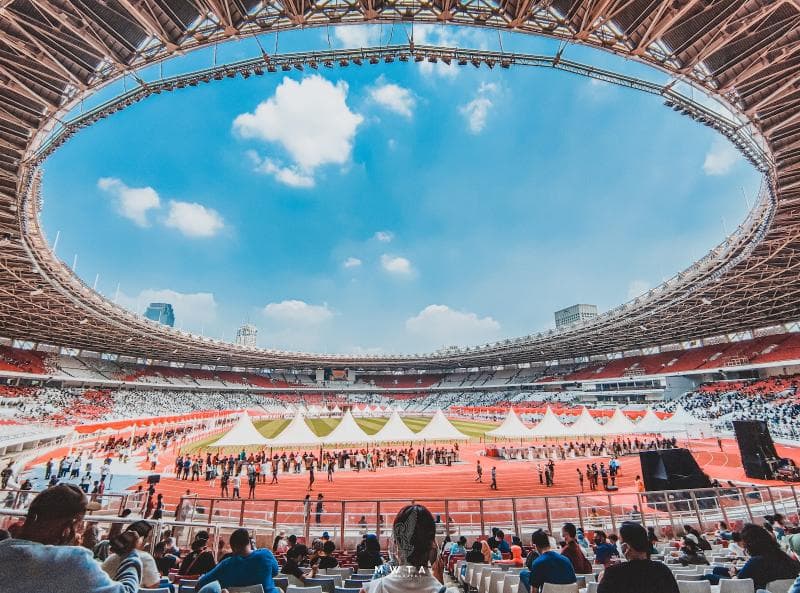
Explore Gelora Bung Karno Main Stadium in Jakarta, Indonesia. Discover its rich history, iconic architecture, and role as a symbol of national pride.
Overview
The Main Stadium, officially known as Stadion Utama Gelora Bung Karno, stands as a monumental landmark within the sprawling Gelora Bung Karno Sports Complex in Jakarta, Indonesia. This multi-purpose arena is far more than just a venue for sports; it is a vibrant center for national pride, cultural events, and community gatherings. Primarily serving as the home ground for the Indonesian national football team and the Liga 1 club Persija Jakarta, the stadium also regularly hosts a diverse array of events, from international music concerts to political rallies and national ceremonies. Its impressive scale and state-of-the-art facilities make it a prominent feature of Jakarta's skyline.
Following significant renovations, the stadium boasts a current capacity of 77,193 single seats, adhering to international safety standards. It is recognized as a five-star, intelligent stadium, celebrated for its advanced infrastructure, including one of the brightest lighting systems in the world, achieving 3,500 lux. This iconic structure represents a blend of historical significance and modern functionality, making it a compelling destination for both sports enthusiasts and curious travelers.
History & Cultural Background
The genesis of Gelora Bung Karno Main Stadium is deeply intertwined with Indonesia's emergence on the global stage. Construction commenced on February 8, 1960, and was remarkably completed by July 21, 1962, just in time to host the 4th Asian Games. The stadium and its encompassing sports complex were the visionary project of Indonesia's first president, Sukarno, after whom the complex is named, signifying a period of intense national development and international aspiration.
Its construction received partial funding through a special loan from the Soviet Union, a testament to the geopolitical alignments of the era. Throughout its history, the stadium has undergone several name changes reflecting Indonesia's political landscape. Initially known as Senayan Main Stadium, it was renamed Gelora Senayan Main Stadium between 1969 and 2001 as part of a 'de-Sukarnoization' policy. However, with the advent of reformasi, the name was rightfully restored to Gelora Bung Karno Main Stadium in 2001, reinstating its connection to its visionary founder.
Over the decades, the stadium has been the stage for numerous historic sporting events, including the 1962 and 2018 Asian Games, where it hosted opening and closing ceremonies, as well as athletics competitions. It also proudly hosted the final of the AFC Asian Cup in 2007 and multiple Southeast Asian Games, solidifying its place in regional sports history.
What Makes It Special
What truly sets Gelora Bung Karno Main Stadium apart is its distinctive blend of innovative architecture and enduring legacy. Its most striking feature is the gigantic ring-shaped façade, known locally as 'temu gelang', or 'joined ring'. This design not only provides an aesthetic grandeur but was also revolutionary as one of the world's first circular roof football stadiums, thoughtfully designed to shade spectators from the tropical sun.
The stadium has undergone several significant renovations to modernize its facilities and comply with international standards. Notable upgrades for the 2007 AFC Asian Cup and the 2018 Asian Games transformed it into an all-seater venue, reducing its original capacity from approximately 110,000 to the current 77,193 single seats. This modernization has positioned it as the 28th largest association football stadium in the world and the 8th largest in Asia. Furthermore, its cutting-edge lighting system, with a luminance of 3,500 lux, makes it one of the brightest and most technologically advanced stadiums globally.
Stories, Fun Facts & Local Details
Beyond its grand structure, the Gelora Bung Karno Main Stadium is a repository of fascinating stories and local anecdotes. It has hosted a remarkable array of non-sporting events, including iconic music concerts. In 1975, the English rock band Deep Purple drew an astounding 150,000 fans, a number that far exceeded the stadium's official capacity at the time. Other global music icons like Michael Jackson, Lady Gaga, Linkin Park, Blackpink, and NCT DREAM have also graced its stage, reflecting its versatility as a premier entertainment venue.
In the realm of sports, a legendary football match in 1985 between Persib Bandung and PSMS Medan reportedly attracted 150,000 spectators, spilling onto the athletics track and setting an unofficial record for attendance in an amateur game. The stadium also witnessed a historic boxing match featuring Muhammad Ali in 1973. Locals often refer to the stadium simply as GBK, viewing it as a powerful symbol of national pride, progress, and a testament to Indonesia's ability to host world-class events. The broader Gelora Bung Karno Sports Complex is also celebrated for its extensive green areas, comprising 84% of the complex, an urban forest housing diverse trees and bird species, offering a natural escape within the bustling city.
Visitor Perspective
For the curious traveler, visiting the Gelora Bung Karno Main Stadium offers a unique insight into Indonesian culture and its passion for sports and entertainment. Modern facilities ensure a comfortable experience, with single flip-up seats, advanced CCTV surveillance, and even facial recognition systems enhancing security and convenience. While football matches provide an electric atmosphere, the complex itself is a vibrant hub of activity.
Visitors can enjoy jogging tracks, explore urban parks, and find various smaller arenas dedicated to other sports like basketball, tennis, and swimming. Attending a local football match is highly recommended for an authentic experience of the passionate fan culture. The stadium complex is easily accessible via Jakarta's public transportation, including the KRL commuter train and Transjakarta buses, making navigation straightforward for tourists. For the most comfortable experience, it is advisable to plan a visit during Jakarta's dry season, typically from May to September, when the weather is ideal for outdoor exploration.
Coordinates: 106.8025111, -6.2185778
View on Google Maps💬 How Travelers Describe This Place
Based on community votes
Unique
996Photogenic
673Beautiful
585Interesting
143Must See
69
Traveler Stories
Discover memorable experiences shared by travelers who have visited this place.
No traveler stories yet.
Be the first traveler to share what made this place memorable.

Tour
By
Spot
Discover amazing places around the world. Your journey starts here.
Explore
© 2026 TourBySpot. All rights reserved.