Main Sanctuary
Madrid, Spain
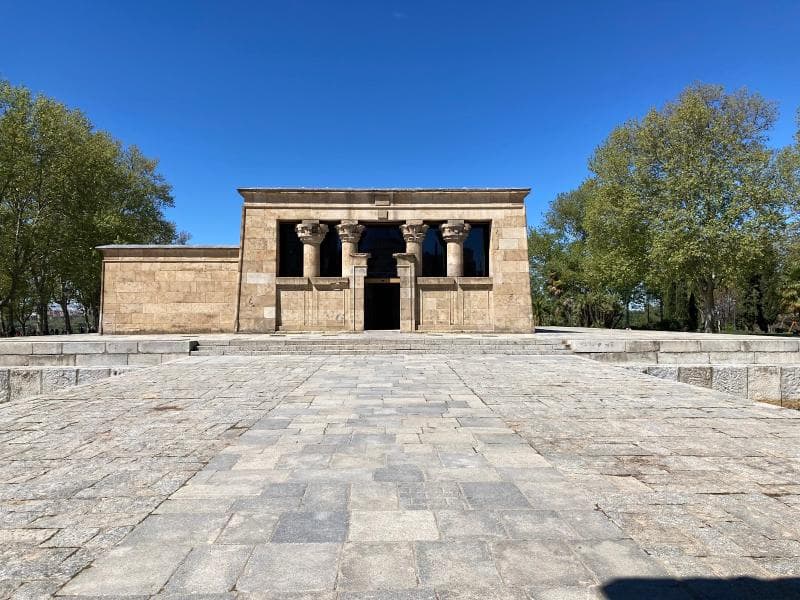
Discover the sacred Main Sanctuary within Madrid's Temple of Debod, an ancient Egyptian temple gifted to Spain. Explore its history and unique charm.
Overview
Nestled amidst the serene Parque del Oeste, the Temple of Debod in Madrid offers a remarkable and unexpected journey back to ancient Egypt. While the entire temple complex is a marvel, the 'Main Sanctuary' refers to its innermost, most sacred chambers—the heart of this transplanted monument. This area provides an intimate glimpse into the religious practices and artistic expressions of a civilization thousands of years old. Moved stone by stone from its original location in Nubia, Egypt, and meticulously reconstructed in Madrid, the Main Sanctuary within the Temple of Debod is a testament to international cooperation and a unique cultural treasure, inviting curious travelers to explore its profound history and spiritual essence.
History & Cultural Background
The genesis of what is now known as the Temple of Debod, and particularly its Main Sanctuary, dates back to the early 2nd century BCE. Its construction began under the orders of King Adikhalamani of Meroë, who initiated the building of a small, single-room chapel dedicated to the powerful Egyptian gods Amun and Isis. This original chapel is the oldest part of the temple and forms the core of its sacred 'Main Sanctuary' area.
Originally situated 15 kilometers south of Aswan, near the First Cataract of the Nile and close to the major religious center of Philae, the temple was an important site of worship in the Nubian region. Over centuries, successive pharaohs of the Ptolemaic dynasty, and later Roman emperors like Augustus and Tiberius, expanded the temple, adding new rooms and decorative elements around this initial sacred core. The inner chamber, or Main Sanctuary, was historically reserved exclusively for high priests, reflecting its profound religious significance as the domain of the god Amun. Its walls were adorned with detailed reliefs depicting kings making offerings to various deities, illustrating the deep spiritual connection and ritualistic life of ancient Egypt.
The temple's relocation to Madrid in the late 1960s and early 1970s is a remarkable story of preservation. Threatened by the construction of the Aswan High Dam, UNESCO launched an international campaign to save numerous Nubian monuments. Spain's significant contribution to saving the Abu Simbel temples led to the Temple of Debod being gifted to Madrid by the Egyptian government in 1968. It was carefully dismantled, transported, and rebuilt in Madrid, maintaining its original east-west orientation, which was crucial for its astronomical and religious alignment.
What Makes It Special
The Main Sanctuary stands out as the historical and spiritual heart of the Temple of Debod. It represents the earliest structure, the Adikhalamani Chapel, where the earliest worship took place. Inside, visitors can still observe the reliefs and hieroglyphs that adorned its walls, depicting King Adikhalamani presenting offerings to the gods Amun and Isis. This intricate artwork tells stories of ancient rituals and beliefs, offering a tangible connection to a distant past.
Unlike many other ancient Egyptian temples, which remain in their original geographical context, the Temple of Debod offers a unique experience outside of Egypt. It provides an accessible window into Egyptian architecture and religious spaces for those who may not travel to the Nile Valley. The preservation of the central chapel, with its dedicated naos (a small shrine that housed cult images), dedicated to Amun and Isis, makes it a rare and valuable artifact.
Stories, Fun Facts & Local Details
Imagine the journey: the temple's stones, each weighing a significant amount, were carefully cataloged, disassembled, and shipped across continents. In 1969, archaeologist Martín Almagro Basch led the massive undertaking, which involved barges down the Nile, cargo ships to Valencia, and then 90 trucks transporting 1,350 boxes of temple parts to Madrid. This monumental effort transformed a potential loss into a celebrated cultural exchange.
While the Main Sanctuary itself speaks of ancient reverence, its current setting in Madrid adds another layer of charm. The temple is surrounded by reflecting pools that mirror its ancient facade, creating stunning visual effects, especially during sunrise and sunset. Locals and visitors alike flock to the area to witness the magical glow as the sun dips below the horizon, bathing the temple in golden hues. It's a favorite spot for quiet contemplation, photography, and enjoying one of Madrid's most spectacular views. The blend of Egyptian antiquity with Madrid's vibrant urban landscape creates a captivating juxtaposition, often evoking a sense of wonder and peacefulness.
Visitor Perspective
Stepping inside the Temple of Debod, particularly venturing into the Main Sanctuary, offers a profound sense of stepping back in time. While the original atmosphere of ancient rituals cannot be fully replicated, the effort made to conserve and present the temple's interior allows visitors to appreciate the scale and artistry of its design. Explanatory panels and audiovisual materials are often available inside, helping to decode the hieroglyphs and historical context of the reliefs.
For conservation reasons, access to the temple's interior is often limited, both in terms of visitor numbers and duration, usually around 30 minutes. This controlled entry helps preserve the delicate ancient structures. Even if queues are long for interior access, the exterior of the temple, with its pylon gateways and reflecting pools, offers a powerful and picturesque experience. The surrounding park provides a tranquil setting for a stroll, allowing visitors to contemplate the temple's incredible journey and its enduring legacy as a symbol of cultural bridge-building between Egypt and Spain.
Coordinates: -3.717056, 40.424167
View on Google Maps💬 How Travelers Describe This Place
Based on community votes
Beautiful
831Photogenic
685Interesting
433Must See
232Unique
211
Traveler Stories
Discover memorable experiences shared by travelers who have visited this place.
No traveler stories yet.
Be the first traveler to share what made this place memorable.

Tour
By
Spot
Discover amazing places around the world. Your journey starts here.
Explore
© 2026 TourBySpot. All rights reserved.