Main Prayer Hall
Tashkent, Uzbekistan
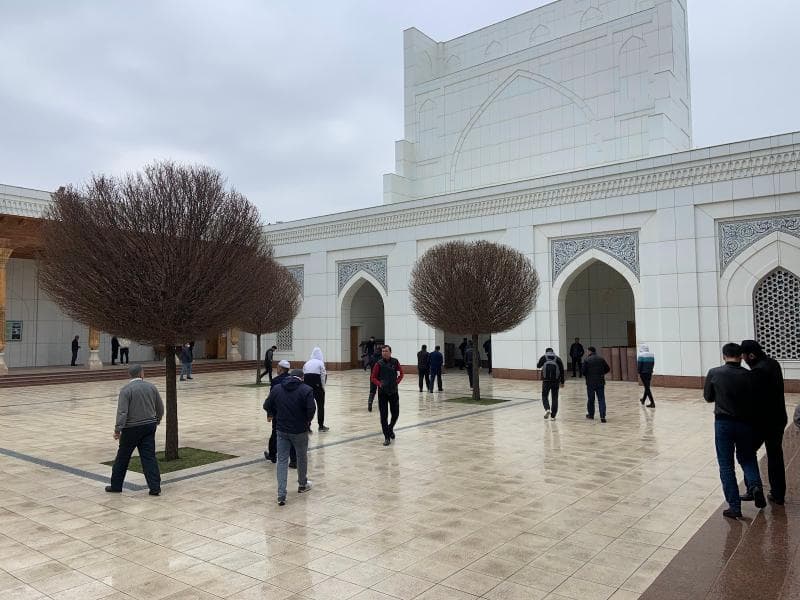
Explore the Main Prayer Hall of Minor Mosque in Tashkent, Uzbekistan. Discover its stunning white marble architecture, intricate interior, and rich cultural significance.
Overview
Nestled gracefully on the banks of the Ankhor Canal in Tashkent, Uzbekistan, the Minor Mosque stands as a luminous testament to modern Islamic architecture. Often affectionately referred to as the 'White Mosque' due to its gleaming white marble facade, this relatively new landmark has swiftly become a significant spiritual and cultural center in the capital. It was inaugurated in 2014 and quickly established itself as a beacon of tranquility and beauty, offering a serene atmosphere for worship and reflection.
The Main Prayer Hall, the heart of the Minor Mosque, is a marvel of contemporary design infused with traditional Uzbek and Oriental artistic elements. It is designed to accommodate a substantial number of worshippers, making it one of the largest spiritual centers in the region. Its pristine appearance and peaceful surroundings make it a compelling destination for both devout Muslims and curious travelers alike.
History & Cultural Background
The construction of the Minor Mosque commenced in July 2013 and was completed with remarkable speed, opening its doors on October 1, 2014, just before the significant Muslim holiday of Eid al-Adha. This rapid development was undertaken following a resolution by then-President Islam Karimov, aimed at establishing a new religious and cultural hub for Muslims in Tashkent.
Unlike many of Uzbekistan's historical brick mosques, the Minor Mosque was deliberately designed to showcase a modern interpretation of Islamic architectural principles while honoring traditional aesthetics. It represents a unique bridge between the past and the present, symbolizing the modern Uzbek state's dedication to its Islamic heritage and fostering spiritual development. The project was financed through the state budget and the Muslim Board of Uzbekistan, highlighting its national importance.
What Makes It Special
The Main Prayer Hall of the Minor Mosque is particularly notable for its impressive scale and exquisite detailing. It is a two-storied structure featuring a vast, round domed hall that can comfortably host over 2,400 to 2,500 people simultaneously. The interior is richly adorned in the intricate 'Naqsh' style, a traditional Central Asian art form characterized by elaborate plaster gypsum carvings and frescoes.
A central feature of the prayer hall is the gilded mihrab, a semi-circular niche that indicates the direction of Mecca. This mihrab is beautifully decorated with verses from the Quran and sayings from the Prophet Muhammad, adding a profound spiritual layer to the aesthetic grandeur. The walls of the mosque are inscribed with calligraphy crafted by renowned artists such as Habibullo Solikh, Islam Mamatov, and Abdulgofur Haqberdiyev. Beyond its visual splendor, the Main Prayer Hall is equipped with modern comforts, including special rooms for ablution, air conditioning for summer, and heated floors for winter, ensuring a comfortable environment for worshippers.
Stories, Fun Facts & Local Details
The name 'Minor' often causes a slight misunderstanding among English speakers, as it does not denote smallness. Instead, it refers to the neighborhood where the mosque is situated. Interestingly, some interpretations suggest the name 'Minor' in Persian signifies 'crystal clear water,' potentially referencing its location by the Ankhor Canal, while another meaning is 'lighthouse', symbolizing hope.
This mosque has rapidly gained popularity not only as a place of worship but also as a favorite spot for evening strolls among locals, thanks to its picturesque setting and beautifully landscaped gardens. Its gleaming white marble exterior sparkles brilliantly under the Central Asian sun, and its turquoise dome seems to blend seamlessly with the sky, creating a breathtaking visual spectacle. This ethereal beauty is particularly captivating during sunset, when the mosque takes on a golden glow.
Visitor Perspective
For visitors to Tashkent, the Main Prayer Hall of the Minor Mosque offers a unique glimpse into contemporary Islamic life and architecture. Entry to the mosque and its surrounding grounds is free, and visitors are generally welcome outside of prayer times.
When planning a visit, it is essential to dress modestly, ensuring shoulders and knees are covered. Women are also typically asked to cover their hair, and sometimes headscarves are provided at the entrance. Shoes should be removed before entering the prayer areas. While the courtyard is usually open to all, access to the Main Prayer Hall itself might sometimes be restricted for non-Muslims or women during certain times, or separate prayer areas may be designated. It is always best to observe and respect local customs and any posted guidelines. Visiting in the early morning or late afternoon is recommended for a quieter experience and optimal lighting for photography.
Coordinates: 69.27497, 41.33527
View on Google Maps💬 How Travelers Describe This Place
Based on community votes
Photogenic
950Beautiful
929Interesting
858Must See
730Unique
275
Traveler Stories
Discover memorable experiences shared by travelers who have visited this place.
No traveler stories yet.
Be the first traveler to share what made this place memorable.

Tour
By
Spot
Discover amazing places around the world. Your journey starts here.
Explore
© 2026 TourBySpot. All rights reserved.