Main Prayer Hall
Ulaanbaatar, Mongolia
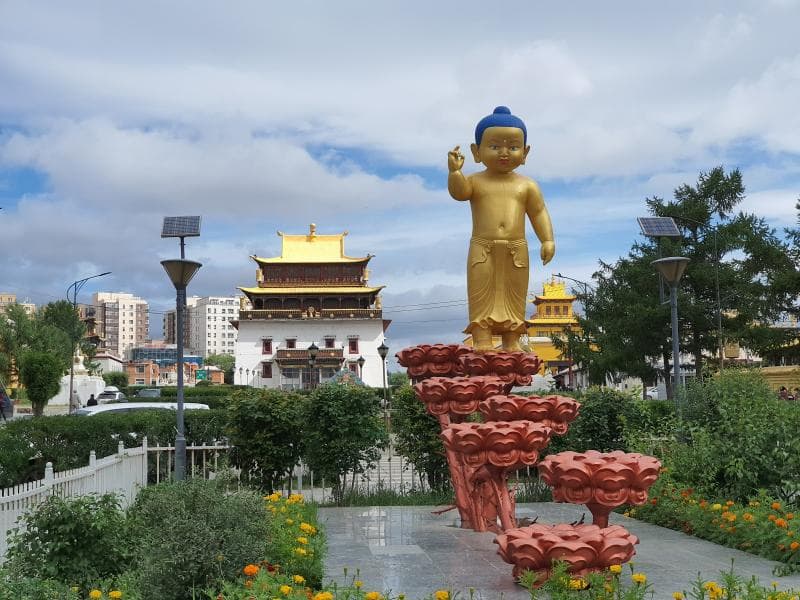
Explore the Main Prayer Hall of Gandan Monastery in Ulaanbaatar, Mongolia, home to the colossal Migjid Janraisig statue and vibrant Buddhist rituals.
Overview
The Main Prayer Hall of Gandan Monastery, more formally known as Gandantegchinlen Khiid, stands as the spiritual heart of Mongolian Buddhism in Ulaanbaatar. Its name, meaning 'the great place of complete joy', perfectly encapsulates the profound sense of peace and reverence one feels upon entering this sacred space. As Mongolia's largest and most significant operating monastery, it is not merely a historical site but a vibrant, living center of worship and learning, home to hundreds of monks.
The central and most awe-inspiring feature of the Main Prayer Hall is the colossal statue of Migjid Janraisig, the Bodhisattva of Compassion, also known as Avalokiteśvara or Chenrézik. This gleaming 26-meter (85 feet) tall statue, crafted from gilded bronze and adorned with thousands of precious stones, dominates the interior, inspiring devotion and wonder. It represents a powerful symbol of Mongolian resilience and the enduring spirit of its Buddhist faith.
History & Cultural Background
Gandan Monastery's origins trace back to the early 19th century, with its establishment generally cited around 1809 or 1838. It quickly grew into a crucial center for Buddhist study and practice, not just within Mongolia but for the wider Mahayana Buddhist community.
The monastery endured immense challenges during the communist purges of the 1930s, when countless monasteries across Mongolia were destroyed and thousands of lamas were persecuted. Gandan, remarkably, survived these tumultuous times. Although closed briefly in 1939 or 1938, it was reopened in 1944 and remained the country's sole active monastery for nearly five decades, serving as a symbolic link to Mongolia's cultural and religious heritage.
A poignant part of its history involves the original Migjid Janraisig statue. Erected in 1911 or 1913, reportedly to restore the eyesight of Bogd Khan and commemorate Mongolia's independence, this initial masterpiece was tragically dismantled by Russian troops in 1937 or 1938 and melted down, allegedly for bullets. Following the collapse of communism in 1990, the statue was magnificently rebuilt in 1996 through extensive national and international donations, embodying a powerful revival of faith and cultural identity.
What Makes It Special
Beyond its sheer size and historical significance, the Main Prayer Hall is special because it is a living, breathing place of worship. It's a place where ancient traditions continue to flourish in a modern urban setting. The vibrant daily rituals, characterized by the rhythmic chanting of monks, the sonorous beat of drums, and the clash of cymbals, offer a deeply immersive spiritual experience.
The current Migjid Janraisig statue itself is a marvel of craftsmanship and devotion. Standing at up to 26.5 meters and weighing over 20 tons, it is adorned with 2,286 precious stones and gilded with gold leaf, representing the collective faith and contributions of the Mongolian people. Surrounding the main statue, hundreds of smaller Buddha images contribute to the hall's sacred ambiance.
Stories, Fun Facts & Local Details
Local legends tell of the original Migjid Janraisig statue being commissioned by Bogd Khan in the hope of curing his blindness. This legend underscores the deep connection between the statue and the spiritual well-being of the Mongolian people.
Another heartwarming detail revolves around the reconstruction of the current statue. It is said that ordinary Mongolians, even those with very little, contributed what they could—from small sums of money to personal jewelry or even stones—to fund its rebuilding. These acts of profound faith are believed to have imbued the statue with immense compassionate power, making it a living guardian of the nation's spirit.
While the Migjid Janraisig Süm is often perceived as the main prayer hall, morning services and more significant ceremonies are sometimes also held at the nearby Ochidara Temple (Gandan Süm), highlighting the complex's multi-faceted spiritual activity.
Visitor Perspective
Visiting the Main Prayer Hall is an opportunity to witness Mongolian Buddhist traditions firsthand. Travelers are encouraged to visit in the morning, ideally between 8:00 AM and 11:00 AM, to experience the captivating chanting ceremonies. The serene atmosphere, filled with the scent of incense, provides a stark contrast to the bustling city outside.
Guests should observe respectful etiquette, such as walking clockwise around temples and prayer wheels, and dressing modestly. While photography is generally allowed within the monastery grounds, it may be restricted or require a small fee inside certain temple areas, especially around the main statue. Engaging with the spiritual energy here, watching the devotees, and turning the prayer wheels alongside them, offers a profound cultural immersion that connects visitors to the enduring soul of Mongolia.
Coordinates: 106.8903, 47.9205
View on Google Maps💬 How Travelers Describe This Place
Based on community votes
Interesting
551Unique
547Beautiful
336Photogenic
298Must See
219
Traveler Stories
Discover memorable experiences shared by travelers who have visited this place.
No traveler stories yet.
Be the first traveler to share what made this place memorable.

Tour
By
Spot
Discover amazing places around the world. Your journey starts here.
Explore
© 2026 TourBySpot. All rights reserved.