Main Nave
Zagreb, Croatia
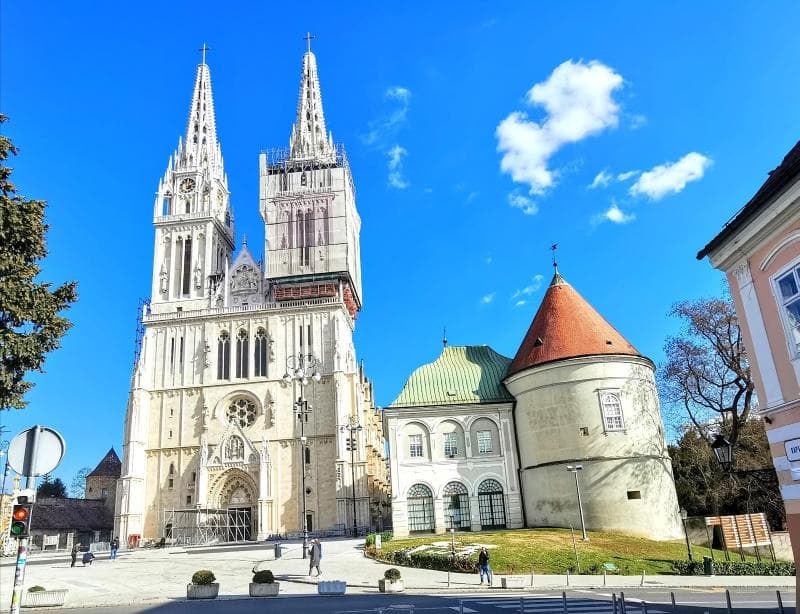
Explore the Main Nave of Zagreb Cathedral in Zagreb, Croatia. Discover its Gothic architecture, rich history, and spiritual significance.
Overview
Standing proudly in Croatia's capital, the Zagreb Cathedral, officially known as the Cathedral of the Assumption of the Blessed Virgin Mary and Saints Stephen and Ladislaus, is an undeniable landmark. As the tallest building in Croatia and the most monumental sacral structure of Gothic architecture southeast of the Alps, its twin spires punctuate the Zagreb skyline, visible from almost every corner of the city.
The cathedral's main nave is a breathtaking testament to Gothic grandeur, stretching approximately 77 meters in length and soaring to an impressive height of 46 meters internally. This vast space is designed to inspire awe, capable of accommodating up to 5,000 people within its sacred confines. Entering the main nave, visitors are immediately struck by the sheer scale and intricate details that define this spiritual heart of Croatian Catholicism.
History & Cultural Background
The history of Zagreb Cathedral is a compelling narrative of resilience and rebirth, deeply intertwined with the Croatian nation's own story. Its foundations were laid as early as 1094 with the establishment of the Zagreb bishopric by King Ladislaus. The original Romanesque structure, completed in 1217, faced an early demise, destroyed by a Mongol raid in 1242.
Over subsequent centuries, the cathedral was rebuilt and expanded in the Gothic style, enduring numerous fires, conflicts, and the ever-present threat of the Ottoman Empire, which led to the construction of defensive walls around it. A pivotal moment in its architectural journey occurred after the devastating 1880 Zagreb earthquake, which caused the main nave to collapse. Austrian architect Hermann Bollé spearheaded a comprehensive Neo-Gothic reconstruction from 1880 to 1906, imbuing the cathedral with its distinctive contemporary appearance, including the iconic twin spires. Today, the cathedral stands not only as a place of worship but also as a cultural good of Croatia, safeguarding centuries of faith and national identity.
What Makes It Special
The main nave of Zagreb Cathedral is a masterful display of Gothic architecture designed to uplift and inspire. As you step inside, your gaze is drawn upwards to the soaring Gothic vaults that arch gracefully towards the heavens, creating an overwhelming sense of space and light. These vaults are expertly supported by exterior flying buttresses, a hallmark of Gothic engineering, which allow for the cathedral's impressive height and expansive windows.
Throughout the nave, finely carved neo-Gothic marble altars contribute to the ornate interior, each a work of devotional art. The vibrant stained-glass windows are particularly captivating, filtering natural light into a kaleidoscope of colors that dance across the ancient stone, enveloping the space in a tranquil, spiritual glow. The meticulously adorned pulpit, with its refined details, serves as another focal point of artistic craftsmanship. One of the most revered treasures within the nave is the tomb of Cardinal Alojzije Stepinac, an important figure in Croatian Catholicism, whose resting place was sculpted by the renowned Ivan Meštrović. Furthermore, the cathedral boasts one of the world's finest organs, featuring over 6,000 pipes, a testament to its musical heritage.
Stories, Fun Facts & Local Details
The main nave, like the entire cathedral, is steeped in stories that speak to Zagreb's enduring spirit. Its repeated reconstruction after calamities, particularly the complete collapse of the main nave in 1880 and damage to the spires in the 2020 earthquake, has cemented its status as a powerful symbol of Croatian resilience and rebirth – a national icon that, as locals say, 'never gives in.'
Interestingly, archaeological findings suggest that the site of the present-day southern nave may have housed the original one-nave pre-Romanesque church. Historical records also mention that three bishops were buried in the church's nave, with Bishop Prodan's burial around 1175 indicating a significant structure already stood here. The imposing fortification walls, some of which still stand today, were erected in the 15th and 16th centuries to protect the cathedral from Ottoman incursions, with the south tower even serving as a military observation point in the 17th century. A curious detail often shared by guides is that the central chandeliers, illuminating the magnificent nave, are rumored to have once graced a Las Vegas casino. The cathedral's national importance is further underscored by its depiction on the reverse of the Croatian 1000 kuna banknote issued in 1993.
Visitor Perspective
For the curious traveler, visiting the main nave of Zagreb Cathedral offers a profound encounter with history, art, and spirituality. While it is generally open for prayer and visitors, it's wise to check current hours, as ongoing restoration efforts, particularly following the 2020 earthquake, can affect access and timings.
Approaching the cathedral from Ban Jelačić Square, the twin spires immediately draw your eye, inviting you into its ancient embrace. Inside the nave, a respectful demeanor is expected; visitors are asked to dress modestly, covering shoulders and knees, and to maintain quiet, especially during services. Photography is usually permitted without flash, though never during mass or directed at those in prayer. Even with ongoing work, the main nave remains a working spiritual center, not merely a museum, offering a serene atmosphere for contemplation and appreciation of its architectural and historical grandeur. The tomb of Cardinal Stepinac in the crypt beneath the nave remains a powerful focal point for many.
Coordinates: 15.9798, 45.8144
View on Google Maps💬 How Travelers Describe This Place
Based on community votes
Beautiful
670Must See
655Interesting
594Unique
166Photogenic
83
Traveler Stories
Discover memorable experiences shared by travelers who have visited this place.
No traveler stories yet.
Be the first traveler to share what made this place memorable.

Tour
By
Spot
Discover amazing places around the world. Your journey starts here.
Explore
© 2026 TourBySpot. All rights reserved.