Main Nave
Graz, Austria
Explore the Main Nave of Graz Cathedral, a stunning blend of Gothic and Baroque architecture in Graz, Austria. Discover its rich history and unique artworks.
Overview
Stepping into the Main Nave of Graz Cathedral, or Dom St. Ägidius, is to enter a remarkable space where centuries of history converge in a harmonious blend of architectural styles. As the principal church of the Diocese of Graz-Seckau in Graz, Austria, this sacred edifice has served as a spiritual beacon and an imperial court church, evolving from its Gothic origins into a structure richly adorned with Baroque splendor. The Main Nave, with its soaring ceilings and impressive scale, invites quiet contemplation and offers a tangible connection to the city's profound past.
Originally conceived as a grand statement of imperial power and religious devotion, the nave today stands as a testament to the artistry and vision of various eras, showcasing how different periods left their indelible mark on this significant landmark. It is a place where every arch, every vault, and every artistic detail tells a part of Graz's multifaceted story, making it a pivotal destination for anyone seeking to understand the cultural and architectural heart of the region.
History & Cultural Background
The genesis of Graz Cathedral dates back to the 12th century, with a smaller Romanesque church preceding the current structure. However, the Main Nave as we largely see it today began to take shape in the 15th century, commissioned by Emperor Frederick III. Constructed between 1438 and 1462, it was initially designed in the late-Gothic style, intended to serve as the Hofkirche, or court church, for the emperor's residence. This Gothic foundation endowed the nave with its characteristic high ceilings, pointed arches, and ribbed vaults, creating an awe-inspiring sense of verticality and light.
A significant transformation occurred from 1577, when the church came under the custodianship of the Jesuits. Over nearly two centuries, particularly in the late 17th and early 18th centuries, the interior of the nave was extensively refurbished in the opulent Baroque style. This period introduced lavish decorations, ornate altars, frescoes, and a grand organ loft, overlaying the Gothic framework with a rich tapestry of Baroque artistry. In 1786, the church was elevated to the status of a cathedral, solidifying its importance in the religious landscape of Styria.
What Makes It Special
The Main Nave of Graz Cathedral distinguishes itself through its unique architectural synthesis, harmoniously combining its fundamental Gothic structure with the subsequent Baroque enhancements. It features a single, broad nave flanked by two narrower side aisles, with eight octagonal piers supporting the high vaults that stretch towards the heavens.
Visitors are immediately struck by the impressive height and the sense of spaciousness within the nave. The interplay of light, filtered through high lancet windows, accentuates the stucco ribs on the vaults and the plastered walls, creating a serene yet majestic atmosphere. The Baroque high altar, dating from the 1730s, is a focal point, drawing the eye towards its intricate design and the painting of St. Giles. The magnificent pulpit, with its detailed wood carvings, and the impressive organ, which was renovated and rededicated in 2023, further enrich the nave's interior.
Stories, Fun Facts & Local Details
Among the intriguing details found within the cathedral, and often referenced in connection with its imperial patron, Emperor Frederick III, are the scattered instances of his mysterious motto: 'AEIOU'. This enigmatic acronym, often accompanied by dates, is believed to stand for 'Austriae Est Imperare Orbi Universo' (It is Austria's destiny to rule the whole world) or 'Alles Erdreich Ist Österreich Untertan' (All the world is subject to Austria), a fascinating glimpse into imperial ambition.
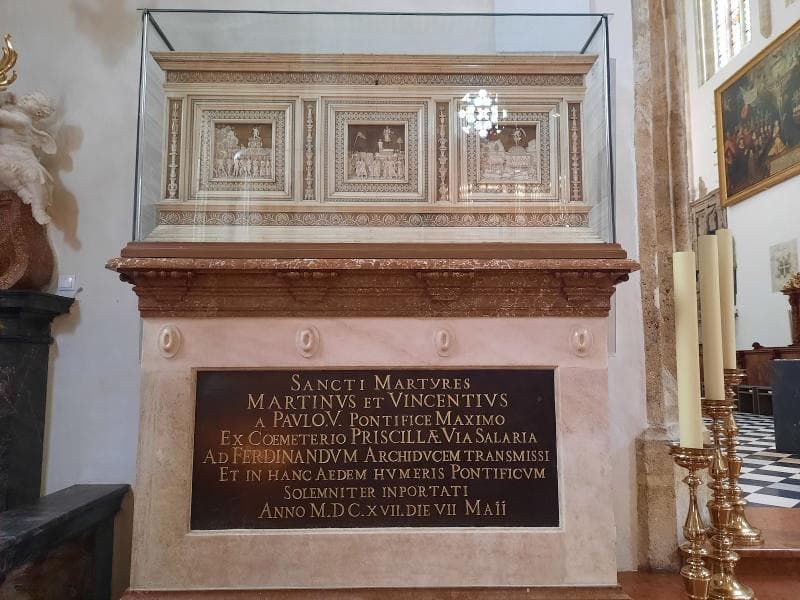
While primarily on the exterior, the 'Gottesplagenbild' (Plagues of God) fresco, located on the south side of the nave, tells a vivid story of the plagues that afflicted Graz in 1480 – pestilence, war, and locusts – serving as a powerful historical document and a testament to the city's resilience. Inside the nave, two historic ivory reliquaries, originally bridal chests belonging to Paola Gonzaga, stand as unique art pieces, later repurposed by the Jesuits to house Christian relics.
Visitor Perspective
For the curious traveler, walking through the Main Nave of Graz Cathedral is an experience that transcends a simple sightseeing visit. It's an opportunity to immerse oneself in a living museum of architectural history. The relatively restrained exterior gives way to an interior that impresses with its scale and artistic richness, offering moments of quiet awe. The blend of Gothic grandeur and Baroque opulence creates a unique visual narrative, inviting visitors to ponder the layers of history and the stories embedded within its walls. From the subtle details of carved wood to the expansive vaulted ceilings, every element contributes to a profound sense of place and historical depth, making it a truly memorable part of any visit to Graz.
Coordinates: 15.44236, 47.07197
View on Google Maps💬 How Travelers Describe This Place
Based on community votes
Photogenic
551Interesting
547Unique
336Beautiful
219Must See
186
Traveler Stories
Discover memorable experiences shared by travelers who have visited this place.
No traveler stories yet.
Be the first traveler to share what made this place memorable.

Tour
By
Spot
Discover amazing places around the world. Your journey starts here.
Explore
© 2026 TourBySpot. All rights reserved.