Main House
Miami, United States
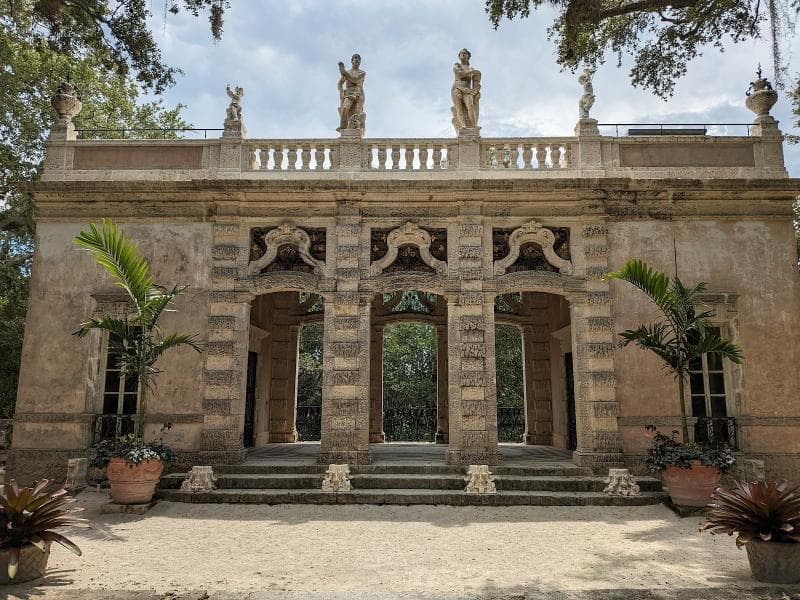
Explore the majestic Main House at Vizcaya Museum and Gardens in Miami, United States. Discover its Gilded Age history, stunning architecture, and unique art collections.
Overview
Step into a bygone era at the Main House of Vizcaya Museum and Gardens in Miami, United States. This magnificent estate, once the opulent winter residence of industrialist James Deering, stands as a testament to Gilded Age extravagance and architectural ambition. Situated on the shimmering shores of Biscayne Bay, Vizcaya's Main House is a European-inspired villa that transports visitors to the refined elegance of centuries past, all while embracing the subtropical allure of South Florida.
Completed primarily between 1914 and 1922, the Main House features 34 exquisitely furnished rooms, each a carefully curated display of European decorative arts and antiques spanning from antiquity to the Renaissance and Baroque periods. Its design, a striking blend of Mediterranean Revival architecture with Italian Renaissance and Baroque influences, was a deliberate effort to evoke the grand villas of Italy's Veneto and Tuscan regions. More than just a static display, the Main House is the heart of a vibrant cultural institution, a National Historic Landmark that invites exploration and imagination.
History & Cultural Background
The vision for Vizcaya began with James Deering, the Vice President of International Harvester, who acquired 180 acres of land in Miami in 1908 with the dream of creating an unparalleled winter estate. Collaborating with artistic director Paul Chalfin, architect F. Burrall Hoffman, and landscape architect Diego Suarez, Deering meticulously planned every detail. Chalfin, an expert in Italian art and interiors, played a pivotal role in shaping the aesthetic, filling the house with artifacts acquired during travels through Europe. Construction of the Main House commenced in 1914, with Deering taking up residence by Christmas Day 1916.
Vizcaya was conceived as a modern interpretation of an 18th-century Italian villa, ingeniously adapting classical European architectural traditions to Miami's unique subtropical climate. Despite its antique appearance, the Main House was remarkably innovative, built with reinforced concrete and equipped with state-of-the-art technologies of the early 20th century, including generators and a water filtration system. Deering's choice of the name 'Vizcaya' paid homage to a Spanish province and intended to commemorate early Spanish explorers, reflecting a romanticized connection to European maritime history. After Deering's passing in 1925, and subsequent hurricane damage in 1926, the estate eventually transitioned into a public museum in 1953, thanks to the efforts of his heirs and Miami-Dade County.
What Makes It Special
The Main House at Vizcaya is special for its extraordinary blend of historical reverence and modern ingenuity. It's not merely a collection of rooms but a meticulously crafted experience designed to transport visitors through time and culture. The building itself is a work of art, with exterior walls coated in traditional stucco to mimic aged European plaster, and much of the structure incorporating local coral rock and limestone.
Inside, the sheer volume and quality of the decorative art collection are breathtaking. The rooms were specifically designed to house the furniture, paneling, and architectural elements collected by Deering and Chalfin, creating harmonious and authentic historical settings. The ingenious layout, with several reception rooms, a Library, Music Room, and Dining Room surrounding an open Courtyard on the first floor, was designed to maximize natural light and airflow, connecting the interiors with the lush outdoor environment. The east facade, grand and monumental, was deliberately oriented towards Biscayne Bay, intended as the primary approach for guests arriving by boat, reflecting Deering's love for the sea.
Stories, Fun Facts & Local Details
Imagine arriving at Vizcaya as Deering's guest, not by car, but by yacht, docking directly at the grand East Loggia, which was built to be the main entrance for those arriving from the sea. This sense of dramatic arrival was central to Deering's vision. A fascinating detail lies in the origins of some of Vizcaya's ceramics; originals were shipped from England in 1912 but sank with the Titanic. Fortunately, Deering had insured them and had them replaced, ensuring his vision was fully realized.
Another intriguing aspect is how the house, while appearing centuries old, was a marvel of early 20th-century technology. Beyond its advanced infrastructure, Vizcaya boasted the first telephone system in Miami-Dade County, a small detail that highlights its modernity within its classical shell. The sprawling estate originally encompassed 180 acres, with Deering actively preserving the shoreline mangrove wetlands and native tropical forests, showcasing an early environmental consciousness. Today, it continues to be a vibrant cultural hub, hosting various events and community programs, and has even been the setting for significant historical meetings, such as Ronald Reagan's meeting with Pope John Paul II in 1987.
Visitor Perspective
Visiting the Main House offers a unique opportunity to immerse oneself in a world where European grandeur meets tropical splendor. As you walk through the exquisitely preserved rooms, you can almost hear the echoes of parties and conversations that once filled these halls. Allow at least two to four hours to fully appreciate the intricate details of the architecture, the diverse art collection, and the stories embedded within its walls.
The Main House provides a tangible connection to the Gilded Age, showcasing how a visionary industrialist blended art, nature, and innovation. Exploring the first floor, much of which is accessible, provides a deep insight into Deering's sophisticated lifestyle and his passion for collecting. The transition from the ornate interiors to the sweeping views of Biscayne Bay from the loggias and terraces is a moment of serene beauty, reminding you of the estate's remarkable setting. It is a place that sparks curiosity, evokes wonder, and leaves visitors with a profound appreciation for Miami's rich cultural heritage.
Coordinates: -80.21028, 25.74438
View on Google Maps💬 How Travelers Describe This Place
Based on community votes
Must See
551Interesting
421Photogenic
366Beautiful
298Unique
212
Traveler Stories
Discover memorable experiences shared by travelers who have visited this place.
No traveler stories yet.
Be the first traveler to share what made this place memorable.

Tour
By
Spot
Discover amazing places around the world. Your journey starts here.
Explore
© 2026 TourBySpot. All rights reserved.