Main Hall
Munich, Germany
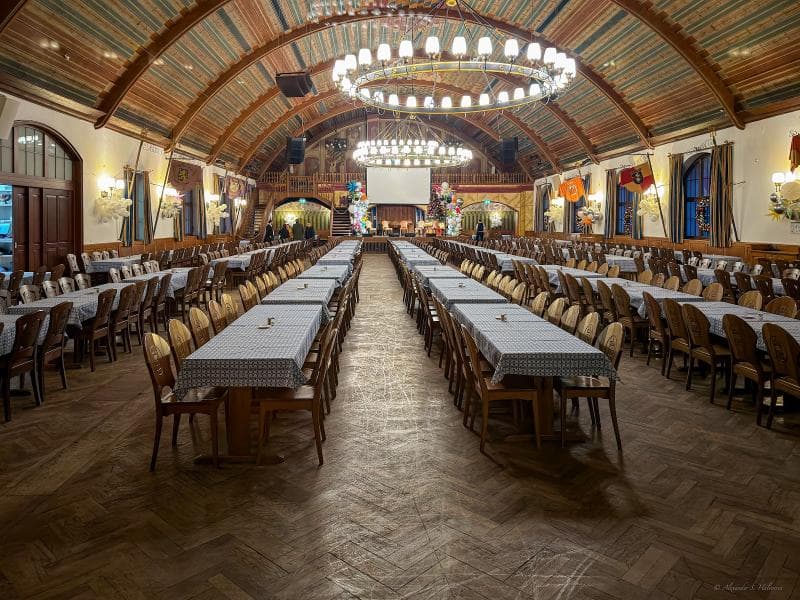
Discover the historic Schwemme, the lively Main Hall of Hofbräuhaus München in Germany. Experience Bavarian beer culture, live music, and rich history.
Overview
Stepping into the Main Hall, more traditionally known as the 'Schwemme', of the Hofbräuhaus München in Munich, Germany, is to immerse oneself in centuries of Bavarian beer culture. This ground-floor space is not merely a dining area; it is the vibrant heart of one of the world's most famous beer halls. With its towering vaulted ceilings and long, communal wooden tables, the Schwemme buzzes with an energy unique to Bavaria. Here, locals known as 'Stammtisch' regulars mingle with curious travelers from across the globe, all united by a love for good beer and convivial atmosphere. Traditional Bavarian music, performed live by brass bands from a central podium, fills the air, creating a soundtrack that is both lively and authentic. It is a place where history feels alive, where every clinking glass and hearty laugh adds to a tradition stretching back over 400 years.
History & Cultural Background
The story of the Hofbräuhaus begins in 1589 when Duke Wilhelm V of Bavaria, dissatisfied with the quality of local beer, founded a brewery to supply his royal court. This royal brewery eventually became the Staatliches Hofbräuhaus in München. The original brewery was situated near the Alter Hof, but by 1607, Duke Maximilian I, Wilhelm's son, commissioned the construction of a new brewery at its current iconic location on Platzl. For centuries, the Hofbräuhaus brewed exclusively for the Wittelsbach court. It wasn't until 1828 that King Ludwig I, recognizing its popularity, decreed that the Hofbräuhaus be opened to the general public, transforming it into a 'people's alehouse'.
The Schwemme itself holds a fascinating past. Originally, it was the actual brewing hall where the famous Hofbräu beer was produced. However, to accommodate the increasing number of guests, the brewing facilities were relocated to Haidhausen in 1896, and the old brewery building underwent significant renovations by architect Max Littmann, opening as the present-day tavern in 1897. Despite sustaining heavy damage during the Second World War, the historic Schwemme was one of the few areas that largely survived the bombings, a testament to its enduring structure and spirit. Its post-war reconstruction, along with the rest of the Hofbräuhaus, solidified its status as a symbol of Bavarian resilience and joy of life.
What Makes It Special
The Schwemme's undeniable charm lies in its preservation of traditional Bavarian 'Gemütlichkeit' – a sense of coziness, good cheer, and belonging. What makes it truly special are its physical elements and intangible spirit. The majestic vaulted ceilings, adorned with frescoes, create an imposing yet inviting space. Below, the long wooden tables, many of which date back to 1897, bear the carved initials, names, and messages of countless visitors through generations, telling silent stories of shared moments.
Daily live music by traditional Bavarian brass bands is another hallmark. Positioned on a central stage, these musicians fill the hall with polka and folk tunes, encouraging singing, swaying, and the rhythmic clinking of 'Maß' (liter-sized beer mugs). The beer itself is a star attraction, brewed in strict accordance with the Reinheitsgebot, Bavaria's ancient Beer Purity Law of 1516. This commitment to tradition ensures that every liter of Hofbräu Original, Dunkel, or Weissbier served in the Schwemme is a taste of authentic Bavarian heritage.
Stories, Fun Facts & Local Details
The Hofbräuhaus has hosted an impressive array of famous figures. Wolfgang Amadeus Mozart, during his time in Munich, was a frequent guest, as was Empress Elisabeth of Austria, affectionately known as 'Sisi'. Even Vladimir Lenin, the revolutionary, reportedly visited the Hofbräuhaus regularly while living in Munich. The hall is also indelibly linked to the immensely popular song 'In München steht ein Hofbräuhaus – oans, zwoa, g’suffa!' (There's a Hofbräuhaus in Munich – one, two, down the hatch!), composed in 1935, which cemented its global fame. A unique local tradition sees many regulars storing their personal, often elaborately decorated, steins in dedicated lockers at the Hofbräuhaus. It is said that in 1632, during the Thirty Years' War, the city of Munich was spared from plunder by Swedish troops in exchange for, among other tributes, 23,168 liters of Hofbräu beer. While the Hofbräuhaus also holds a somber place in history as a venue for early Nazi party meetings in its upstairs Festsaal, the Schwemme has largely remained a place of joyful public gathering, overcoming the shadows of the past.
Visitor Perspective
Visiting the Schwemme offers a truly authentic Munich experience. There is no entrance fee, and visitors are welcome to walk through, soak in the atmosphere, and take photographs. Seating is typically at long, shared tables, fostering a friendly, communal environment. Don't be shy; it's perfectly normal to find an open spot and ask if it's taken before joining others. The atmosphere is often bustling, loud, and incredibly lively, particularly in the evenings and on weekends. Service is attentive, with waitstaff often dressed in traditional Bavarian attire, serving generous portions of classic Bavarian dishes like 'Schweinshaxe' (pork knuckle) and giant pretzels alongside the famed beer. The Hofbräuhaus is open daily from morning until late, and while reservations aren't generally needed for casual seating in the Schwemme, arriving earlier in the day can offer a slightly less crowded experience.
Coordinates: 11.5805, 48.1373
View on Google Maps💬 How Travelers Describe This Place
Based on community votes
Must See
673Photogenic
336Interesting
219Unique
186Beautiful
80
Traveler Stories
Discover memorable experiences shared by travelers who have visited this place.
No traveler stories yet.
Be the first traveler to share what made this place memorable.

Tour
By
Spot
Discover amazing places around the world. Your journey starts here.
Explore
© 2026 TourBySpot. All rights reserved.