Main Facade
Lyon, France
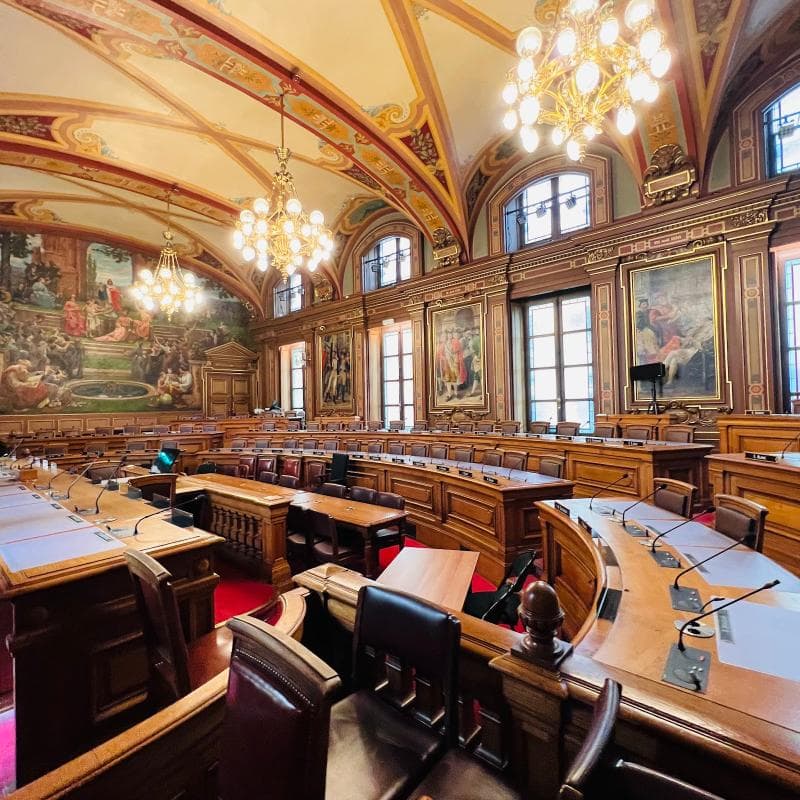
Discover the magnificent Main Facade of Hôtel de Ville de Lyon, France. Explore its rich history, Baroque architecture, and intricate sculptures overlooking Place des Terreaux.
Overview
The Main Facade of the Hôtel de Ville de Lyon stands as a magnificent testament to Lyon's rich history and architectural grandeur, prominently situated between the bustling Place des Terreaux and the Place de la Comédie. This grand building, which serves as the city hall of Lyon, France, is a breathtaking example of 17th-century architecture, primarily in the French Baroque style. Its striking presence defines one of Lyon's most famous public squares, drawing the eye with its symmetrical design and intricate details. Recognized as a Monument Historique by the French government since 1886, the facade offers a compelling visual narrative of the city's past and its enduring civic pride.
Visitors are immediately captivated by the sheer scale and detailed artistry that characterize this architectural masterpiece. It is not merely a government building but a historical landmark that embodies the spirit and resilience of Lyon, making it an essential point of interest for any traveler exploring the city's cultural landscape. From its commanding central position, it gazes across the Place des Terreaux, forming an iconic ensemble with the nearby Bartholdi Fountain and the Museum of Fine Arts.
History & Cultural Background
The construction of the Hôtel de Ville de Lyon commenced between 1646 and 1651, under the direction of architect Simon Maupin, in an era when Lyon's Presqu'île district was rapidly developing into the city's administrative heart. The project was conceived to reflect the growing influence and wealth of the city during the reign of King Louis XIV, with its foundation stone reportedly laid on the king's birthday in 1646.
However, the building's journey was marked by adversity. A devastating fire in 1674 severely damaged the structure, including its facade. King Louis XIV then commissioned the esteemed architect Jules Hardouin-Mansart, renowned for his work on Versailles, along with his pupil Robert de Cotte, to oversee its restoration and modification. This rebuilding phase introduced new elements and cemented its grand design, largely shaping the facade we admire today. The facade also witnessed the tumultuous events of the French Revolution. In 1792, the original half-relief of King Louis XIV on horseback was removed by revolutionaries, only to be replaced by a statue of Henry IV during the Restoration period. Another fire in 1803 necessitated further renovations, ensuring the building's continued grandeur through centuries of change.
What Makes It Special
The Main Facade of the Hôtel de Ville de Lyon is distinguished by its classic French Baroque characteristics, featuring a symmetrical frontage of nine bays. The end two bays on either side project forward as pavilions, adding depth and grandeur to the design. At the center, an equestrian statue of Henry IV proudly presides, flanked by elegant female figures that allegorically represent the two great rivers of Lyon, the Saône and the Rhône, flowing into the city. This sculptural group is a powerful symbol of Lyon's geography and vitality.
Further enhancing its visual appeal are the meticulously carved details throughout the facade. The ground floor windows are adorned with architraves and keystones, while the first-floor windows are fenestrated with triangular pediments. Intricate Ionic order columns frame various sections, and a balustraded parapet crowns the roofline, embellished with finely sculpted figures. The facade's central clock tower and belfry are particularly noteworthy, housing one of Europe's largest carillons, comprising 65 bells that periodically fill the square with their unique sound. Additionally, medallions depicting members of the Bourbon dynasty, including Henri IV, Louis XIII, Louis XIV as a child, and Anne of Austria, are found on the ground floor, offering a glimpse into France's royal past.
Stories, Fun Facts & Local Details
The facade of the Hôtel de Ville de Lyon holds many stories, reflecting the city's dynamic past. A fascinating detail is the changing central equestrian statue. Originally depicting Louis XIV, it was violently removed during the fervor of the French Revolution, only to be replaced later by Henry IV, symbolizing the shifts in political power. This alteration underscores the building's role as a silent witness to monumental historical events.
Another captivating feature is the impressive carillon housed within the central bell tower. With 65 bells, it is counted among Europe's largest, and its periodic ringing adds a unique auditory layer to the ambiance of Place des Terreaux. For those with a keen eye for subtle humor, a unique angel-shaped knocker, locally known as the 'Heurtoir Tony Tape-du-cul', can be found on the doors of the City Hall, often cited by locals as an example of French wit. The building's careful alignment with the famous Bartholdi Fountain on Place des Terreaux, created by the sculptor of the Statue of Liberty, Frédéric Auguste Bartholdi, transforms the entire area into a grand outdoor gallery, where history and art converge in striking harmony.
Visitor Perspective
From a visitor's perspective, approaching the Main Facade of the Hôtel de Ville de Lyon is an immersive experience. The facade is freely accessible at all times, allowing travelers to marvel at its architectural splendor and intricate details from the expansive Place des Terreaux. It serves as a natural focal point for photographs, particularly against the backdrop of the square's vibrant atmosphere.
While the interior of the Hôtel de Ville is primarily an active administrative center, making public access generally restricted, special opportunities do arise. During events like the annual European Heritage Days, or through specific organized tours, visitors might gain entry to experience its opulent interior halls, adorned with gilding and historical paintings. However, the true spectacle for most lies in appreciating the exterior. Taking time to observe the various sculptures, the ornate columns, and the majestic clock tower provides a deep appreciation for the artistry and historical significance embedded within its stone. Its central location also makes it an ideal starting point for exploring other nearby cultural gems, including the Museum of Fine Arts and the famed Bartholdi Fountain, all within easy walking distance.
Coordinates: 4.835, 45.76778
View on Google Maps💬 How Travelers Describe This Place
Based on community votes
Photogenic
998Must See
685Unique
472Beautiful
399Interesting
92
Traveler Stories
Discover memorable experiences shared by travelers who have visited this place.
No traveler stories yet.
Be the first traveler to share what made this place memorable.

Tour
By
Spot
Discover amazing places around the world. Your journey starts here.
Explore
© 2026 TourBySpot. All rights reserved.