Main Dome
Lviv, Ukraine
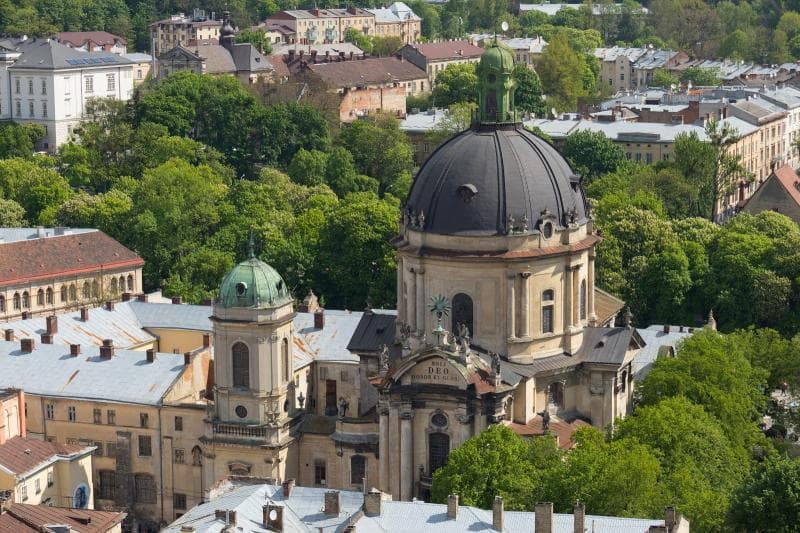
Explore the Main Dome of Lviv's Dominican Cathedral, an iconic Baroque masterpiece in Ukraine. Discover its rich history, unique architecture, and cultural significance.
Overview
The Dominican Cathedral in Lviv, Ukraine, officially known today as the Church of the Holy Eucharist, is a magnificent example of Late Baroque architecture, dominating the city's Old Town skyline. Its most distinguishing feature, a colossal dome, crowns the edifice and is visible from various vantage points across Lviv. While not technically a cathedral in the sense of being a bishop's seat, its sheer scale and historical significance have earned it this popular moniker among locals and visitors alike. The structure stands on Muzeina Square, serving as a vibrant spiritual center for the Ukrainian Greek Catholic Church and a testament to centuries of Lviv's rich and often turbulent history.
This architectural masterpiece, with its grand elliptical design and monumental dome, reflects a deep-rooted history, from its origins as a 13th-century Dominican monastery to its role as a museum during the Soviet era. The dome itself is not merely an architectural element; it is a symbol of endurance, artistic ambition, and the spiritual heart of a city that has seen numerous transformations.
History & Cultural Background
The story of the Dominican Cathedral begins in the 13th century when the Dominican Order first established a presence in Lviv. The initial wooden church, believed to have been built around 1234, was founded under the patronage of Princess Constance, wife of Prince Lev. Over the centuries, several earlier churches on this site faced destruction by fire and warfare, only to be rebuilt with unwavering dedication. A Gothic church, constructed in 1378, eventually made way for the current Baroque structure after structural issues emerged in the mid-18th century.
The present-day church, designed by military engineer Jan de Witte, was constructed between 1749 and 1764. Its creation was generously supported by Polish nobility, notably Józef Potocki, who laid the cornerstone, and Mikołaj Bazyli Potocki. Consecrated in 1764, the church originally served as the Roman Catholic Church of Corpus Christi. Its journey through time includes a period under Soviet rule when it was converted into a warehouse and later a Museum of Religion and Atheism, a stark contrast to its sacred origins. Following Ukraine's independence, the church was rightfully returned to religious use, becoming the Church of the Holy Eucharist under the Ukrainian Greek Catholic Church.
What Makes It Special
The Dominican Cathedral's dome is arguably its most striking feature and a defining element of Lviv's architectural panorama. Described as a 'huge towering green dome', it is supported by eight pairs of columns, a powerful visual statement that captures attention from afar. This 'green cap' is famously visible from all high points of Lviv, becoming an instantly recognizable landmark. Its massive elliptical shape, topped with a radiant sunburst cross, dramatically rises above the surrounding rooftops, showcasing the grandeur of Central European Baroque influence.
Inside, the dome contributes to an interior known for its spaciousness and balanced proportions. The central section of the church forms an ellipse, over which the massive cupola presides. The interior beneath the dome is often described as feeling 'weightless' and 'unadorned', creating an atmosphere of calm and contemplation that highlights the church's long liturgical tradition. The play of light against the pale walls and gilded accents further enhances the spiritual ambiance, drawing the eye upwards towards the majestic dome.
Stories, Fun Facts & Local Details
The persistent presence of a Dominican church on this very spot for centuries is a story of incredible resilience. The order rebuilt their place of worship multiple times after devastating fires, showcasing an unwavering dedication. Imagine the skill of the 18th-century architects and builders who erected such a monumental dome without modern technology, creating an architectural marvel that has stood the test of time. Local lore suggests that the excellent acoustics beneath the dome have made it an ideal venue not just for religious services but also for concerts and cultural events, adding another layer to its community role. It’s also fascinating to consider how the dome’s 'green patina' – likely from copper – has developed over centuries, making it a living canvas of time and weather. The architectural style of the Dominican Cathedral, with its echoes of the Karlskirche in Vienna, reflects broader European influences and the ambitions of its designers to create a truly grand sacred space.
Visitor Perspective
For any traveler exploring Lviv, the Dominican Cathedral and its iconic dome are an unmissable sight. As you approach Muzeina Square, the dome immediately commands attention, its monumental presence a stark contrast to the surrounding historical buildings. Walking beneath the soaring ceilings, beneath the massive cupola, one can't help but feel a sense of awe and wonder. The expansive interior, with its dynamic high-rise space and elegant rococo carvings of Dominican saints, offers a profound experience of Baroque artistry. It's a place where history whispers from every corner, from the alabaster gravestones carried over from earlier structures to the solemnity of the present-day services. Whether admiring its exterior from a distant viewpoint or gazing up at the interior's 'weightless' dome, the Main Dome of the Dominican Cathedral offers a memorable journey through Lviv's spiritual, cultural, and architectural heritage.
Coordinates: 24.03417, 49.84278
View on Google Maps💬 How Travelers Describe This Place
Based on community votes
Beautiful
896Interesting
550Must See
95Photogenic
56Unique
28
Traveler Stories
Discover memorable experiences shared by travelers who have visited this place.
No traveler stories yet.
Be the first traveler to share what made this place memorable.

Tour
By
Spot
Discover amazing places around the world. Your journey starts here.
Explore
© 2026 TourBySpot. All rights reserved.