Main Basilica Interior
Venice, Italy
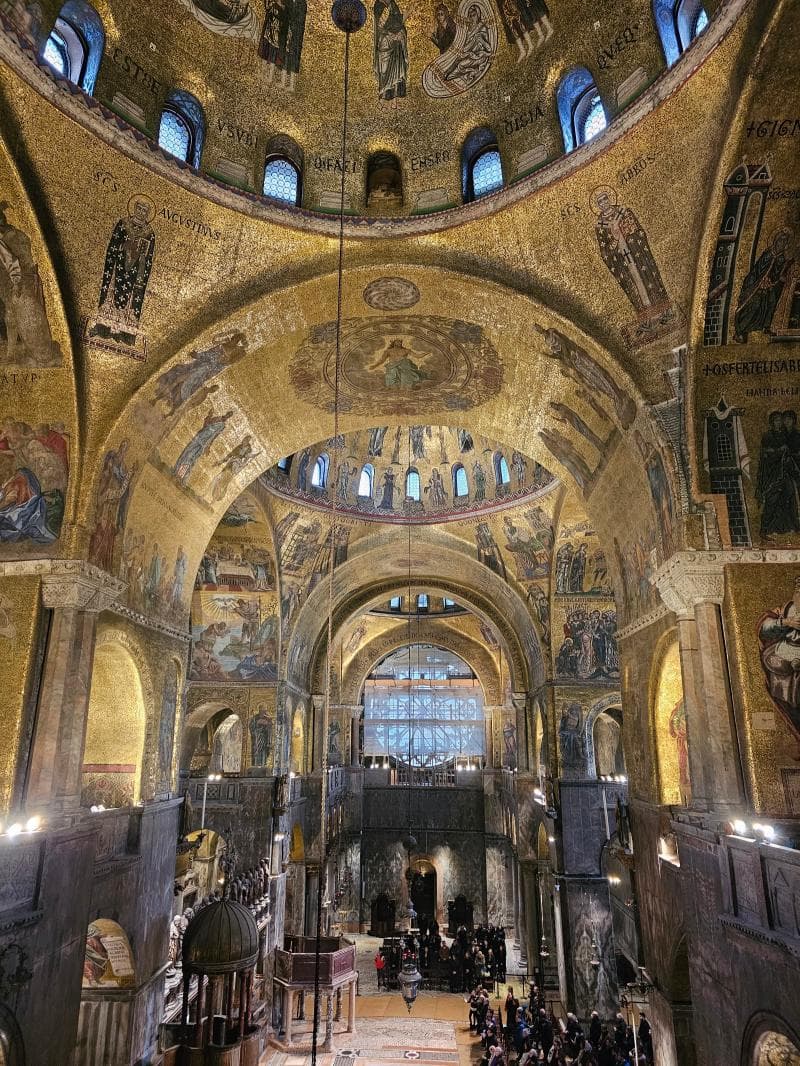
Explore the opulent Main Basilica Interior of St. Mark's Basilica in Venice, Italy, a marvel of golden mosaics, Byzantine art, and rich history.
Overview
Step inside the Main Basilica Interior of St. Mark's Basilica in Venice, Italy, and prepare to be enveloped in a shimmering world of gold and light. Often affectionately known as the 'Chiesa d'Oro' or 'Church of Gold,' this sacred space is a dazzling testament to centuries of Venetian artistry, wealth, and profound spiritual devotion. Every surface, from the towering domes to the intricate floors, tells a story, making it far more than just a church; it is a living canvas of history and faith. Visitors are immediately struck by the sheer opulence and the unique blend of Eastern and Western artistic traditions that define its character.
History & Cultural Background
The origins of St. Mark's Basilica are deeply intertwined with Venice's ambition to establish itself as a powerful maritime republic. Its story began in 828 AD when Venetian merchants famously (or infamously) smuggled the relics of Saint Mark the Evangelist from Alexandria, Egypt, reportedly hiding them under layers of pork to bypass customs. This audacious act transformed St. Mark into Venice's patron saint and necessitated a grand structure to house his revered remains. The first basilica, built in 828, was a more modest affair, succeeded by a second structure that was largely destroyed by fire in 976. The current basilica, whose construction commenced around 1063 and was consecrated in 1094, became the third iteration on this significant site. Its design was heavily inspired by Byzantine architecture, particularly the Church of the Holy Apostles in Constantinople, reflecting Venice's extensive trade and cultural connections with the East. For many centuries, it served not as a public cathedral but as the private chapel of the Doge, the elected leader of the Venetian Republic, symbolizing the close relationship between church and state.
What Makes It Special
The interior of St. Mark's Basilica is most renowned for its breathtaking golden mosaics, which cover an astonishing 8,000 square meters—a surface area large enough to cover more than one and a half American football fields. These intricate artworks, crafted from tiny pieces of glass called tesserae, adorn the ceilings, walls, and five domes, depicting biblical narratives, stories of saints, and allegorical figures. Developed over eight centuries, these mosaics represent a unique blend of Byzantine and Western European styles, with some derived from traditional Byzantine representations and others based on drawings by prominent Renaissance artists. Another jewel within is the Pala d'Oro, an exquisite altarpiece located behind the high altar. This masterpiece of Byzantine craftsmanship is fashioned from gold, silver, and adorned with approximately 1,900 precious stones, including pearls, garnets, emeralds, sapphires, and amethysts. The Pala d'Oro features 187 enamel plaques illustrating scenes from the lives of Christ, the Virgin Mary, and various saints. The basilica's five grand domes, arranged in a Greek cross layout, are also spectacularly decorated with golden mosaics, earning the basilica its nickname. Beneath this gilded splendor, the floors are a mosaic of marble and limestone, laid in intricate geometric patterns and animal motifs using techniques like opus sectile and opus tessellatum, many sourced from Constantinople and Byzantine Greece.
Stories, Fun Facts & Local Details
The legend of St. Mark's relics being smuggled from Alexandria is famously depicted in a 13th-century mosaic above one of the front entrances. It's said the Venetians hid the remains beneath pork to outwit Muslim guards, a vivid tale that underscores the city's resourceful, and sometimes audacious, spirit. The sheer scale of the mosaic work is mind-boggling; imagine artisans meticulously placing millions of tiny tesserae over hundreds of years to create this sacred narrative. The interior is supported by over 500 columns and capitals, many of which are Byzantine and date back to the 6th century, some even older, reflecting Venice's habit of bringing back treasures from its expeditions. The Pala d'Oro itself has a fascinating history, commissioned in the 10th century and later enhanced with spoils from the Fourth Crusade in 1204, further enriching its already immense value. It was traditionally unveiled only during the most solemn religious feasts, a spectacular sight reserved for significant occasions.
Visitor Perspective
Stepping into the Main Basilica Interior is an overwhelming experience for many, a true 'wow moment' as visitors gaze upon the centuries of golden mosaics that cover almost every visible surface. The ambient light within the basilica plays a crucial role in how the mosaics are perceived; visiting between 11:30 AM and 12:30 PM is often recommended, as the church turns on all its interior lights, allowing for optimal viewing of the intricate details and shimmering gold. Alternatively, during earlier or later hours, the natural light filtering through creates a more atmospheric, deeper glow. Beyond the main mosaics, don't miss the Zen Chapel with its mosaic cycle illustrating St. Mark's life, or the Treasury, which houses a collection of religious relics and precious objects acquired during the Fourth Crusade. The interior also contains the crypt, believed to have housed St. Mark's body before its relocation to the high altar. To fully appreciate the artistry, consider bringing binoculars to examine the detailed biblical scenes high above. The interior serves as a powerful reminder of Venice's historical grandeur and its profound connection to both Eastern and Western cultures.
Coordinates: 12.3395, 45.434
View on Google Maps💬 How Travelers Describe This Place
Based on community votes
Unique
791Interesting
514Beautiful
457Must See
252Photogenic
207
Traveler Stories
Discover memorable experiences shared by travelers who have visited this place.
No traveler stories yet.
Be the first traveler to share what made this place memorable.

Tour
By
Spot
Discover amazing places around the world. Your journey starts here.
Explore
© 2026 TourBySpot. All rights reserved.