Main Arch Structure
Chisinau, Moldova
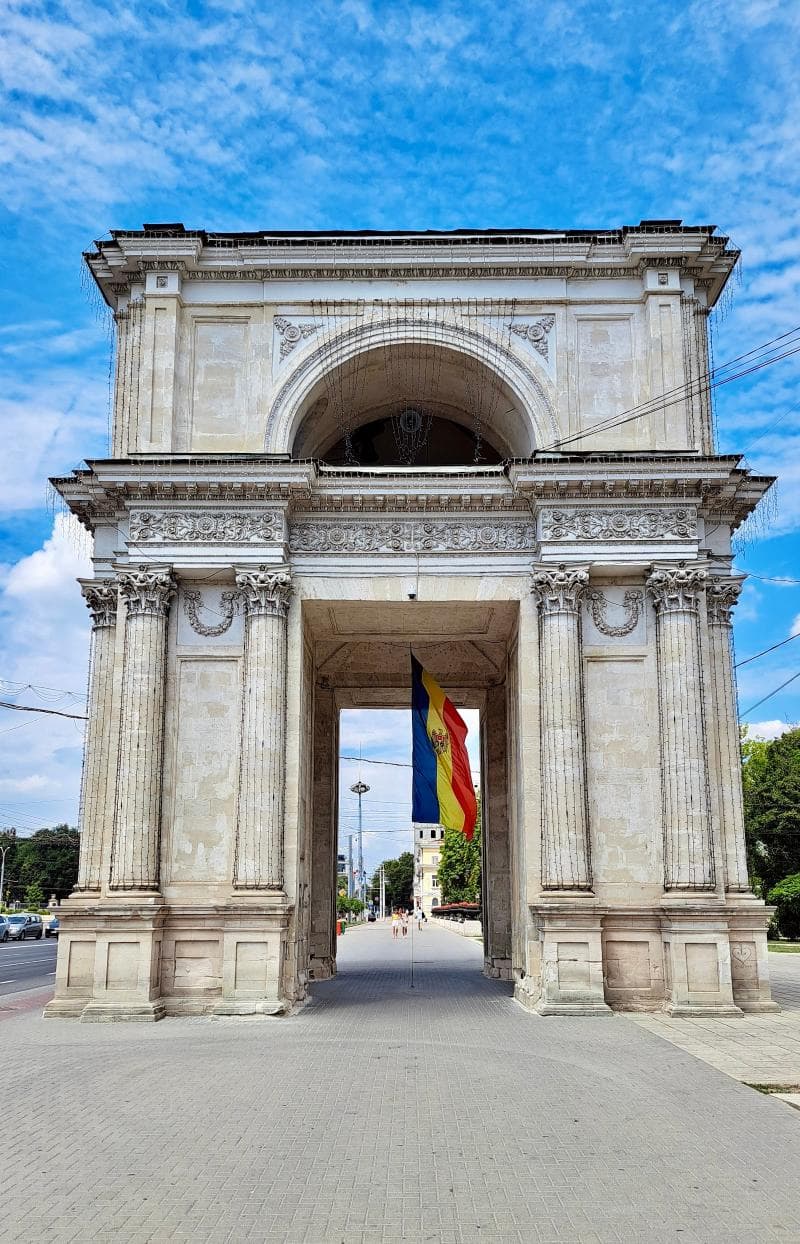
Explore the Triumphal Arch in Chisinau, Moldova. Discover its unique history, neoclassical architecture, and the fascinating stories behind this iconic landmark.
Overview
The Triumphal Arch, known locally as Arcul de Triumf, stands as a prominent and cherished landmark in the heart of Chisinau, Moldova. It is situated centrally on Piața Marii Adunări Naționale, directly opposite the Government House and adjacent to the revered Nativity Cathedral. This elegant structure, often referred to as the Holy Gates or the Arch of Victory, is crafted from polished white stone, presenting a square plan with four majestic openings. Standing approximately 13 meters tall, its design is an integral part of the city center's architectural ensemble, serving as a symbolic gateway to Cathedral Park.
History & Cultural Background
The construction of Chisinau's Triumphal Arch dates back to 1840-1841, designed by the Odessa architect Luka Zaușchevici. Its primary purpose was to commemorate the Russian Empire's victory over the Ottoman Empire during the Russo-Turkish War of 1806-1812 or 1828-1829, a pivotal moment in the region's history. Interestingly, the arch's existence is somewhat serendipitous; it was originally built to house a massive 6.4-ton bell that had been cast from captured Turkish cannons but proved too large for the nearby Nativity Cathedral's belfry. Over the decades, the monument has witnessed various periods of Moldovan history, reflected in its changing names, including Arch of Victory during the Soviet era. In 1945, marble memorial plaques detailing Soviet patriotic scenes and honoring heroes of the Second World War were affixed to its walls, only to be removed in 1991 following Moldova's independence.
What Makes It Special
The Triumphal Arch's uniqueness stems from several compelling aspects. Foremost is its remarkable origin story: conceived not merely as a symbol of military triumph but as a practical solution to house an oversized church bell. This massive bell, weighing around 6.4 tons, was historically cast from the metal of Turkish cannons, literally turning instruments of war into a symbol of peace and spiritual purpose. Another distinctive feature is the mechanical clock gracing its facade. This timepiece has a storied past, with the first clock appearing in 1842, later replaced in 1881, and tragically damaged during World War II before being repaired. Its architecture is also captivating, showcasing a neoclassical style with four sturdy Corinthian pillars supporting its structure, adorned with ceramic ornaments. Its strategic alignment with the Nativity Cathedral and its bell tower led to its designation as the 'Holy Gates', marking a ceremonial entrance to the sacred space. Many consider it one of the world's most beautiful triumphal arches, a testament to its enduring charm and historical significance.
Stories, Fun Facts & Local Details
The most charming anecdote surrounding the Triumphal Arch is its 'accidental' birth. Imagine a bell so grand it couldn't fit its intended home; thus, an arch was constructed specifically to embrace it. This bell, forged from captured cannons, offers a tangible link to the very conflict the arch commemorates. The arch's clock, a silent observer of Chisinau's changing times, has survived vandalism attempts, including one in the early 2000s when youngsters bent its hands for scrap metal, only for them to be meticulously restored. Locals often refer to it affectionately by its various historical names, reflecting a layered past that resonates with the city's identity. During national holidays, the area around the arch buzzes with activity, serving as a backdrop for parades and celebrations, where you can feel the pulse of Moldovan culture. The arch's central location has also earned it the informal title of the 'Moldavian Champs-Élysées', signifying its importance as the city's focal point. It truly marks the zero-kilometer point of the capital, a starting line for all urban exploration.
Visitor Perspective
For any traveler to Chisinau, the Triumphal Arch is an unmissable stop. Its central location makes it incredibly accessible, positioned conveniently in the Great National Assembly Square, right beside the tranquil Cathedral Park. The arch is an open architectural monument, meaning it can be visited freely at any time of day or night, year-round, without tickets or prior bookings. Walking beneath its historic arches allows for an intimate appreciation of its intricate details and imposing scale. It is particularly enchanting in the evening when subtle lighting enhances its architectural beauty, offering a perfect photo opportunity. Many visitors find it an ideal starting point for a walking tour of Chisinau's historical center, providing an easy transition to the adjacent Nativity Cathedral and the lush greenery of Cathedral Park. Whether you seek historical depth or simply a beautiful urban landmark, the Triumphal Arch offers a meaningful glimpse into Moldova's rich heritage.
Coordinates: 28.8325, 47.02472
View on Google Maps💬 How Travelers Describe This Place
Based on community votes
Interesting
853Must See
667Unique
190Photogenic
93Beautiful
32
Traveler Stories
Discover memorable experiences shared by travelers who have visited this place.
No traveler stories yet.
Be the first traveler to share what made this place memorable.

Tour
By
Spot
Discover amazing places around the world. Your journey starts here.
Explore
© 2026 TourBySpot. All rights reserved.