Love Lock Area
Frankfurt, Germany
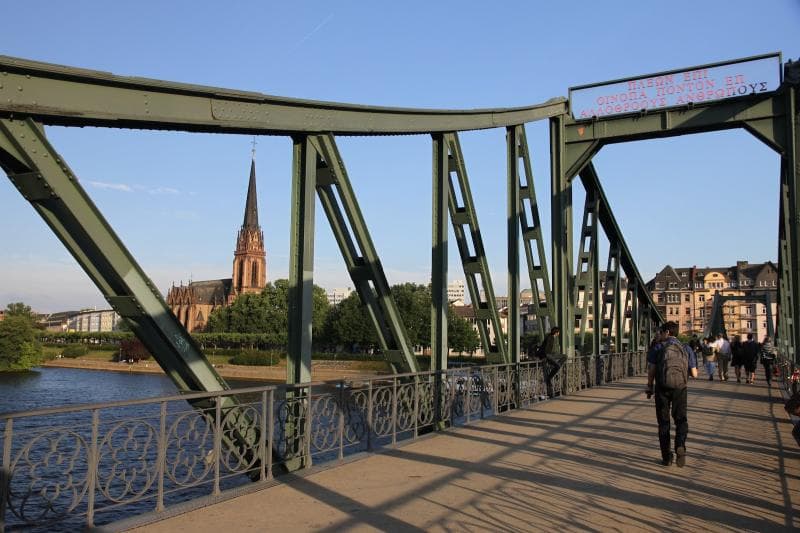
Discover the enchanting Love Lock Area on Eiserner Steg in Frankfurt, Germany. Explore its history, cultural significance, and thousands of romantic padlocks.
Overview
The Eiserner Steg, often translated as the Iron Footbridge, is a prominent pedestrian bridge spanning the Main River in Frankfurt, Germany. This iconic structure serves as a vital link, connecting the historic city center, or Altstadt, with the vibrant Sachsenhausen district on the southern bank. More than just a crossing, the Eiserner Steg has become synonymous with romance, largely due to its 'Love Lock Area'. Here, thousands of padlocks, inscribed with names and messages, adorn the bridge's railings, creating a colorful testament to enduring affection. It is a much-photographed and visited spot, offering breathtaking panoramic views of Frankfurt's impressive skyline, often nicknamed 'Mainhattan', and the serene Museum Embankment.
History & Cultural Background
The story of the Eiserner Steg is one of resilience and civic pride. The first iteration of the bridge was constructed in 1868, financed by public subscription, reflecting the community's desire for a direct pedestrian link across the Main. Initially a wrought-iron structure, it was later replaced in 1911/1912 by a larger steel cantilever bridge to accommodate increasing traffic. Tragically, the bridge was destroyed by the German Wehrmacht in March 1945 during the final days of World War II. However, demonstrating the city's unwavering spirit, it was rapidly rebuilt by 1946, becoming one of the first structures restored in the war-devastated city and a powerful symbol of Frankfurt's determination to rebuild. The bridge underwent a significant renovation in 1993, which also saw the installation of elevators for improved accessibility.
Adding another layer of cultural significance, the Eiserner Steg features a Greek inscription from Homer's Odyssey. This quote, which translates roughly to 'Sailing across the wine-dark sea to people of another language', symbolizes humanity's enduring desire for connection and exploration. It is believed this inscription, installed by artist Hagen Bonifer in 1999, was chosen to acknowledge Frankfurt's diverse demographic and its historical role as a center for trade and international exchange.
What Makes It Special
The Eiserner Steg stands out for several reasons. Firstly, its strategic location provides unparalleled vistas. From its center, visitors can gaze upon the stunning contrasts of Frankfurt: the gleaming skyscrapers of the financial district on one side and the historical architecture and lush Museumsufer on the other. These views are particularly captivating at sunset when the city lights begin to reflect on the Main River.
Secondly, the bridge is a living monument to human connection and enduring love. The 'Love Lock Area' transforms an engineering marvel into an interactive art installation, where each padlock tells a personal story of affection and commitment. This modern tradition has infused the historic bridge with a contemporary romantic charm, drawing couples from around the globe to participate in this symbolic ritual. The bridge is not merely a path; it is a destination, a place where history and heartfelt personal gestures intertwine.
Stories, Fun Facts & Local Details
The tradition of love locks, while globally widespread, finds a poignant home on the Eiserner Steg. Couples engrave their initials or a special date onto a padlock, secure it to the bridge's framework, and then, as tradition dictates, cast the key into the Main River below. This act symbolizes an unbreakable bond, an eternal commitment cast into the river's flow. This practice has earned the Eiserner Steg affectionate nicknames such as 'Padlock Bridge' or the 'Frankfurt Love Bridge'.
While the exact origin of the love lock tradition is debated, with theories pointing to Italy or even a Serbian village before World War I, its popularity soared across Europe in the early 2000s. On the Eiserner Steg, these countless locks form a vibrant, ever-evolving mosaic that changes with each new declaration of love. Beyond romance, the bridge's Homeric inscription—'Sailing across the wine-dark sea to people of another language'—is a fascinating detail. It was thoughtfully chosen to reflect Frankfurt's open and diverse character, a city that has always welcomed travelers and different cultures.
Visitor Perspective
For a curious traveler, walking across the Eiserner Steg is an essential Frankfurt experience. It offers more than just a means to get from one side of the river to the other; it's a journey through history, culture, and emotion. The gentle sway of the bridge, the subtle creak of the ironwork, and the sheer volume of locks create an immersive atmosphere. You'll find yourself pausing, not just for the stunning photographs of the 'Mainhattan' skyline or the Museumsufer, but to observe the myriad of locks, each a silent pledge.
Whether you're visiting with a loved one, contemplating your own connections, or simply admiring the cityscape, the Love Lock Area on the Eiserner Steg invites contemplation and wonder. It's a place where personal stories are publicly celebrated, woven into the very fabric of a historic landmark. The bridge, which thousands of people cross daily, often feels particularly romantic at dusk, as the city lights begin to twinkle and the locks glint in the fading light.
Coordinates: 8.6814, 50.1086
View on Google Maps💬 How Travelers Describe This Place
Based on community votes
Unique
934Must See
879Beautiful
741Interesting
276Photogenic
30
Traveler Stories
Discover memorable experiences shared by travelers who have visited this place.
No traveler stories yet.
Be the first traveler to share what made this place memorable.

Tour
By
Spot
Discover amazing places around the world. Your journey starts here.
Explore
© 2026 TourBySpot. All rights reserved.