Loggia Dei Lanzi
Florence, Italy
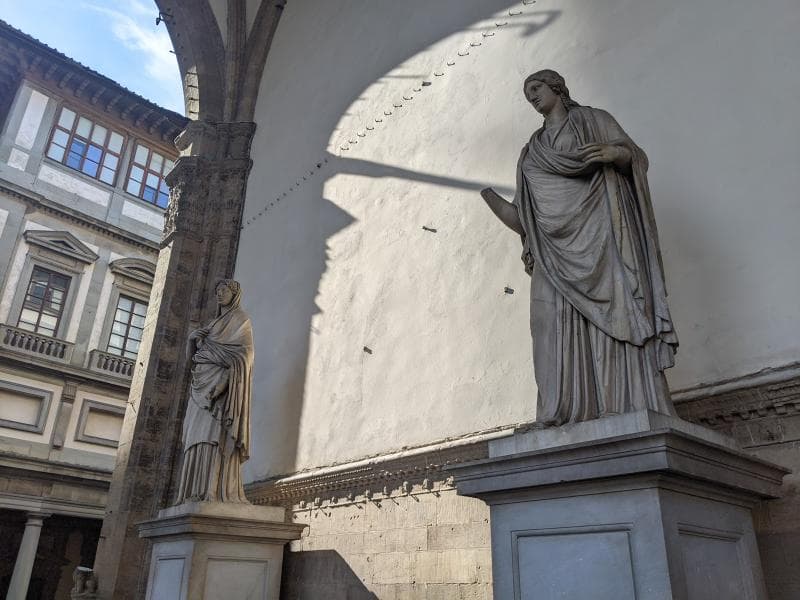
Discover Loggia dei Lanzi in Florence, Italy, an iconic open-air sculpture gallery in Piazza della Signoria showcasing masterpieces like Cellini's Perseus.
Overview
Nestled in the heart of Florence, Italy, within the magnificent Piazza della Signoria, stands the Loggia dei Lanzi. This elegant open-air gallery, often described as an outdoor museum, offers a captivating glimpse into Florence's rich artistic and political past. With its grand arches and impressive collection of sculptures, the Loggia invites travelers to pause and immerse themselves in centuries of history and artistic mastery. It adjoins the renowned Uffizi Gallery, making it an unmissable stop for anyone exploring the city's historic center.
Initially constructed for civic purposes, the Loggia dei Lanzi transformed over time into a public exhibition space, housing both ancient Roman and Renaissance masterpieces. Its strategic location in Piazza della Signoria, directly in front of the Palazzo Vecchio, has always placed it at the center of Florentine life. Today, it remains a free and accessible monument, allowing visitors to admire some of the world's most iconic sculptures in a truly unique setting, day or night.
History & Cultural Background
The Loggia dei Lanzi, originally known as Loggia della Signoria, was built between 1376 and 1382 by Benci di Cione and Simone di Francesco Talenti, possibly following a design by Jacopo di Sione. Its primary function during the Florentine Republic was to serve as a venue for public assemblies, ceremonies, and the swearing-in of city officials, offering a sheltered space for important civic events.
Architecturally, the Loggia exhibits a late Gothic style, yet its wide, sweeping arches are considered a significant precursor to the Renaissance aesthetic. It is even suggested that these arches inspired Filippo Brunelleschi's design for the Ospedale degli Innocenti. The name 'Loggia dei Lanzi' emerged in the mid-16th century when Grand Duke Cosimo I de' Medici used the structure to house his German mercenary pikemen, known as 'Lanzichenecchi', a term corrupted to 'Lanzi'. With the rise of the Medici family's power, the Loggia's purpose shifted. It evolved into one of the world's first open-air sculpture galleries, intended not just for aesthetic display but to powerfully express Medici rule and political messages through carefully selected artworks.
What Makes It Special
What truly distinguishes the Loggia dei Lanzi is its dual identity as both a historical architectural marvel and an unparalleled open-air sculpture museum. The three grand arches, supported by clustered columns with Corinthian capitals, create an imposing yet welcoming space. Above these arches, decorative medallions feature allegorical figures representing the four cardinal virtues: Fortitude, Temperance, Justice, and Prudence, crafted from designs by Agnolo Gaddi.
The collection of sculptures within the Loggia is extraordinary. It includes Benvenuto Cellini's bronze masterpiece, 'Perseus with the Head of Medusa' (1545-1554), a powerful work commissioned by Cosimo I de' Medici to symbolize the triumph of the Medici over republican institutions. Another highlight is Giambologna's dynamic 'Rape of the Sabine Women' (1579-1583), notable for being one of the first group sculptures designed to be admired from all angles, carved from a single, challenging block of marble. Also present are Giambologna's 'Hercules and the Centaur Nessus' and Pio Fedi's 'Rape of Polyxena', alongside ancient Roman statues, including 'Menelaus supporting the body of Patroclus' and a series of Roman female figures.
Stories, Fun Facts & Local Details
The sculptures within the Loggia dei Lanzi tell more than just mythological tales; they whisper stories of Florentine political intrigue. For instance, when the Medici were initially expelled from Florence in 1494, Donatello's 'Judith and Holofernes', symbolizing the overthrow of tyranny, was placed in the Loggia. However, upon the Medici's return, this republican symbol was replaced by their own narratives of power. Cellini's 'Perseus' was a direct response, its gruesome depiction of Medusa's severed head a stark warning to those who might challenge Medici authority.
A fascinating detail for keen observers is found on Cellini's 'Perseus'. If you look closely at the back of Perseus' helmet, you might just spot a miniature self-portrait of the sculptor himself. Another curious aspect is the pair of 'Medici Lions' guarding the steps: one is an authentic Roman antiquity from the 2nd century AD, while the other was sculpted by Flaminio Vacca in 1598 to create a symmetrical pair, demonstrating Renaissance artists' reverence for classical works. High above, a terrace, once a private viewing spot for the Medici to observe events in the Piazza, was created by Bernardo Buontalenti after the Uffizi Gallery's construction. Today, this terrace is part of the Uffizi Museum and houses a bar, offering stunning panoramic views.
Visitor Perspective
Visiting the Loggia dei Lanzi offers a truly accessible and enriching experience for any traveler to Florence. As a free and always-open public space, it provides an intimate encounter with world-class art without the constraints of museum hours or entry fees. You can wander beneath its arches at your leisure, taking photographs and observing the intricate details of each sculpture from various angles, even under the atmospheric night sky.
While a quick walk-through might take only 15-30 minutes, allowing more time enables a deeper appreciation of the artworks' historical and artistic significance. The Loggia's location makes it a perfect starting point for further exploration of Piazza della Signoria, the Palazzo Vecchio, and the nearby Uffizi Gallery. It's a place where art, history, and the vibrant life of Florence converge, providing an unforgettable cultural immersion for every curious traveler.
Coordinates: 11.25556, 43.76972
View on Google Maps💬 How Travelers Describe This Place
Based on community votes
Photogenic
951Unique
748Beautiful
499Interesting
427Must See
94
Traveler Stories
Discover memorable experiences shared by travelers who have visited this place.
No traveler stories yet.
Be the first traveler to share what made this place memorable.

Tour
By
Spot
Discover amazing places around the world. Your journey starts here.
Explore
© 2026 TourBySpot. All rights reserved.