Lisbon Cathedral
Lisbon, Portugal
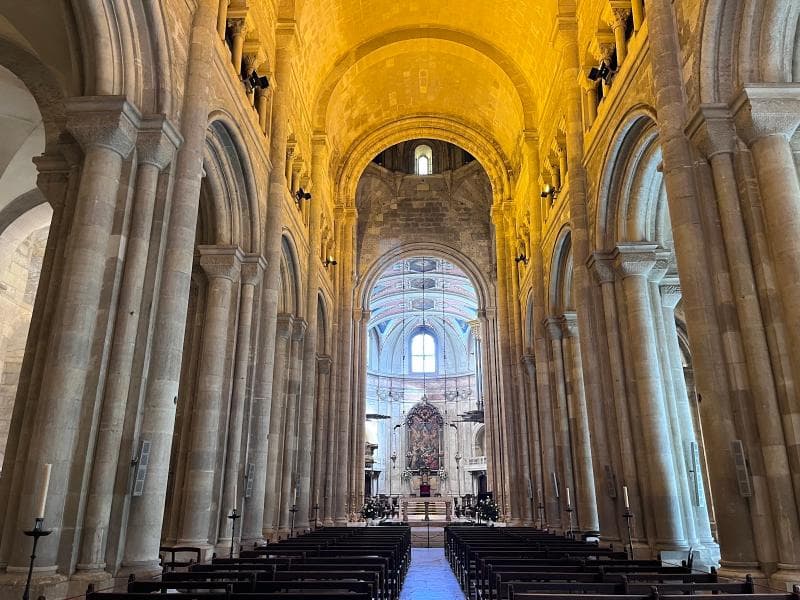
Explore Lisbon Cathedral (Sé de Lisboa) in Alfama District, Lisbon, Portugal. Discover its Romanesque, Gothic, and Baroque history, ancient legends, and unique fortress-like architecture.
Overview
Nestled within the labyrinthine alleys of Lisbon's historic Alfama District stands the venerable Lisbon Cathedral, locally known as Sé de Lisboa or Basilica of Santa Maria Maior. This iconic landmark, a powerful symbol of the city's rich past, is the oldest church in Lisbon, boasting over 800 years of history. Its imposing, fortress-like facade, with two sturdy bell towers, immediately captures attention, hinting at a past where defense was as crucial as devotion. The cathedral's architectural style is a captivating blend, predominantly Romanesque, but featuring elements of Gothic and Baroque, a testament to centuries of construction, destruction, and restoration.
Situated on a hillside, it proudly overlooks the cityscape and the Tagus River, embodying the resilience and spirit of Lisbon. Its strategic location in Alfama makes it an integral part of exploring the city's oldest and most charismatic neighborhood, offering a profound glimpse into its cultural and religious heritage.
As a National Monument since 1910, the Lisbon Cathedral continues to serve as the seat of the Patriarchate of Lisbon, welcoming pilgrims, history enthusiasts, and curious travelers alike to uncover its profound stories and architectural grandeur.
History & Cultural Background
The history of Lisbon Cathedral began in 1147, immediately following the Christian reconquest of Lisbon from Moorish rule by King Afonso Henriques and his crusader forces. It was built upon the site of the city's former main mosque, a common practice in medieval Europe, and archaeological excavations within the cloister have revealed even earlier Roman and Visigothic foundations beneath.
Designed by the French architect Mestre Roberto, the original structure was largely completed in the late 12th and early 13th centuries in the Late Romanesque style, characterized by its thick walls and fortified appearance. Over the centuries, the cathedral endured numerous trials, most notably devastating earthquakes. The earthquake of 1344 caused significant damage, but the most catastrophic was the Great Lisbon Earthquake of 1755, which destroyed the south tower, the Gothic chancel, a royal burial chapel, and parts of the nave roof. These calamities led to extensive reconstruction and renovation, incorporating Gothic elements like the ambulatory and cloister in the 13th and 14th centuries, and later Baroque additions in the 17th and 18th centuries, particularly in the high altar and decoration.
The early 20th century saw revivalist restorations that aimed to return the cathedral to its medieval Romanesque character, removing many Baroque elements and restoring features like the rose window.
What Makes It Special
What truly sets Lisbon Cathedral apart is its formidable, almost castle-like exterior. Unlike many European cathedrals that prioritize soaring Gothic elegance, the Sé de Lisboa's crenellated towers and robust stone walls were a deliberate defensive design, a strongpoint in a city newly wrested from centuries of Islamic rule.
Inside, the austere Romanesque nave, with its barrel vaulting and a Latin cross plan, provides a serene contrast to the exterior's defensive posture. However, it is the Gothic cloister, built in the 14th century, that holds some of the cathedral's most compelling secrets. Here, archaeological excavations have unearthed layers of history, revealing Roman road foundations and remnants of Moorish buildings, offering a tangible journey through Lisbon's ancient past.
The cathedral also houses a Treasury, located in the sacristy, which displays a remarkable collection of religious artifacts, jewels, and sacred art spanning various periods, including the venerated relics of Saint Vincent. The reconstructed rose window on the west façade, an iconic feature, bathes the interior in a gentle light, contributing to the cathedral's unique atmosphere.
Stories, Fun Facts & Local Details
The stones of Lisbon Cathedral whisper tales that intertwine with the city's identity. One of the most beloved legends concerns Saint Vincent of Saragossa, Lisbon's patron saint. In 1173, when King Afonso Henriques ordered his relics transferred from the Algarve to Lisbon, tradition holds that two ravens accompanied the ship throughout the journey, guarding the saint's remains. These faithful birds became a permanent symbol of Lisbon, appearing on the city's coat of arms, and remarkably, ravens were reportedly seen nesting around the cathedral towers until 1978.
Another significant figure connected to the cathedral is Fernando Martins de Bulhões, better known as Saint Anthony of Padua. Born in Lisbon in 1195, he was baptized in the cathedral's font, which you can still see near the main entrance. Legend even recounts that as a child studying there, Saint Anthony was tempted by the devil and repelled him by drawing the sign of the cross on a wall, marking what is said to be his first miracle.
Historically, the cathedral held strong ties to Portuguese royalty, serving as the official church for coronations and as the final resting place for several monarchs, including King Afonso IV and his wife Queen Beatriz.
Visitor Perspective
Stepping into Lisbon Cathedral is to step back in time, offering a profound sense of history that contrasts with the bustling Alfama district outside. The interior, though austere compared to some European cathedrals, possesses a quiet dignity. The main nave, with its Romanesque arches, encourages contemplation. Visitors can explore various Gothic chapels, including the significant Capela de Bartolomeu Joanes, and admire the collection in the Treasury Museum.
The Gothic cloister is a must-see, providing not only architectural beauty but also the fascinating archaeological excavations beneath, which literally peel back layers of Lisbon's past. While entry to the main cathedral is often free, there is typically a small fee to access the cloister and Treasury, which is highly recommended for those seeking a deeper understanding. Its location in Alfama means it's easily accessible and often combined with a ride on the iconic Tram 28, making it a perfect starting point for exploring this ancient quarter.
Coordinates: -9.133235, 38.709743
View on Google Maps💬 How Travelers Describe This Place
Based on community votes
Unique
896Photogenic
550Must See
102Beautiful
95Interesting
28
Traveler Stories
Discover memorable experiences shared by travelers who have visited this place.
No traveler stories yet.
Be the first traveler to share what made this place memorable.

Tour
By
Spot
Discover amazing places around the world. Your journey starts here.
Explore
© 2026 TourBySpot. All rights reserved.