Lion Throne Room
Yangon, Myanmar
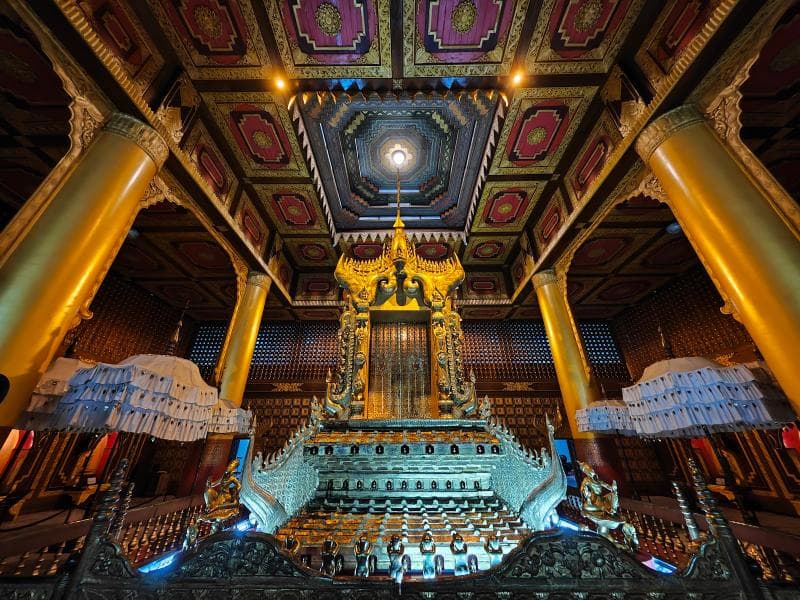
Explore the majestic Lion Throne Room at the National Museum of Myanmar in Yangon, home to the last surviving royal throne of Burmese monarchs.
Overview
Deep within the National Museum of Myanmar in Yangon lies a treasure that embodies centuries of Burmese royal heritage: the Lion Throne Room. This dedicated space houses the magnificent Lion Throne, known as the Sihasana or Thihathana Palin, which served as a paramount symbol of royal authority and prestige for the country's monarchs. As the sole surviving original royal throne, it offers a tangible connection to Myanmar's rich imperial past and the powerful Konbaung Dynasty. Visitors are invited to step into a realm where history and artistry converge, exploring a centerpiece that once dictated the very rhythm of royal court life.
History & Cultural Background
The origins of the Burmese Lion Throne are steeped in ancient traditions, drawing influences from both Indian and Southeast Asian cultures. Historically, Burmese palaces featured eight different types of thrones, each designated for specific royal functions and housed within nine palace halls. Among these, the Lion Throne held the most distinguished position, specifically used for judicial affairs in the Supreme Court (Hluttaw Hall) of the Myanansankyaw Golden Palace during the Yadanabon period.
This particular Lion Throne, crafted from smooth-grained 'Yamanay' wood and heavily gilded, belonged to King Thibaw Min, the last monarch of Myanmar. Its journey to the museum is a tale of historical upheaval. Following the Third Anglo-Burmese War in 1885 and the fall of King Thibaw, the British transported the throne to India, where it was displayed at the Indian Museum in Kolkata. For over six decades, it remained abroad, a poignant symbol of a lost era. However, with Myanmar gaining independence in 1948, the Lion Throne was repatriated, eventually finding its permanent home in the National Museum of Myanmar in 1957.
What Makes It Special
What truly distinguishes the Lion Throne is its unique status as the only original royal throne to have survived the ravages of time. Seven of the eight imperial thrones were tragically destroyed by fire during the Allied bombing in World War II, making this gilded masterpiece an exceptionally rare artifact. Its survival, due to its presence in India, underscores its immense historical value and its role as a national heritage item.
The throne's design is an intricate display of Burmese craftsmanship and symbolic depth. It features elaborate carvings and embellishments, prominently depicting lions—symbols of strength, courage, and royalty in Burmese culture. The upper portion, known as the 'U-gin', is adorned with eleven Chakra and Devas floral carvings. Further symbolic elements include peacock figurines representing the sun and hare figurines representing the moon, reflecting the belief that Burmese kings descended from both Solar and Lunar dynasties. Guardian gods of the world (Lokanat) and 33 figures of Nats (devas), representing the Trāyastriṃśa (abode of gods), are also intricately incorporated, transforming the throne into a microcosm of the celestial realm.
Stories, Fun Facts & Local Details
Beyond its visual splendor, the Lion Throne carries a wealth of stories and protocols. Its usage was highly ceremonial and strictly governed, occupied by the king only three times a year: at the beginning of the Burmese New Year, and at the commencement and conclusion of the Buddhist Lent. An interesting court protocol dictated that anyone presenting a gift to the king while he was on the throne had to seek permission and then touch the throne with their right hand only, as the left was considered inferior.
The Throne Room also displays miniature models of the other seven types of thrones that once existed, offering a glimpse into the broader regal traditions and diverse functions of royal seating. Each of these thrones had distinct designs and purposes, contributing to the rich tapestry of Burmese court life, but it is the Lion Throne that stands as the ultimate embodiment of kingship.
Visitor Perspective
Visiting the Lion Throne Room provides a profound historical experience. Located on the ground floor of the National Museum of Myanmar, it is often highlighted as the museum's main exhibit. While the museum itself offers a comprehensive overview of Burmese history, art, and culture across its five floors, the Lion Throne commands a special reverence.
The room housing the throne is often dimly lit, creating an atmosphere of quiet contemplation that allows visitors to fully appreciate its grandeur and significance. It is important to note that photography is generally not permitted in the Lion Throne Room, ensuring its preservation and encouraging visitors to immerse themselves fully in the moment. This focused viewing opportunity, free from the distractions of digital capture, allows for a deeper connection with this incredible artifact, making it a truly memorable part of any visit to Yangon.
Coordinates: 96.1425, 16.78861
View on Google Maps💬 How Travelers Describe This Place
Based on community votes
Interesting
879Photogenic
741Beautiful
482Unique
396Must See
274
Traveler Stories
Discover memorable experiences shared by travelers who have visited this place.
No traveler stories yet.
Be the first traveler to share what made this place memorable.

Tour
By
Spot
Discover amazing places around the world. Your journey starts here.
Explore
© 2026 TourBySpot. All rights reserved.