Library
Vilnius, Lithuania
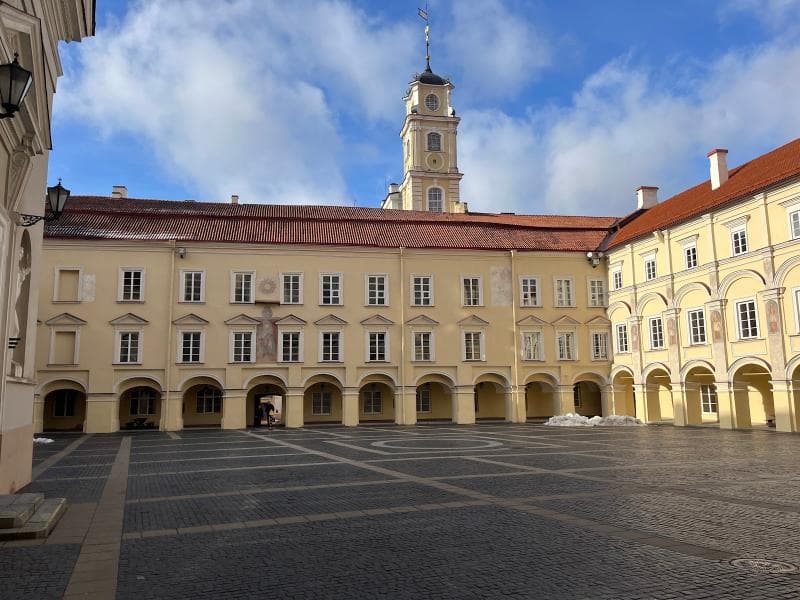
Explore the Vilnius University Library in Vilnius, Lithuania – the oldest in the Baltics. Discover centuries of history, rare collections, and stunning architectural halls.
Overview
The Vilnius University Library, affectionately known as VU Library, stands as Lithuania's oldest and one of its largest academic libraries. Founded by the Jesuits in 1570, it predates Vilnius University itself by nine years, marking it as a profound testament to enduring knowledge and cultural heritage in the Baltic region. More than just a repository of books, it functions as a vibrant cultural institution, meticulously safeguarding a vast collection of documents that trace back centuries.
Today, the library presents a compelling blend of old and new. Its historic Central Library, nestled within the magnificent architectural ensemble of Vilnius Old Town, preserves its authentic 16th-century premises. Complementing this ancient heart is the modern Scholarly Communication and Information Centre (SCIC), a state-of-the-art facility offering round-the-clock access to resources and collaborative spaces.
History & Cultural Background
The origins of the Vilnius University Library are deeply intertwined with the arrival of the Jesuits in Vilnius in 1569, who established a college and its library on July 17, 1570. The foundational collection was remarkably rich, comprising books from the Grand Duke of Lithuania and King of Poland Sigismund Augustus, as well as Bishop Georgius Albinius. King Sigismund Augustus's personal library, for instance, contained classical works, travelogues, historical texts, and literature on natural science, law, and medicine.
In 1579, with the transformation of the Vilnius Jesuit College into a university, the library officially assumed its role as the university library. Over the centuries, its collections expanded significantly through generous bequests from Lithuanian clergy, nobility, and even former university students. A notable donation included the entire collection of Lew Sapieha, given by his son Kazimierz Leon Sapieha, comprising approximately 3,000 volumes. The library endured various historical upheavals, including periods under the Russian Empire when it was temporarily converted into the Vilnius Public Library and Museum, consolidating valuable books from closed institutions. It also faced devastation during World War I and interruptions during World War II.
Following Lithuania's re-establishment of independence, the library embarked on a significant modernization journey. This included the launch of an online electronic catalogue in 1993 and the grand opening of the Scholarly Communication and Information Centre (SCIC) in 2013, ensuring its continued relevance in the digital age.
What Makes It Special
The true gem of the Vilnius University Library lies in its extraordinary collections and its breathtaking historical architecture. With approximately 5.4 million documents and 166 kilometers of shelving, it houses some of the oldest manuscripts, incunabula, and engravings in Lithuania and Eastern Europe. Among its most prized possessions is the first printed Lithuanian book, 'Catechism' by Martynas Mažvydas. The library's rare book department alone holds around 160,000 items published before 1800, including 313 incunabula and 1,650 palaeotypes from renowned Western European publishers.
Visitors can explore magnificent historical halls, each with its unique character. The Franciszek Smuglewicz Hall, for instance, is often likened to a book museum, displaying unique book monuments. The Joachim Lelewel Hall is famous for its cartographic collections, including Professor Lelewel's personal library. The White Hall, which once served as an astronomical observatory, now proudly exhibits a unique collection of ancient astronomical instruments, including globes from the 17th and 18th centuries. The library's rich graphic arts collection, accumulated since 1805, comprises 73,000 works. Since 1965, the VU Library has also served as a depository library for the United Nations, further underscoring its international significance.
Stories, Fun Facts & Local Details
The library's history is peppered with fascinating tales. Imagine the agents of King Sigismund Augustus scouring European cities, including Frankfurt, to acquire books that would form the nucleus of this great institution. The early royal collections were bound in leather with the Polish and Lithuanian coats of arms, showcasing royal ownership.
For many visitors, the atmosphere within the historic halls evokes a sense of wonder, sometimes compared to the magical libraries depicted in 'Hogwarts.' It's one of the few public buildings in Vilnius that has continuously served its original purpose since its founding. The manuscript department holds over 226,000 documents, encompassing personal archives of old Vilnius University professors and even autographs from celebrated figures like Victor Hugo and Voltaire. Beyond its historical depth, the library actively shares its treasures through digital exhibitions on platforms like Google Arts & Culture, allowing a wider audience to delve into its unique decorated papers or explore the world of 17th-century Jesuit scholars.
Visitor Perspective
A visit to the Vilnius University Library offers a journey through time and knowledge. The Central Library, still housed in its original 16th-century premises, provides a traditional and historically immersive experience. Guided tours are available, offering a comprehensive look at the university's architectural ensemble, including the Grand, Observatory, and Mathias Casimir Sarbievius courtyards, and significant halls like the Franciszek Smuglewicz Hall, Joachim Lelewel Hall, and the White Hall. These tours offer a deeper appreciation for the historical and cultural layers of the institution. For those wishing to explore independently, the Franciszek Smuglewicz Hall can often be visited without a guide during specific hours.
In stark contrast, the Scholarly Communication and Information Centre (SCIC) offers a hyper-modern environment designed for contemporary study and research. Located in Saulėtekis, this facility operates 24/7, providing extensive study spaces and advanced technologies. Whether you're seeking the quiet grandeur of centuries-old texts or the dynamic resources of a modern academic hub, the Vilnius University Library caters to diverse interests, making it a must-see for anyone exploring Vilnius. Its status as part of a UNESCO World Heritage Site ensures its architectural and cultural significance are recognized globally.
Coordinates: 25.28725, 54.68284
View on Google Maps💬 How Travelers Describe This Place
Based on community votes
Unique
1.0kMust See
869Beautiful
309Interesting
100Photogenic
63
Traveler Stories
Discover memorable experiences shared by travelers who have visited this place.
No traveler stories yet.
Be the first traveler to share what made this place memorable.

Tour
By
Spot
Discover amazing places around the world. Your journey starts here.
Explore
© 2026 TourBySpot. All rights reserved.