Library Hall
Vientiane, Laos
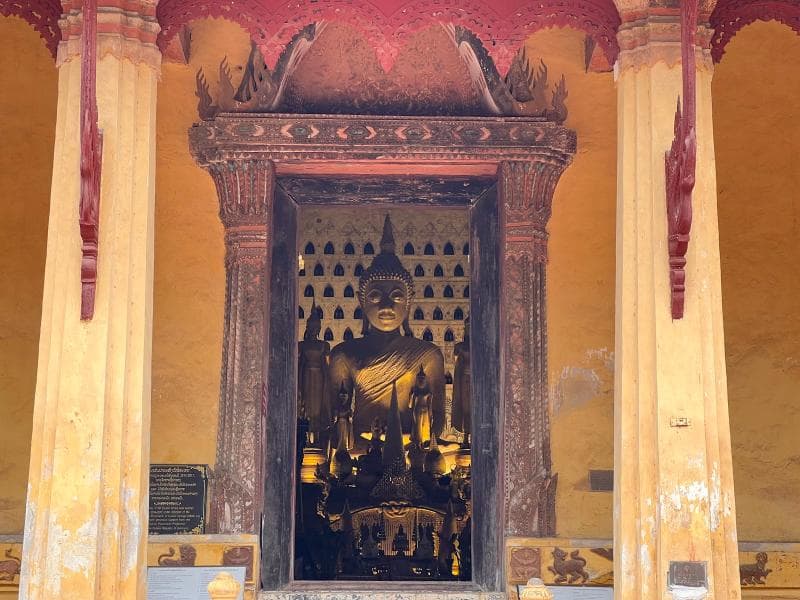
Explore the historic Library Hall (Ho Trai) at Wat Si Saket in Vientiane, Laos, a surviving treasury of ancient Buddhist manuscripts and architecture.
Overview
Tucked within the serene grounds of Wat Si Saket in Vientiane, Laos, lies the venerable Library Hall, often referred to as Ho Trai or the Tripitaka library. This elegant structure stands as a testament to the temple's historical role as a center for Buddhist scholarship and the preservation of sacred texts. Unlike many other structures in Vientiane that succumbed to historical conflicts, Wat Si Saket, including its Library Hall, has remarkably endured, making it one of the oldest surviving temples in the city. Visitors will discover a quiet, reflective space that offers a glimpse into the intellectual and spiritual heritage of Lao Buddhism. Its distinctive architectural style, with a Burmese-style roof, sets it apart within the temple complex and invites curious travelers to explore its storied past.
History & Cultural Background
Wat Si Saket itself was constructed between 1818 and 1824 by King Anouvong, the last monarch of the Kingdom of Vientiane. Uniquely, the temple was built in a Siamese architectural style, which is believed to be a key reason it was spared from destruction during the Siamese invasion of 1828 that devastated much of Vientiane. The Library Hall, or Ho Trai, was an integral part of this early 19th-century complex, designed to house invaluable Buddhist manuscripts. These manuscripts, often inscribed on palm leaves, contained the sacred teachings of the Buddha (the Tripitaka), forming the bedrock of Buddhist education and practice. The Hall's existence underscores the deep reverence for knowledge and scripture within Lao Buddhist culture, where temples historically served not only as places of worship but also as centers of learning and monastic study.
What Makes It Special
The Library Hall's special appeal lies in its enduring presence and its rich, albeit somewhat melancholic, history. It is a rare example of a traditional monastic library that has survived the tumultuous past of Vientiane. Architecturally, the building is distinguished by its well-proportioned square form and a unique Burmese-style roof, offering a visual contrast to some other structures within the compound. Inside, a massive wooden cabinet, though now faded, once showcased intricate black lacquer and gold designs, holding the precious palm-leaf manuscripts. These ancient texts, carefully hand-written, preserved centuries of Buddhist wisdom and philosophy. While many of the original scriptures are said to have been moved to Bangkok following historical events, the Hall itself remains a powerful symbol of the preservation of religious knowledge and artistic craftsmanship in Laos.
Stories, Fun Facts & Local Details
One fascinating detail about the Library Hall is the story of its wooden doors. Of the four wooden doors adorning the structure, only one is believed to be original, with the other three having been restored in 1913. This subtle detail speaks to the continuous efforts over centuries to maintain and preserve this significant sub-spot. Although the valuable palm-leaf manuscripts that once filled the grand cabinet are now reportedly in Bangkok, the thought of monks diligently copying and studying these ancient texts in the very space creates a vivid picture of intellectual devotion. Imagine the quiet contemplation on the small balcony, meant for silent reading, overlooking what is now a bustling street, yet once a tranquil temple ground. The Library Hall is not just a building; it's a silent witness to history, a repository of spiritual thought, and a reminder of the resilience of Lao culture in the face of adversity.
Visitor Perspective
For the curious traveler, the Library Hall offers a moment of quiet introspection amidst the grandeur of Wat Si Saket. Approaching the square building with its distinctive roof, one can almost feel the weight of centuries of knowledge it once contained. While the interior might appear simple today, understanding its original purpose and the treasures it held enriches the experience immensely. It encourages visitors to ponder the dedication of ancient scholars and the importance of preserving cultural heritage. Standing beside the now-empty, yet still impressive, cabinet evokes a sense of the past. The presence of the Library Hall within Wat Si Saket complements the countless Buddha images and the temple's overall spiritual atmosphere, offering a deeper understanding of the temple's multifaceted role in Lao society beyond mere worship – as a beacon of education and historical memory. It's a place to connect with the intellectual heart of Lao Buddhism.
Coordinates: 102.61167, 17.96306
View on Google Maps💬 How Travelers Describe This Place
Based on community votes
Photogenic
965Must See
894Beautiful
862Unique
443Interesting
184
Traveler Stories
Discover memorable experiences shared by travelers who have visited this place.
No traveler stories yet.
Be the first traveler to share what made this place memorable.

Tour
By
Spot
Discover amazing places around the world. Your journey starts here.
Explore
© 2026 TourBySpot. All rights reserved.