Leif Erikson Statue
Reykjavik, Iceland
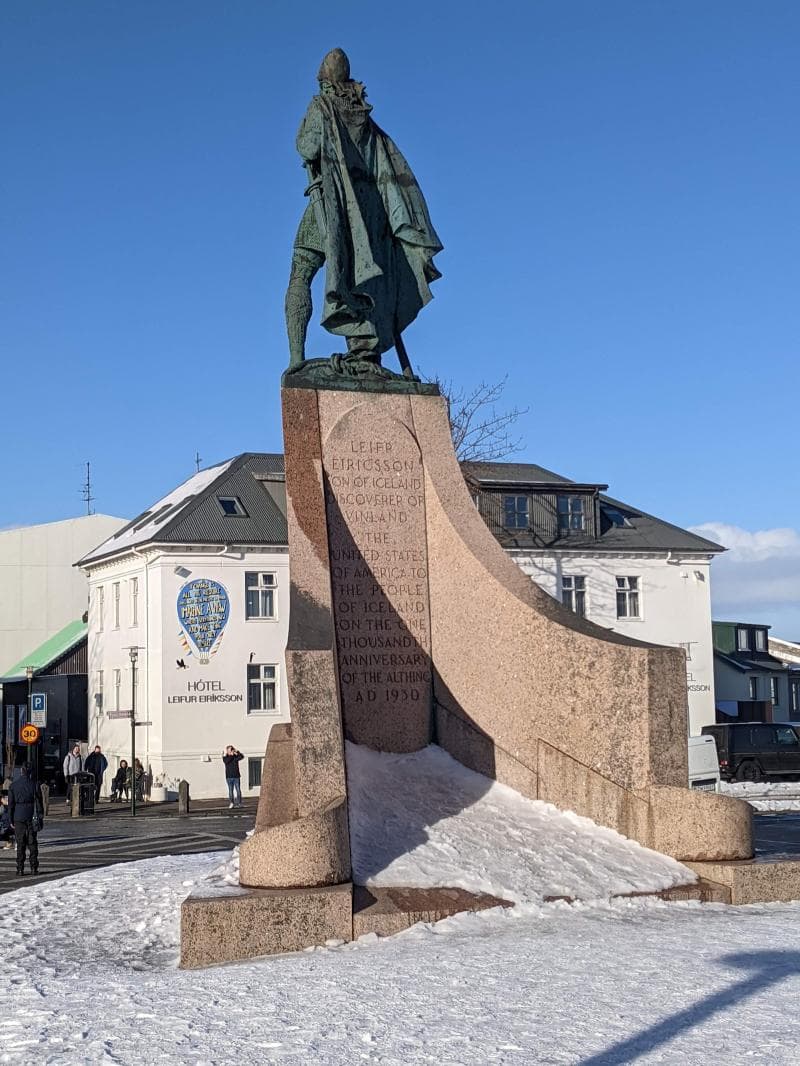
Discover the Leif Erikson Statue in Reykjavík, Iceland – a gift from the USA honoring the first European explorer of North America.
Overview
Perched majestically before the iconic Hallgrímskirkja church in Reykjavík, Iceland, stands the distinguished Leif Erikson Statue. This striking monument pays homage to Leif Erikson, the Norse explorer widely credited as the first European to set foot on continental North America, known as Vinland, around 1000 AD. This momentous journey predates Christopher Columbus's voyage by approximately five centuries, marking a pivotal chapter in transatlantic exploration. The bronze figure, with its gaze fixed westward, serves as a powerful symbol of Iceland's rich Viking heritage and its enduring spirit of discovery. It is not merely a statue but a prominent landmark, instantly recognizable and frequently photographed by visitors from around the globe, forming an integral part of Reykjavík's cultural landscape.
History & Cultural Background
The Leif Erikson Statue holds a significant place in the historical narrative of both Iceland and the United States. It was presented to the Icelandic people as a generous gift from the United States to commemorate the 1,000th anniversary of the Alþingi, Iceland's ancient parliament, which was established in 930 AD. The decision to commission this artwork was made by the 71st United States Congress in 1929, with the statue officially unveiled on July 17, 1932. The esteemed American sculptor Alexander Stirling Calder designed the monument after winning a competition in 1929. It was strategically placed atop Skólavörðuholt hill, offering a commanding view over Reykjavík. Interestingly, the statue was erected well before the completion of the Hallgrímskirkja church itself, which began construction in 1945 and was finally consecrated in 1986. This chronological order means the church was built around the statue, solidifying its prominent position. For many Icelanders, the gift of the statue was interpreted as a formal acknowledgment by the United States of Leif Erikson's Icelandic origins, a point of national pride often debated with Norway.
What Makes It Special
The Leif Erikson Statue is unique for several compelling reasons. Its strategic placement directly in front of the Hallgrímskirkja church creates one of Reykjavík's most iconic and memorable vistas, a juxtaposition of ancient exploration and modern architectural grandeur. The monument itself is a profound symbol of the long-standing friendship and cultural ties between Iceland and the United States. Alexander Stirling Calder's design is particularly evocative; the bronze figure of Leif Erikson stands tall, with one hand raised, seemingly guiding the way, embodying both an adventurous spirit and the resilience characteristic of Iceland's seafaring past. The pedestal supporting the statue is ingeniously crafted to resemble the bow of a Viking longship, further enhancing the narrative of oceanic voyages and discovery. This integrated design visually connects the explorer to his vessel and his historic journey across the Atlantic, making the entire monument a cohesive storytelling piece.
Stories, Fun Facts & Local Details
Leif Erikson, or Leifur Eiríksson as he is known in Icelandic, was the son of Erik the Red, and though born in Iceland, he was raised in Greenland. He earned the nickname 'Leif the Lucky,' possibly due to his serendipitous discovery of Vinland. A fascinating detail is that an identical twin to Reykjavík's Leif Erikson Statue exists in the United States. A second casting was made from the original plaster models for the Icelandic exhibit at the 1939 New York World's Fair, and it now resides at the Mariners' Museum and Park in Newport News, Virginia. The site where the statue proudly stands today, Skólavörðuholt hill, was once home to a historic tower called Skólavarðan, which had to be demolished to make way for the monument. This means the statue truly laid claim to its prominent spot even before its towering church neighbor took shape. The United States officially celebrates Leif Erikson Day on October 9th, recognizing his pioneering expedition. The statue's inscription, 'LEIFR EIRICSSON SON OF ICELAND DISCOVERER OF VINLAND THE UNITED STATES OF AMERICA TO THE PEOPLE OF ICELAND ON THE ONE THOUSANDTH ANNIVERSARY OF THE ALTHING A. D. 1930,' clearly articulates the statue's purpose and Leif's acclaimed identity.
Visitor Perspective
For any traveler exploring Reykjavík, the Leif Erikson Statue is an unmissable stop. Its location at the summit of Skólavörðuholt hill, at the end of the bustling Skólavörðustígur street, makes it easily accessible and a natural focal point for walking tours of the city. There is no admission fee to visit the statue, allowing everyone to appreciate its historical and artistic significance up close. Visitors often find themselves drawn to the statue not only for its impressive scale but also for the panoramic views it offers of Reykjavík, with the city stretching out below and the majestic Hallgrímskirkja rising behind. It provides an excellent vantage point for photography, capturing both the statue and the church in a single, memorable frame. Standing here, travelers can almost feel the whispers of ancient Viking sagas and the spirit of exploration that defined an era, connecting them to Iceland's deep historical roots and its celebrated place in global history. It's a place that inspires reflection on human endeavor and discovery.
Coordinates: -21.92754, 64.14235
View on Google Maps💬 How Travelers Describe This Place
Based on community votes
Beautiful
852Photogenic
645Interesting
244Must See
146Unique
80
Traveler Stories
Discover memorable experiences shared by travelers who have visited this place.
No traveler stories yet.
Be the first traveler to share what made this place memorable.

Tour
By
Spot
Discover amazing places around the world. Your journey starts here.
Explore
© 2026 TourBySpot. All rights reserved.