Lakeside Paths
Phnom Penh, Cambodia
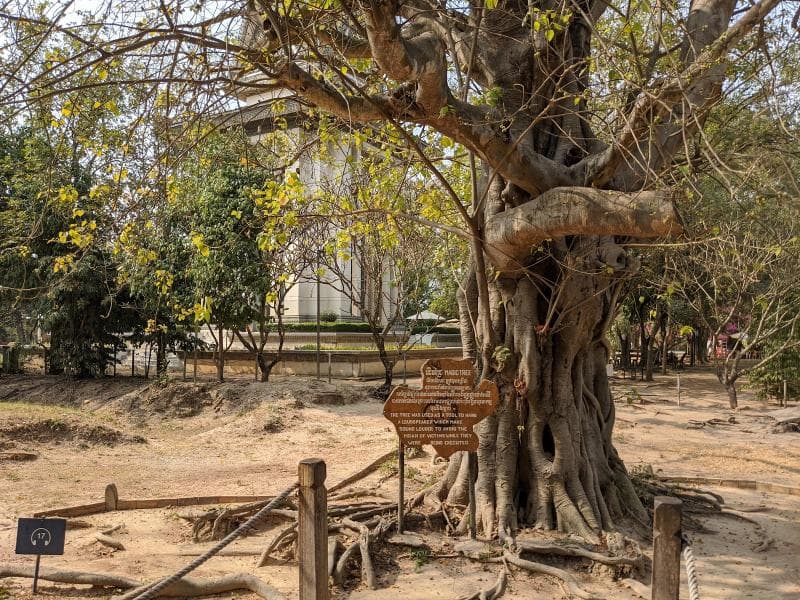
Explore the solemn Lakeside Paths at Choeung Ek Genocidal Center in Phnom Penh, Cambodia, a poignant memorial to the Khmer Rouge genocide. Reflect on Cambodia's past.
Overview
The Lakeside Paths at the Choeung Ek Genocidal Center in Phnom Penh, Cambodia, offer a profound and somber journey through a landscape forever marked by history. While not a distinct attraction on its own, these paths are an integral part of the memorial site, guiding visitors around a tranquil lake and through the grounds where unimaginable atrocities once occurred. The Choeung Ek Genocidal Center, often referred to as 'The Killing Fields,' stands as a stark reminder of the Cambodian genocide perpetrated by the Khmer Rouge regime between 1975 and 1979. Situated approximately 15 to 17 kilometers south of Phnom Penh's city center, this site was one of many such fields across Cambodia, but its proximity to the capital and its direct link to the S-21 prison make it the most well-known and a crucial place for remembrance and education.
As visitors walk the Lakeside Paths, they are immersed in a seemingly peaceful environment, yet one that carries the echoes of a tragic past. An audio guide, highly recommended and often included with admission, serves as a silent narrator, recounting the history and personal stories that bring the landscape to life. The paths lead past mass graves, a memorial stupa housing thousands of victims' skulls, and other poignant markers, each contributing to a deeply moving and educational experience.
History & Cultural Background
Before its horrific use by the Khmer Rouge, Choeung Ek was a serene orchard and even a Chinese cemetery. The very name 'Choeung Ek' is believed to derive from a Khmer phrase that could mean 'to pour out' or 'to overflow,' possibly referring to a place once rich in nature or water. This peaceful etymology stands in chilling contrast to its later function. From 1975 to 1979, the Khmer Rouge, led by Pol Pot, transformed Cambodia into an agrarian socialist society, leading to the systematic extermination of an estimated 1.7 to 3 million people through execution, starvation, and forced labor. Choeung Ek became a primary execution site, especially for prisoners transported from the notorious S-21 security prison (Tuol Sleng Genocide Museum) in Phnom Penh.
The Khmer Rouge's methods were brutal; bullets were considered too precious, so victims were often bludgeoned to death with tools like pickaxes, bamboo sticks, or shovels. Infants and children were murdered by being swung against trees. The bodies were then interred in mass graves across the orchard. After the regime's fall in 1979, excavations revealed thousands of remains, though many graves were deliberately left undisturbed, allowing visitors to witness the actual depressions in the earth. In 1988, a Buddhist stupa was erected at the center of the site, containing over 5,000 human skulls, organized by age and gender, serving as a powerful memorial.
What Makes It Special
The Lakeside Paths of Choeung Ek are special because they facilitate a unique, reflective experience within a site of immense historical gravity. Unlike a traditional museum with walls and exhibits, the paths encourage a slow, contemplative walk through the actual landscape where the genocide unfolded. The very act of treading these paths, especially around the small, often calm lake, creates a profound connection to the past. Visitors often remark on the overwhelming silence that pervades the site, a silence that amplifies the audio guide's narratives and personal testimonies. This quietude, broken only by the rustling leaves or the occasional bird, allows for personal reflection on the human cost of the regime.
Moreover, the unexpected presence of nature—the lake, the trees, and the surrounding farmland—creates a stark and unsettling contrast. Farmers can sometimes be seen tending paddy fields just beyond the memorial's boundary, illustrating life's continuity against the backdrop of unimaginable sorrow. This juxtaposition emphasizes the enduring spirit of Cambodia and the ever-present memory of its darkest chapter. The paths also wind past areas where fragments of human bones and clothing still surface after heavy rains, serving as a raw, tangible link to the victims.
Stories, Fun Facts & Local Details
One of the most impactful stories associated with Choeung Ek is the origin of the term 'Killing Fields' itself, coined by Cambodian journalist Dith Pran, who survived the Khmer Rouge regime. His experiences, alongside American journalist Sydney Schanberg, were later immortalized in the Oscar-winning film 'The Killing Fields,' bringing global awareness to the Cambodian genocide.
A particularly haunting detail along the paths is the 'Killing Tree,' against which infants and children were brutally murdered. Today, it stands as a memorial, often adorned with bracelets, a silent testament to the innocent lives lost. Visitors also learn about the 'Magic Tree' or 'Loudspeaker Tree,' where music was played at high volume to mask the sounds of executions from victims awaiting their fate and to prevent nearby villagers from hearing the horrific acts. The memorial stupa itself is a significant local detail; in Khmer Buddhism, violent deaths are believed to cause the spirit to linger at the site of death, preventing reincarnation. The stupa, therefore, also serves a spiritual purpose, housing the remains to aid the spirits of the deceased.
Visitor Perspective
A visit to the Lakeside Paths and the entire Choeung Ek Genocidal Center is an intensely emotional experience, often described as harrowing yet profoundly necessary. The site is not a typical tourist attraction but a solemn memorial requiring respect and a contemplative mindset. Visitors are encouraged to dress modestly, covering shoulders and knees, and to maintain silence throughout their visit. Smiling for photographs is generally discouraged due to the gravity of the location. The audio guide is crucial, offering survivor testimonies and historical context that guide visitors through the site's various points of interest, from the mass graves to the memorial stupa.
Many visitors combine their trip to Choeung Ek with a visit to the Tuol Sleng Genocide Museum (S-21), following the historical progression of the victims. This sequential experience provides a comprehensive understanding of the Khmer Rouge's brutality, from imprisonment and torture to execution. While the experience is undeniably sad and disturbing, it offers invaluable insight into a dark chapter of human history, fostering a deeper understanding of resilience and the importance of remembrance.
Coordinates: 104.90194, 11.48444
View on Google Maps💬 How Travelers Describe This Place
Based on community votes
Unique
965Interesting
629Must See
443Beautiful
184Photogenic
176
Traveler Stories
Discover memorable experiences shared by travelers who have visited this place.
No traveler stories yet.
Be the first traveler to share what made this place memorable.

Tour
By
Spot
Discover amazing places around the world. Your journey starts here.
Explore
© 2026 TourBySpot. All rights reserved.