Kunsthaus Graz
Graz, Austria
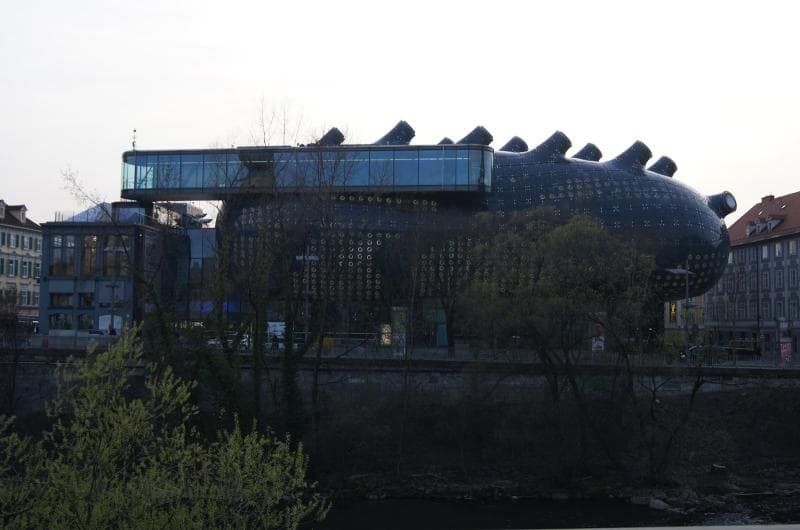
Discover Kunsthaus Graz, Austria's 'Friendly Alien,' a striking contemporary art museum in Graz. Explore its unique biomorphic architecture and innovative BIX media facade.
Overview
Perched on the banks of the Mur River in Graz, Austria, the Kunsthaus Graz stands as a dazzling beacon of contemporary architecture and a vibrant hub for art enthusiasts. Often affectionately dubbed the 'Friendly Alien,' this extraordinary museum immediately captivates with its distinct, biomorphic shape and luminous blue exterior, contrasting dramatically with the historic cityscape of Graz. It serves as a dynamic exhibition center dedicated to international contemporary art, primarily from the 1960s to the present day. The Kunsthaus Graz is not just a museum; it is an architectural landmark that has become integral to the city's identity, drawing thousands of visitors from around the globe annually.
History & Cultural Background
The genesis of the Kunsthaus Graz is rooted in a pivotal moment for the city: its designation as the European Capital of Culture in 2003. An international competition launched in 1999 sought a design that would incorporate the historic 'Iron House' (Eiserne Haus) and reimagine Graz's cultural identity. The winning proposal came from the visionary British architects Peter Cook and Colin Fournier. Their bold design, completed for the 2003 celebrations, intentionally defied traditional architectural norms, bridging the city's rich past with a forward-looking future. The Kunsthaus was strategically built in a less privileged district, the Lend district, on a vacant lot next to the 'Iron House,' an iron-framed structure from 1846–48. Its arrival spearheaded urban regeneration, revitalizing the area around Südtiroler Platz and connecting it to Graz's old town, fostering a new creative scene with numerous small shops and restaurants.
What Makes It Special
The most striking feature of the Kunsthaus Graz is undoubtedly its architecture. It is a prime example of 'blob architecture,' characterized by its organic, free-flowing form that resembles a giant, shimmering blue bubble or a 'friendly alien.' Its exterior is clad in iridescent blue acrylic panels, many of which double as photovoltaic panels. A true marvel of design and engineering, the building also boasts the groundbreaking BIX media facade, a fusion of 'big' and 'pixels'. This interactive installation, designed by realities:united, comprises 930 fluorescent lamps behind the acrylic skin, functioning as a low-resolution screen. It transforms the museum into a communicative entity, displaying animations, patterns, and messages that engage directly with the urban environment, blurring the lines between architecture and digital media. Inside, a 40-meter-long glass gallery, known as the 'Needle,' connects the new 'Bubble' with the historic 'Iron House' and offers visitors panoramic views of Graz's old town. The exhibition spaces are notably flexible and adaptable, designed to stage multidisciplinary, modern, and contemporary art from the 1960s onwards, rather than housing a permanent collection.
Stories, Fun Facts & Local Details
The Kunsthaus Graz has garnered a collection of charming nicknames, reflecting its unusual appearance. Beyond the widely known 'Friendly Alien,' it has been playfully called a 'baby hippo,' 'sea snail,' 'porcupine,' and 'whale' by locals and architects alike. Architect Colin Fournier himself described it as a 'biomorphic, indefinable something, a hybrid, strange and familiar at the same time, with the charm of a friendly mixed-breed stray dog, definitely highly questionable in terms of pedigree.' This deliberate contrast with Graz's Baroque and medieval surroundings, including the city's characteristic red-tiled roofs, makes it a fascinating focal point. The BIX facade is not merely a static display; it is an active participant in Graz's cultural life, used by artists and curators to communicate with the urban space, often transforming into a vivid, interactive 'eye' or displaying artistic light installations, especially after dark.
Visitor Perspective
For the curious traveler, the Kunsthaus Graz offers a unique and thought-provoking experience. The museum is generally open from Tuesday to Sunday and on public holidays, typically from 10 am to 6 pm. Reaching this architectural marvel is convenient, with several tram lines (1, 4, 6, 7) stopping at 'Südtiroler Platz – Kunsthaus,' just a short walk away. As part of the Universalmuseum Joanneum, it provides a seamless cultural experience within Graz. Visitors can expect to explore diverse exhibitions addressing current social issues and showcasing contemporary art from various perspectives. Audio guides are available in multiple languages, including English and German, often accompanied by stories about the 'Friendly Alien's' architecture, enhancing the visit. While the interior promises artistic discovery, the exterior itself is a spectacle, particularly when the BIX media facade illuminates the night sky.
Coordinates: 15.4341, 47.0714
View on Google Maps💬 How Travelers Describe This Place
Based on community votes
Unique
915Photogenic
873Beautiful
123Must See
74Interesting
53
Traveler Stories
Discover memorable experiences shared by travelers who have visited this place.
No traveler stories yet.
Be the first traveler to share what made this place memorable.
Things to see at Kunsthaus Graz



Tour
By
Spot
Discover amazing places around the world. Your journey starts here.
Explore
© 2026 TourBySpot. All rights reserved.