Kon-Tiki Museum
Oslo, Norway
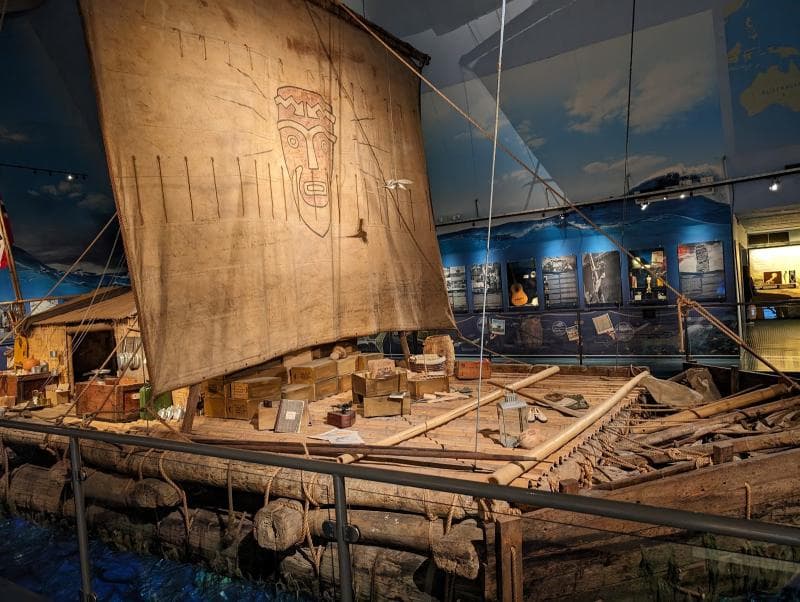
Explore the Kon-Tiki Museum in Oslo, Norway, home to Thor Heyerdahl's legendary Kon-Tiki raft and Ra II reed boat, detailing daring expeditions.
Overview
Nestled on the verdant Bygdøy Peninsula in Oslo, Norway, the Kon-Tiki Museum invites visitors into a world of daring exploration and scientific curiosity. This unique institution is dedicated to the legendary voyages of Norwegian ethnographer and adventurer Thor Heyerdahl, whose expeditions challenged conventional wisdom about ancient migrations and the capabilities of early seafarers. The museum proudly houses the original Kon-Tiki balsa raft, which Heyerdahl and his crew sailed across the Pacific Ocean in 1947, and the reed boat Ra II, used to cross the Atlantic. It serves as a testament to human ingenuity, perseverance, and the spirit of discovery, drawing nearly 20 million visitors since its opening in 1950.
The museum provides a deep dive into Heyerdahl's life's work, showcasing not only the iconic vessels but also a rich collection of artifacts, maps, and photographs from his various expeditions, including those to the Galápagos, Easter Island (Rapa Nui), and Tùcume in Peru. Visitors can immerse themselves in the stories behind these extraordinary journeys, learning about the challenges faced and the theories Heyerdahl sought to prove.
History & Cultural Background
The Kon-Tiki Museum was established in 1950, just three years after Thor Heyerdahl's groundbreaking Kon-Tiki expedition. Heyerdahl's journey across the Pacific on a balsa raft was a bold attempt to prove his theory that ancient South Americans could have reached Polynesia by sea, influencing the islands' early populations. Built using prehistoric knowledge and materials, the Kon-Tiki raft's successful 101-day voyage covered 7,000 kilometers and became a worldwide sensation.
Heyerdahl's adventurous spirit didn't stop there. He continued his research into ancient maritime capabilities with the Ra expeditions in 1969 and 1970, aiming to demonstrate that ancient Egyptians could have crossed the Atlantic in reed boats. The Ra II successfully completed this journey, further cementing Heyerdahl's legacy as a pioneer who lived out his scientific theories through extraordinary feats of navigation. His work consistently championed environmental protection, respect for indigenous peoples, and challenged established truths, making him a figure of cultural and scientific significance.
What Makes It Special
The heart of the Kon-Tiki Museum's appeal lies in its centerpiece: the original Kon-Tiki raft. This impressive vessel, constructed from balsa logs, is displayed in a way that allows visitors to appreciate its scale and the rudimentary nature of its construction.
Beyond the Kon-Tiki, the museum also exhibits the papyrus reed boat Ra II, offering a tangible connection to Heyerdahl's Atlantic crossings. Other significant displays include a model of the Tigris reed boat, which explored ancient sea routes in the Indian Ocean, and an extensive collection of artifacts from various expeditions. Interactive elements, such as an 'underwater' exhibition beneath the Kon-Tiki raft showcasing marine life encountered during the voyage, and a 30-meter-long replica of an Easter Island cave, enhance the immersive experience.
Stories, Fun Facts & Local Details
One of the most captivating aspects of Heyerdahl's Kon-Tiki journey is the Oscar-winning documentary film about the expedition, released in 1950. This authentic documentary, narrated by Heyerdahl himself, screens daily at the museum, offering a direct glimpse into the challenges and triumphs of the voyage. The actual Oscar statuette can also be viewed at the museum.
For younger adventurers, the museum incorporates engaging narratives with characters like Johannes the crab from the Kon-Tiki voyage and Safi the monkey from the Ra expedition. There's even an activity corner where children can slide down from a raft replica and 'check navigation,' making the history accessible and fun for all ages.
The Kon-Tiki Museum is part of a cluster of world-class museums on the Bygdøy Peninsula, including the Fram Museum and the Norwegian Maritime Museum, making it a perfect destination for a day of cultural exploration.
Visitor Perspective
A visit to the Kon-Tiki Museum is an inspiring journey that typically takes about 1.5 to 2 hours, allowing ample time to explore the main exhibits, watch the documentary film, and browse the fascinating artifacts. The exhibitions are accompanied by informative texts available in multiple languages, ensuring a rich learning experience for international visitors.
The museum is designed to be family-friendly, offering specific storylines and activities for children. Its location on Bygdøy is easily accessible via public transport, including a scenic ferry ride from Oslo's city center during warmer months, or by bus year-round. This allows for a comfortable and engaging visit, providing a unique perspective on human endeavor and exploration.
Coordinates: 10.697980598620507, 59.903633912989164
View on Google Maps💬 How Travelers Describe This Place
Based on community votes
Photogenic
953Unique
695Beautiful
396Must See
286Interesting
22
Traveler Stories
Discover memorable experiences shared by travelers who have visited this place.
No traveler stories yet.
Be the first traveler to share what made this place memorable.

Tour
By
Spot
Discover amazing places around the world. Your journey starts here.
Explore
© 2026 TourBySpot. All rights reserved.