Khemarin Palace
Phnom Penh, Cambodia
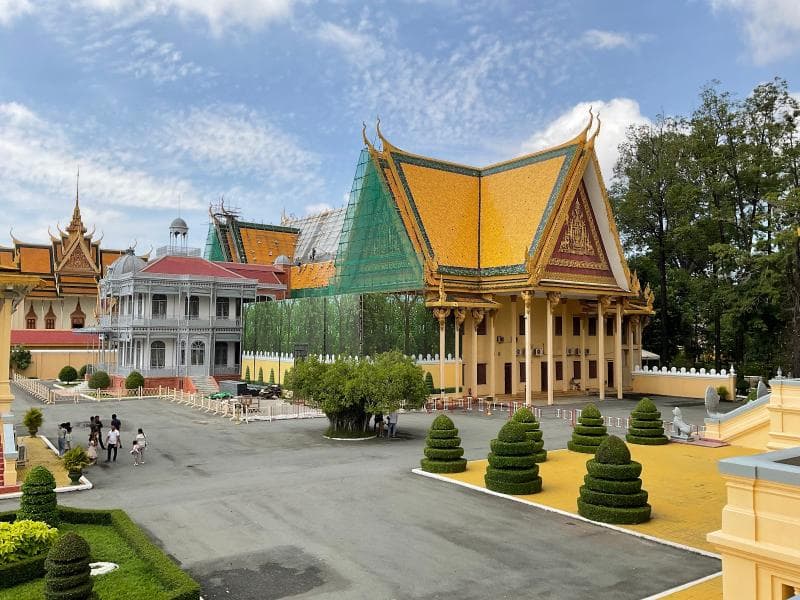
Discover Khemarin Palace, the official royal residence of the King of Cambodia, nestled within the Royal Palace complex in Phnom Penh. Explore its history and cultural significance.
Overview
The Khemarin Palace, often referred to by its full Khmer name, Khemarin Moha Prasat, or 'Palace of the Khmer King', stands as a central, yet private, jewel within the expansive Royal Palace complex in Phnom Penh, Cambodia. It serves as the official residence of the reigning monarch of Cambodia, currently His Majesty King Norodom Sihamoni. While visitors are welcomed to explore much of the Royal Palace grounds, the Khemarin Palace itself remains a strictly private domain, offering a glimpse into the ongoing life of the Cambodian monarchy rather than a museum experience.
Situated on the northern side of the Royal Palace complex, distinctly separated from public areas by a small wall, it is positioned to the right of the impressive Throne Hall. This deliberate arrangement underscores its revered status as the King's personal abode, making it a living symbol of the nation's royal heritage.
History & Cultural Background
The Royal Palace in Phnom Penh was established in 1866 by King Norodom, marking a significant relocation of the royal capital from Oudong to the present-day bustling city. Over the decades, the complex underwent various transformations, with buildings being added, modified, or rebuilt. The current structure of the Khemarin Palace dates back to 1931, when it was constructed to replace an older royal residence during the reign of King Monivong.
The architecture of the Royal Palace complex, including views of the Khemarin Palace, showcases a blend of traditional Khmer artistic styles and designs inspired by the ancient Angkorian era. However, the period of French protectorate also introduced subtle European elements, creating a unique synthesis of cultural influences. The larger complex reflects Cambodia's rich history, from its Angkorian roots to its more recent past, serving as a continuous seat of Khmer power for centuries.
What Makes It Special
What truly sets the Khemarin Palace apart is its profound significance as the active royal residence. Unlike many historical palaces that have been converted entirely into museums, Khemarin Palace retains its original, vibrant purpose. It is where the King lives, works, and conducts many private royal affairs, imbuing it with a sense of sacredness and contemporary relevance.
Architecturally, the palace is distinguished by its main building topped with a single spired prang, a common feature in Khmer religious and royal architecture, symbolizing Mount Meru, the center of the universe in Hindu-Buddhist cosmology. Its exclusive nature, guarded by the Royal Cambodian Armed Forces, reinforces its special status within the Royal Palace grounds. This continuous occupation by the monarchy makes it a powerful, enduring symbol of Cambodian sovereignty and cultural identity.
Stories, Fun Facts & Local Details
The very name 'Khemarin Moha Prasat' translates directly to 'Palace of the Khmer King', leaving no doubt about its esteemed function and who resides within its walls. A fascinating local detail for those passing by or visiting the Royal Palace grounds is the presence of a royal blue flag. If this flag is flying, it is a clear, traditional indication that the King is currently in residence at the palace. This subtle signal connects the public to the otherwise private world of the monarch.
While the Khemarin Palace itself is off-limits, its presence helps tell a broader story of the Royal Palace complex. Visitors exploring the nearby Throne Hall, Silver Pagoda, and other pavilions can appreciate that they are walking through a compound that is not merely historical, but actively serving its purpose as a royal seat. The knowledge that Cambodia's king lives just beyond a small separating wall adds a layer of intrigue and authenticity to the entire experience, highlighting the living nature of Cambodia's heritage.
Visitor Perspective
For the curious traveler, visiting the Royal Palace in Phnom Penh offers an unparalleled opportunity to witness the grandeur surrounding the Khemarin Palace, even if direct entry is not permitted. Understanding that this is the King's active residence shifts the perspective from merely viewing ancient artifacts to appreciating a continuously evolving cultural landscape.
When exploring the Royal Palace complex, one can admire the exquisite traditional Khmer architecture, manicured gardens, and the overall serene atmosphere, which stand in stark contrast to the bustling city outside. While you cannot step inside Khemarin Palace, its visible spired roof and its guarded perimeter speak volumes about its significance. It's an invitation to ponder the continuity of Cambodian royalty and the traditions that persist. Visitors are advised to dress respectfully, ensuring shoulders and knees are covered, as this is a sacred and active royal site.
Coordinates: 104.93081, 11.56365
View on Google Maps💬 How Travelers Describe This Place
Based on community votes
Beautiful
972Unique
787Must See
720Interesting
85Photogenic
73
Traveler Stories
Discover memorable experiences shared by travelers who have visited this place.
No traveler stories yet.
Be the first traveler to share what made this place memorable.

Tour
By
Spot
Discover amazing places around the world. Your journey starts here.
Explore
© 2026 TourBySpot. All rights reserved.