Keats-Shelley House
Rome, Italy
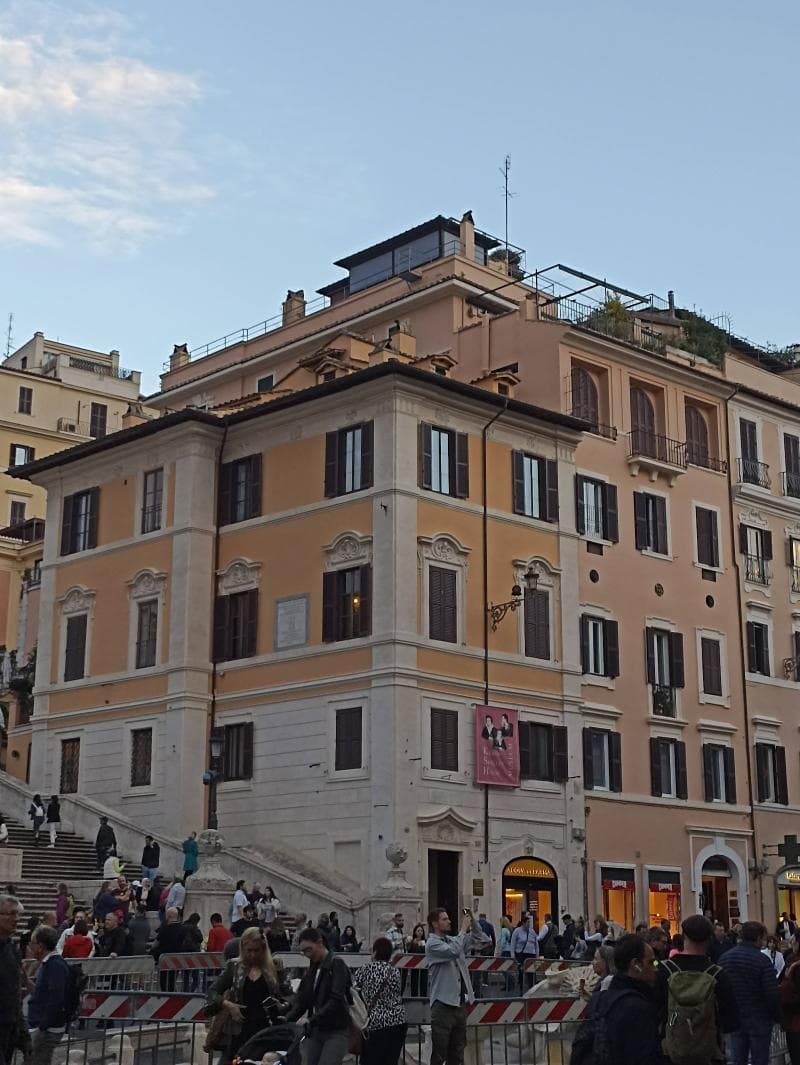
Explore the Keats-Shelley House in Rome, Italy, a moving tribute to Romantic poets like John Keats, located at the Spanish Steps.
Overview
Nestled at the foot of Rome's iconic Spanish Steps, the Keats-Shelley House stands as a poignant tribute to the Romantic poets, most notably John Keats, who spent his final days within its walls. This eighteenth-century building, overlooking the bustling Piazza di Spagna and Bernini's Barcaccia fountain, now serves as a museum and library, drawing visitors into the evocative world of early 19th-century English Romanticism [2, 3, 7]. It's a place of quiet contemplation amidst the vibrant energy of the city, offering a unique literary pilgrimage for those seeking a deeper connection to the lives and works of Keats, Percy Bysshe Shelley, and Lord Byron [3, 7, 10]. The house, purchased and preserved by the Keats-Shelley Memorial Association, opened to the public in 1909 and has since amassed an extraordinary collection of memorabilia, manuscripts, and first editions related to these literary giants and their contemporaries [9, 10]. From its location, it provides an unchanged view of the Spanish Steps, much as Keats himself would have seen them.
History & Cultural Background
The story of the Keats-Shelley House is inextricably linked to John Keats's tragic last journey. Suffering from advanced tuberculosis, the young English poet travelled to Rome in November 1820 with his friend, the artist Joseph Severn, hoping the milder Italian climate would improve his failing health [4, 15]. They rented rooms on the second floor of the building at Piazza di Spagna 26 [3, 4]. Tragically, Keats's condition worsened, and he died here on February 23, 1821, at the tender age of 25 [4, 15].
Following Keats's death, in accordance with the health laws of 19th-century Rome designed to prevent the spread of consumption, all the movable furnishings of his sickroom, including the wallpaper, were burned, and the walls were scraped [4, 11]. This grim act aimed to disinfect the space but inadvertently erased many direct physical traces of his final moments. Despite this, the memory of Keats and the other Romantics endured. The effort to preserve the house began in 1903, instigated by American poet Robert Underwood Johnson, leading to its purchase in 1906 and dedication in 1909 as a public museum [4, 9, 10]. The museum also commemorates Percy Bysshe Shelley, who died in Italy a year after Keats, and Lord Byron, both of whom were inspired by and lived in Italy [3, 7, 10]. During World War II, the house went 'underground' to protect its invaluable contents from destruction, with artifacts hidden in an abbey until 1944 [4, 13].
What Makes It Special
What makes the Keats-Shelley House truly special is its profound atmospheric resonance. Visitors step into a space where history feels palpable, especially in Keats's preserved bedroom, recreated to evoke the solemnity of his final days. While the original furnishings were destroyed, a replica of his 'boat bed' now rests in the room, facing a window that offers the same view of the Spanish Steps and the Barcaccia fountain that Keats gazed upon [3].
Beyond Keats's personal tragedy, the house is a vibrant center for Romantic literature. It boasts one of the world's most extensive collections of memorabilia, letters, manuscripts, and first editions relating not only to Keats and Shelley but also to Byron, Wordsworth, and the Brownings, among others [4, 9, 13]. The library, with its over 8,000 volumes, is considered one of the finest libraries of Romantic literature globally, attracting scholars and enthusiasts alike [5, 6, 9, 13]. The museum also features terraces offering stunning views of Piazza di Spagna, and it regularly hosts public talks, exhibitions, and poetry readings, keeping the spirit of Romanticism alive [7, 10].
Stories, Fun Facts & Local Details
The house is rich with stories that bring the poets' lives to life. When Keats coughed up blood, he famously remarked, 'I know the color of that blood, it is arterial blood – I must die,' recognizing his death warrant [2, 11, 15]. His loyal friend Joseph Severn, who cared for him until the end, would reportedly play ‘hidden symphonies’ on a rented piano in the adjacent room to lift Keats's spirits [6]. Severn also recounted an earlier anecdote of Keats, frustrated with bad food from a local trattoria, emptying plates out the window, confidently declaring, 'We will soon have an excellent dinner,' which proved true [2].
Another poignant detail involves the Protestant Cemetery in Rome, where both Keats and Shelley are buried [3, 9]. Severn had reported back to Keats about its peacefulness and the little white daisies growing in the grass, a detail Keats found comforting [2]. The museum also houses fascinating artifacts, including a life mask of Keats and a silver scallop shell reliquary containing locks of hair from Milton and Elizabeth Barrett Browning, showcasing the deep literary connections of the era [3, 9]. The building's survival during WWII, with its contents hidden away, adds another layer to its compelling history [4].
Visitor Perspective
Visiting the Keats-Shelley House offers a profound experience for anyone with an appreciation for literature, history, or the enduring power of human emotion. Stepping inside, one is immediately enveloped in a hushed, contemplative atmosphere, a stark contrast to the lively piazza outside [9]. The museum is thoughtfully arranged, guiding visitors through rooms filled with displays, portraits, and personal effects that illuminate the lives and inspirations of the Romantic poets [5, 7].
Many visitors find the most moving part to be Keats's bedroom, where the weight of history and the poet's tragic end are most keenly felt [3, 5]. The unchanged view from the window allows for a direct connection to the poet's final perspective. The extensive library is a treasure trove for scholars and casual readers alike, inviting hours of exploration [5, 13]. While not a 'must-see' for every Roman tourist, for those who love literature, the Keats-Shelley House provides an authentic and deeply affecting journey, offering a contemplative escape and a unique insight into the lives of some of the world's most cherished poets [5, 13]. It is indeed a place of pilgrimage for many [3, 10].
Coordinates: 12.482309, 41.905774
View on Google Maps💬 How Travelers Describe This Place
Based on community votes
Unique
445Interesting
416Must See
289Beautiful
141Photogenic
33
Traveler Stories
Discover memorable experiences shared by travelers who have visited this place.
No traveler stories yet.
Be the first traveler to share what made this place memorable.

Tour
By
Spot
Discover amazing places around the world. Your journey starts here.
Explore
© 2026 TourBySpot. All rights reserved.