Juhamnu Pavilion
Seoul, South Korea
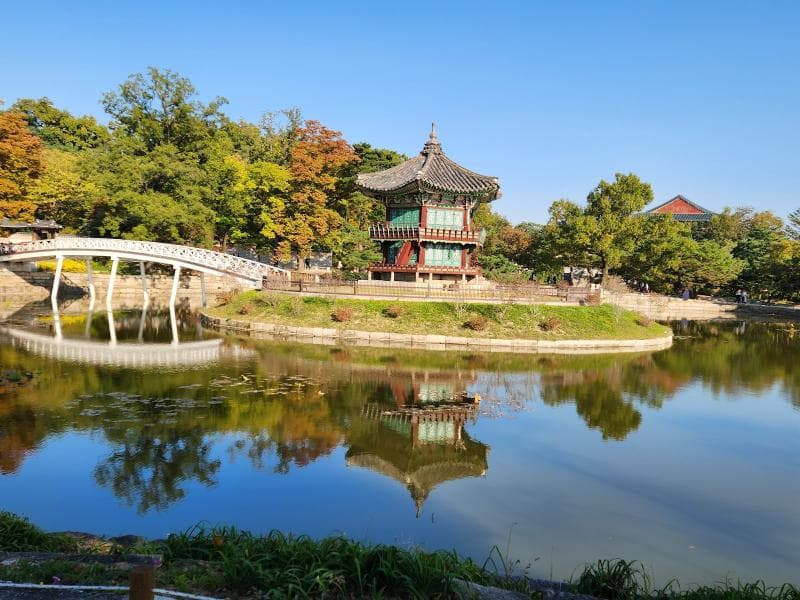
Explore Juhamnu Pavilion, a royal library and hub of reform in Changdeokgung Palace, Seoul, South Korea. Discover its history, unique architecture, and cultural significance within the UNESCO World Heritage site.
Overview
Nestled within the serene and picturesque Huwon, or Secret Garden, of Changdeokgung Palace in Seoul, South Korea, stands the elegant Juhamnu Pavilion. This two-story structure, built in 1776, served a dual purpose: as a royal library and a tranquil space for the monarch to contemplate and oversee affairs of state. Juhamnu Pavilion is not merely an architectural marvel; it represents a profound era of intellectual and political reform under King Jeongjo of the Joseon Dynasty, making it a focal point of cultural and historical significance within the UNESCO World Heritage site of Changdeokgung Palace.
Its strategic location, overlooking the rectangular Buyongji Pond, harmoniously blends human design with the natural landscape, a characteristic celebrated throughout Changdeokgung. The pavilion stands as a testament to the Joseon Dynasty's emphasis on scholarship and effective governance, inviting modern visitors to step back in time and experience a glimpse into the intellectual heart of the palace.
History & Cultural Background
The construction of Juhamnu Pavilion in 1776 coincided with the enthronement of King Jeongjo (reign 1776-1800), a monarch renowned for his progressive reforms and dedication to scholarly pursuits. The pavilion's lower floor housed the Gyujanggak, the royal library and archives, which became the nerve center for King Jeongjo's political reforms and cultural renaissance. Here, the king's own writings, paintings, calligraphic works, and seals were meticulously stored.
The Gyujanggak was more than just a library; it functioned as a research institute where distinguished scholar-statesmen, including figures like Jeong Yak-yong, Park Je-ga, Yu Deuk-gong, and Yi Deok-mu, collaborated to develop state policies and engage in intellectual discourse crucial for national development. This period marked a vibrant flourishing of Korean scholarship and a concentrated effort to bring about enlightened rule.
Changdeokgung Palace itself holds a unique place in Korean history. Constructed in 1405 as a secondary palace to Gyeongbokgung, it became the preferred residence for many Joseon kings due to its organic integration with the natural topography, a stark contrast to Gyeongbokgung's more formal and symmetrical layout. After being destroyed during the Imjin War in 1592, Changdeokgung was restored and served as the principal palace for approximately 270 years, witnessing numerous significant historical events. Its design, respecting the contours of the land rather than imposing upon it, embodies Confucian ideals of balance, simplicity, and respect for nature, contributing to its designation as a UNESCO World Heritage site.
What Makes It Special
Juhamnu Pavilion's special appeal lies in its thoughtful design and symbolic depth. Architecturally, it is a two-story building resting on a robust four-tier stone base, crafted from precisely piled rectangular stones. The structure measures five 'kan' (a traditional unit of measurement) at the front and four 'kan' on its sides, featuring single-block columns and narrow verandas on all four sides. Ornate double-winged brackets support the roof structures, which are further adorned with double-layer eaves, a hipped-and-gabled roof, and decorative 'eagle heads,' 'dragon heads,' and 'miscellaneous figurines' along the ridge and rakes. This meticulous detail ensures the pavilion maintains its original, dignified condition.
Beyond its physical attributes, the pavilion's setting within the Huwon is intrinsically special. It is one of three key pavilions situated around Buyongji Pond, complemented by Buyongjeong and Yeonghwadang. Access to Juhamnu is often through the Eosumun Gate, whose name, meaning 'Fish-Water Gate,' eloquently symbolizes the ideal relationship between the king (water) and his ministers (fish), suggesting that the ministers cannot thrive without the benevolent guidance of the monarch. The king would use the main entrance, while his ministers utilized smaller archways, reinforcing this hierarchy and philosophy.
Stories, Fun Facts & Local Details
The symbolic Eosumun Gate leading to Juhamnu Pavilion encapsulates a profound political philosophy. The saying 'fish cannot live out of water' represented King Jeongjo's belief that his ministers, much like fish, depended entirely on him for their well-being and ability to serve the nation effectively. This clever detail served as a constant reminder of their symbiotic relationship and the king's central role in governance.
The upper story of Juhamnu, while serving as a reading room, also offered breathtaking views of Buyongji Pond and the surrounding natural beauty. It was a place where scholars could not only delve into texts but also find inspiration and tranquility in their natural surroundings. This blend of scholarly rigor and natural harmony made it an exceptionally desirable environment for intellectual pursuits. It is even said that there is a poem called 'The Eight Views of Kyujanggak' that sings about the beauty of the Juhamnu area, suggesting its profound aesthetic appeal to those who experienced it.
The entire Secret Garden, where Juhamnu resides, was designed to minimize artificial landscaping, allowing nature's inherent beauty to take precedence. This approach created a peaceful, almost otherworldly realm for the royal family, used for contemplation, poetry composition, banquets, and even archery. The serene atmosphere around the pavilion today still echoes the quiet dedication to learning and enlightened rule that once flourished within its walls.
Visitor Perspective
Visiting Juhamnu Pavilion today offers a uniquely immersive experience into Korea's rich royal history and cultural heritage. As you approach through the meticulously preserved Secret Garden, the pavilion emerges as a beacon of scholarship and tranquility. The journey through the garden itself, with its winding pathways, varied flora, and strategically placed structures, evokes a sense of walking through a living painting, adapting naturally to the terrain.
Standing before Juhamnu, you can almost hear the rustle of ancient manuscripts and the quiet discussions of scholars shaping the future of a nation. The views from the pavilion's upper level, looking out over Buyongji Pond, offer a moment of peaceful reflection, just as they did for kings centuries ago. The attention to detail in its architecture, combined with the profound historical narratives it holds, creates a deeply meaningful connection to the past. It's a place that encourages visitors to appreciate not only the aesthetic beauty of traditional Korean architecture but also the enduring legacy of intellectual pursuit and harmonious governance that defined the Joseon Dynasty. The entire Changdeokgung Palace complex, including Juhamnu, stands as a rare and well-preserved example of Joseon palace architecture, celebrated for its harmony with the natural world.
Coordinates: 126.993178287036, 37.5817183333333
View on Google Maps💬 How Travelers Describe This Place
Based on community votes
Interesting
618Unique
449Must See
335Photogenic
308Beautiful
22
Traveler Stories
Discover memorable experiences shared by travelers who have visited this place.
No traveler stories yet.
Be the first traveler to share what made this place memorable.

Tour
By
Spot
Discover amazing places around the world. Your journey starts here.
Explore
© 2026 TourBySpot. All rights reserved.